Many women notice prolapse months before they name it. There is a heaviness that builds through a long day on their feet. A sense that something is sitting lower than it should. By evening, a small soft bulge at the vaginal entrance that seems to pull back once they lie down.
When women finally do see a gynaecologist, many expect the next conversation to be about surgery. For some, surgery is the right path. But a large number of women, across all ages and stages of prolapse, can manage their symptoms comfortably and confidently for years, sometimes for life, with a vaginal pessary.
This post covers the practical side: what a pessary is, which types are available in India, how the fitting works, how to care for one, and what it costs. If you are still at the stage of understanding your prolapse itself, the complete guide to pelvic organ prolapse after menopause covers the types, POP-Q staging, and the full treatment ladder.
I am Dr. Suganya Venkat, an OB-GYN with fifteen years of clinical experience working with women through perimenopause and menopause, through online consultations at Menolia.
What a vaginal pessary is
A pessary is a small device, usually made of medical-grade silicone, that sits inside the vaginal canal and mechanically supports the organ or organs that have prolapsed. It does not repair the prolapse, in the way that surgery attempts to. It holds everything in place so that symptoms, the heaviness, the pressure, the dragging sensation, are significantly reduced or eliminated.
Pessaries have been used in gynaecology for more than a century. The materials and designs have improved substantially, but the principle is the same: a well-fitted pessary supports the vaginal walls and whatever organ has descended through them, allowing the woman to stand, walk, and go about her day without the discomfort of untreated prolapse.
When a pessary is fitted correctly, you should not be able to feel it at all. It should not interfere with urinating or with passing a bowel motion. It should stay in place when you cough, squat, or walk.
The types available in India
Three designs are most relevant for women managing prolapse in an Indian gynaecology setting.
Ring pessary
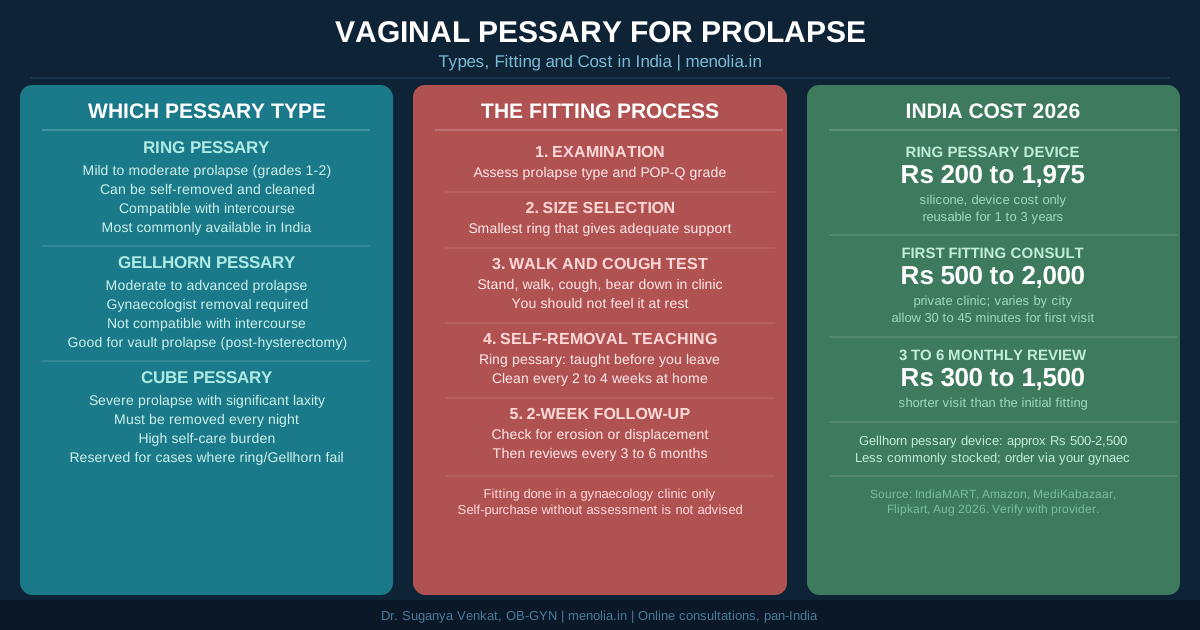
The ring pessary is the most commonly used type in India. It is a flexible silicone ring, available in multiple sizes (typically 55 mm to 105 mm diameter), that sits in a diagonal plane inside the vaginal canal, with one edge behind the pubic bone and the other angled toward the posterior vaginal wall.
Ring pessaries work well for mild to moderate prolapse (POP-Q stages 1 and 2, and many stage 2 presentations). They are compatible with sexual intercourse in most cases. Most women can learn to remove, clean, and reinsert a ring pessary themselves, which makes them the most manageable type for long-term use.
Ring pessaries are widely stocked in India, available from gynaecological suppliers and online marketplaces, so getting a replacement is straightforward.
Gellhorn pessary
A Gellhorn pessary has a disc at one end and a central stem or post. It sits with the disc resting against the cervix or the vaginal apex (after hysterectomy), providing support for more advanced prolapse (stages 2 to 4, vault prolapse, or uterine prolapse where the cervix is descending significantly).
Gellhorn pessaries are not compatible with sexual intercourse because of the stem. They typically require a gynaecologist or trained nurse to remove and reinsert, though some women do learn self-management with practice.
In India, Gellhorn pessaries are available through gynaecological surgical suppliers, though they are less commonly stocked than ring pessaries. Your gynaecologist may need to source one specifically.
Cube pessary
A cube pessary is a six-sided silicone device that creates suction against the vaginal walls. It is used for severe prolapse with significant vaginal wall laxity, particularly where a ring pessary has not provided adequate support.
The cube pessary must be removed every night. Daily removal is not optional with this type. The suction mechanism, which is what makes it effective, also means that vaginal wall erosion is a genuine risk if the device is left in for extended periods. For women who are motivated and disciplined about the nightly removal routine, a cube pessary can work well. For those who find daily removal burdensome, a Gellhorn or a surgical approach is more sustainable.
The fitting process
Pessary fitting is done in a gynaecology clinic. It involves a pelvic examination to assess the type and grade of your prolapse, and then a trial-and-fitting process.
Step 1: Assessment. Your gynaecologist will examine the vaginal walls, assess which compartments are affected (front wall or bladder prolapse, back wall or bowel prolapse, uterine descent), and estimate the grade. This guides the type of pessary to try first.
Step 2: Size selection. For a ring pessary, fitting typically begins with a size that fills the vaginal canal snugly without causing pressure. This is assessed by feel. It is normal to try two or three sizes before finding the right one.
Step 3: Testing in clinic. Once a size is placed, you will be asked to stand, walk around the room, cough, and bear down. The pessary should stay in place through all of these. You should also be asked to sit, stand again, and confirm you cannot feel it at rest.
Step 4: Teaching self-management. If a ring pessary has been fitted, your gynaecologist or the clinic nurse will walk you through removing it, cleaning it, and reinserting it before you leave. This takes fifteen to twenty minutes. You do not have to be able to do it on the first day, but the goal is that you are comfortable with it before your first review.
Step 5: Two-week follow-up. A review is booked for approximately two weeks after fitting. At this visit, the gynaecologist checks for any vaginal wall erosion or ulceration (areas where the pessary has been rubbing), any unusual discharge, and confirms the pessary is still in the correct position. Most women have no problems at this stage.
Self-care and cleaning
For ring pessaries managed at home:
Cleaning frequency: Remove the ring once every two to four weeks. Wash it with mild soap and warm water, rinse thoroughly, and reinsert. Some women find it easiest to do this in the shower.
What to watch for: A small amount of clear or white discharge is normal with a pessary in place. If discharge becomes yellow, green, or foul-smelling, or if you notice any new bleeding or significant discomfort, contact your gynaecologist. These can indicate vaginal irritation or infection.
Do not leave it in longer than advised. A ring pessary left in continuously for months without removal can cause erosion of the vaginal wall. The two-to-four-week cleaning interval is a practical guide, not an estimate.
The oestrogen connection
Menopause-related oestrogen loss thins the vaginal tissues. Thinner vaginal walls are more prone to irritation from any device, including a pessary. A pessary that fits well on a well-oestrogenised vaginal wall may cause more friction on tissue that is atrophic.
Adding local vaginal oestrogen, in the form of a cream, gel, or ring, reduces this risk substantially. It is not always necessary, but for women who notice increased discharge, discomfort, or minor spotting with their pessary, your gynaecologist is likely to suggest a topical oestrogen alongside the device. The vaginal estrogen cream guide for Indian women covers the available options and how they are used.
A well-oestrogenised vaginal wall also makes insertion and removal more comfortable, particularly for women who found the initial fitting uncomfortable.
For women who are not using any oestrogen at all, a conversation about the benefits of local (topical) oestrogen specifically, as distinct from systemic HRT, is worth having with your gynaecologist. Local oestrogen is absorbed minimally into the bloodstream and is considered safe for most women, including many who have had breast cancer.
If you are weighing your options for prolapse management and want a second perspective, you can speak with me directly through Menolia. A video consultation covers your symptoms, your stage of prolapse, whether a pessary is a realistic option for you, and how to find a gynaecologist in your area who does fittings. Start the conversation on WhatsApp.
Review schedule after fitting
Once the two-week check has gone well, most women are seen every three to six months.
At each review, the gynaecologist or clinic nurse:
- Removes the pessary and inspects the vaginal walls
- Cleans the pessary (or confirms the woman is cleaning it correctly at home)
- Checks for erosion, discharge, or displacement
- Reassesses the prolapse grade if there have been symptoms of progression
Women managing their ring pessary at home still need these clinic visits. The review is not just about the device. It is a chance to monitor the vaginal tissue and to discuss whether the pessary is still meeting the need.
When a pessary is the right long-term choice, and when it is a bridge
A pessary is not a temporary measure by definition. Many women use one for five, ten, or twenty years without difficulty or surgery. There is no clinical rule that says a pessary must eventually lead to an operation.
A pessary is often the right long-term approach when:
- Prolapse symptoms are well-controlled and quality of life is good
- Medical conditions (heart disease, poorly controlled diabetes, significant obesity) make surgery higher-risk
- A woman is not fit for general anaesthesia
- She has a clear preference for a non-surgical path
- She is sexually active and a ring pessary allows comfortable intercourse
A pessary is often used as a bridge when:
- Surgery is planned but there is a waiting period
- A woman wants time to decide about surgery
- Prolapse appeared after childbirth and there is uncertainty about whether she may want another pregnancy (surgery to repair prolapse is generally deferred until family is complete)
Surgery becomes more appropriate when:
- Prolapse progresses despite a well-fitted pessary
- The pessary is no longer retaining (advancing prolapse means larger devices are needed, and eventually the vaginal anatomy no longer holds any pessary adequately)
- A woman finds the maintenance burden of a pessary unacceptable
- She develops complications such as recurrent infections or persistent erosion
The decision between a pessary and surgery is not a hierarchy where surgery is the better outcome. For many women, a pessary is the right lifetime answer. For others, a planned repair operation is the cleaner resolution. Your gynaecologist can help you weigh those paths based on your specific prolapse, your overall health, and what matters to you. Refer to the hysterectomy and prolapse surgery recovery guide for context if surgery is being discussed.
For strengthening the pelvic floor alongside pessary use, the Menolia pelvic floor guide covers what exercises are realistic and what to expect from them at different grades of prolapse.
India availability and cost in 2026
Device cost (the pessary itself): Ring pessaries are available from surgical suppliers, medical e-commerce platforms (IndiaMART, MediKabazaar, Flipkart, Amazon), and directly from gynaecology clinics. Prices checked in August 2026 ranged from approximately Rs 200 to Rs 1,975 for a silicone ring pessary, depending on brand, size, and supplier. Most silicone ring pessaries in the Rs 400-900 range come from reliable surgical suppliers. The device is reusable and, with proper care, can last one to three years before replacement.
Gellhorn pessaries are less widely stocked online; check with your gynaecologist’s clinic or a gynaecological surgical supplier. Approximate device price: Rs 500-2,500.
Fitting consultation: The gynaecologist’s consultation fee for a pessary fitting is separate from the device cost. This varies widely across India by city, clinic tier, and specialist. A rough range for a private gynaecology clinic:
- Smaller cities and towns: Rs 300-800 per consultation
- Metro cities (Chennai, Bengaluru, Mumbai, Delhi, Hyderabad): Rs 700-2,000 per consultation
- Senior urogynaeecology specialists: Rs 1,500-3,500
The fitting appointment is longer than a standard review visit (allow 30-45 minutes for the first fitting and self-management teaching).
Follow-up reviews: At 3-6 monthly intervals. Typically a shorter, lower-cost visit than the initial fitting. Rs 300-1,500 depending on the clinic.
Public hospitals: Government medical college hospitals and district hospitals in India do not uniformly offer pessary fitting as a routine service, though some teaching hospitals with urogynaeecology departments do. If cost is the primary concern, it is worth asking directly at the nearest public gynaecology department.
What it is called in Hindi and regional languages
| Language | Term |
|---|---|
| Hindi | योनि पेसरी (yoni pessary) / prolapse ke liye support ring |
| Tamil | யோனி பெசரி (yoni pessari) |
| Telugu | యోని పెసరీ (yoni pesari) |
| Kannada | ಯೋನಿ ಪೆಸ್ಸರಿ (yoni pessari) |
In everyday Hindi, women and healthcare workers sometimes describe it informally as a “prolapse support device” (pralapas ke liye sahara yantra) or simply “ring for falling womb.” All of these descriptions point to the same device.
Questions about whether a pessary would work for your degree of prolapse, or how to find a urogynaeecologist in your city who does fittings? You can ask Dr. Suganya Venkat directly through a video consultation at Menolia. Message on WhatsApp to get started.
Frequently asked questions
What grade of prolapse is a pessary suitable for? Ring pessaries work best for POP-Q stages 1 and 2. A Gellhorn pessary can support stages 2, 3, and some stage 4 presentations. Even advanced prolapse that is causing significant symptoms can often be managed with a pessary, at least for a period. Your gynaecologist will assess whether your anatomy is suitable for fitting. A bulging that reaches or passes beyond the vaginal entrance does not automatically mean a pessary cannot work.
Can I have sex with a pessary in place? It depends on the type. Ring pessaries are generally compatible with intercourse. Most women and their partners do not notice the ring during sex. Gellhorn pessaries and cube pessaries are not compatible with intercourse because of their design. Women who are sexually active and want to use a pessary are usually fitted with a ring pessary first.
How often do I need to see a gynaecologist once fitted? After the initial fitting and the two-week check, most women are reviewed every three to six months. Self-managed ring pessary users still need these visits. The review is about checking the vaginal tissue, not only whether the device is in place.
Does a pessary make prolapse worse over time? No. A correctly fitted pessary does not worsen prolapse. It holds the prolapsed tissue in place and may actually reduce the progression that comes from the chronic downward pressure of untreated prolapse. A pessary does not treat the underlying weakness, but it is not harmful to the tissue when fitted and maintained correctly.
Can I buy a ring pessary online without a gynaecologist fitting? You can purchase the device, but fitting without a gynaecological assessment is not advisable. The right size, the right type, and whether a pessary is safe for your specific anatomy (for example, whether you have any vaginal narrowing, scarring, or other factor that affects fit) all require an internal examination. An incorrectly sized device can cause erosion, discomfort, or simply fall out.
How long can a vaginal pessary be used? There is no set time limit. Many women use a pessary for a decade or more. The device itself needs replacing periodically (silicone pessaries typically last one to three years with proper care), but the approach is sustainable long-term. There is no medical reason a pessary must lead to surgery.
Yoni pessary kitne saal tak use kar sakte hain? Koi time limit nahi hota. Bohot si mahilain dasha saalon tak pessary use karti hain bina kisi problem ke. Silicone ring pessary ko har saal ya har do saal mein badalna padta hai. Har 3-6 mahine mein gynaecologist ke paas check-up ke liye jaana zaroori hai.