A patient once brought a jar of wild yam cream into her consultation and asked me a direct question: “This says it’s natural progesterone. Can I use this instead of the tablet you prescribed?” The label on the jar used the word “progesterone” three times. Nothing on it explained why that word was there, or whether the cream could actually do what a prescribed progestogen does.
It is a fair question, and it deserves a real answer rather than a dismissal. Wild yam cream sits at an unusual intersection: the plant genuinely contains a compound with a real, documented connection to progesterone, which is exactly why the marketing claim sounds credible. But the connection is industrial, not biological, and the gap between those two things is where the confusion, and the risk, both live.
What This Post Covers
- What wild yam contains, and why it gets called “natural progesterone”
- The real chemistry: how a plant compound becomes a pharmaceutical hormone, and where that happens
- What the human trial evidence shows when wild yam cream is tested directly
- Why this matters beyond trivia, especially if you are on oestrogen therapy
- How wild yam cream differs from the body-identical progesterone your gynaecologist prescribes
What Wild Yam Contains
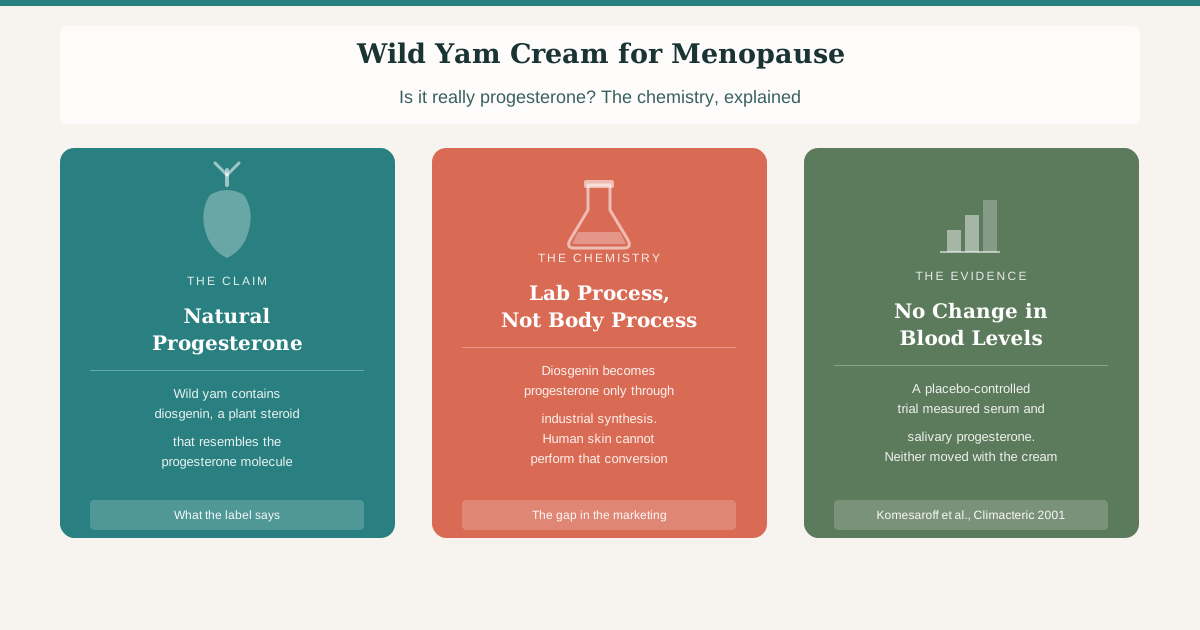
Wild yam, most commonly Dioscorea villosa, is a tuberous plant whose root contains a group of plant steroids called steroidal saponins. The one relevant here is diosgenin.
Diosgenin has a molecular structure that resembles the backbone shared by all steroid hormones, including progesterone, oestrogen, and testosterone. That structural resemblance is real, and it is the entire basis for every “natural progesterone” claim made about wild yam products. A recent review in Physiologia Plantarum confirms diosgenin’s role plainly: it has been used as a precursor for the biosynthesis of corticosteroids and steroidal hormones, including cortisone, pregnenolone, and progesterone (Mandal N et al., Physiologia Plantarum, 2025, PMID 41189364).
Read that sentence carefully, because the word doing all the work is “precursor,” not “equivalent.” A precursor is a raw material used to build something else. It is not the finished product, and it does not become the finished product just by being present in the same jar as your skin.
The Real Chemistry: A Laboratory Process, Not a Body Process
Here is where the story of “wild yam progesterone” happens in real life, and it is worth being specific because the specificity is what breaks the marketing claim.
Converting diosgenin into pharmaceutical progesterone is a multi-step chemical synthesis. It requires controlled reaction conditions, industrial reagents, and laboratory equipment. This process is exactly how a large share of the world’s supply of progesterone, and other steroid hormones, has been manufactured for decades. Diosgenin extracted from wild yam or similar plants is a genuine, valuable starting material for the pharmaceutical industry. This is also where the “natural” framing on the label comes from, and it is not technically false. Diosgenin is a plant-derived, natural compound.
What is false is the next step in the marketing logic: that if diosgenin can become progesterone in a factory, it must also become progesterone in your body when you rub the cream onto your skin. Human cells do not have the enzymes or the reaction pathway required to perform that conversion. The steps that a chemical plant uses to turn diosgenin into progesterone simply do not exist in human skin, liver, or any other tissue. Applying wild yam cream introduces diosgenin to your body. It does not introduce progesterone.
What Happens When You Test the Cream Directly
This is not a theoretical argument. It has been tested directly.
A double-blind, placebo-controlled crossover trial gave healthy menopausal women a topical wild yam cream for three months and measured their blood and saliva at multiple points along the way, alongside their symptom diaries. The result was unambiguous: there was no change in serum or salivary progesterone levels, and no change in oestradiol, FSH, or lipid levels, when compared with the placebo cream. Symptom scores also showed no meaningful difference between the active cream and placebo (Komesaroff PA et al., Climacteric, 2001, PMID 11428178).
In plain terms: women applied the cream, researchers checked their hormone levels in blood and saliva, and the numbers did not move. Whatever a wild yam cream does for the skin locally, it does not raise the amount of progesterone circulating through the rest of the body, which is the part that matters for anything progesterone is meant to do.
If you’re currently using a wild yam or “natural progesterone” product and want to understand whether your current regimen is actually protecting you, that is worth a direct conversation.
Ask Dr. Suganya about your HRT and supplement questions on WhatsApp
Why This Is a Safety Question, Not Just a Trivia Point
This distinction matters most for one specific group of women: those taking oestrogen therapy for menopause who have an intact uterus.
Our full explanation of why oestrogen HRT needs progesterone covers the mechanism in detail, but the short version is this: oestrogen on its own stimulates the uterine lining to keep growing. Without a real progestogen to counter that growth, the lining can thicken over time into endometrial hyperplasia, and in some cases, endometrial cancer. That is not a small or theoretical risk. It is the reason every woman with a uterus on oestrogen therapy is prescribed a progestogen alongside it, without exception.
If a woman in this position substitutes wild yam cream for her prescribed progesterone, believing the label’s claim, she is not protected. Her endometrium receives the same unopposed oestrogen stimulation as if she were taking no progestogen at all, because the cream never delivered any progesterone to begin with. The trial above shows exactly why: her actual serum progesterone would not move. This is not a small inefficiency to shrug off. It is the specific safety failure that makes this myth worth correcting clearly, rather than treating it as a harmless alternative-medicine choice.
To be clear about where the fault lies here: this is a marketing and information gap, not a mistake on the part of any woman who trusted a product label. The chemistry is genuinely counterintuitive unless someone lays it out plainly, which is exactly what most product packaging does not do.
How Wild Yam Cream Differs From What Your Gynaecologist Prescribes
Micronised progesterone, the tablet or capsule your gynaecologist prescribes (brand names in India include Susten and Utrogestan), is also frequently derived from plant sources, sometimes including diosgenin from yam or soy. This is where a second layer of confusion tends to creep in: “if the pharmaceutical version also comes from a plant, why is it different from the cream?”
The answer is the missing step. Pharmaceutical micronised progesterone goes through the full laboratory conversion, diosgenin transformed into an actual progesterone molecule, then micronised (broken into fine particles) so it can be reliably absorbed by the body, then manufactured under pharmaceutical quality control with a known, standardised dose in every capsule. Our guide to bioidentical hormones covers what “bioidentical” means in a regulated medical context versus a marketing one, and this is precisely that distinction in action. Wild yam cream skips every one of those steps. It delivers diosgenin, unconverted, in an unstandardised, unregulated topical product, with no way to know how much (if any) of the compound is even absorbed through the skin.
If you are looking for a plant-based option that does have real trial evidence behind it, our guide to shatavari, black cohosh, and other herbal supplements for menopause rates each one honestly on the evidence, separately from the ones worth avoiding. Wild yam cream, specifically as a progesterone substitute, does not belong in the “worth trying” category.
Practical Takeaways
- Wild yam contains diosgenin, a plant compound that genuinely resembles the steroid hormone structure, which is why it is marketed as “natural progesterone.”
- Diosgenin is a real industrial precursor used to manufacture pharmaceutical progesterone, but that conversion happens in a laboratory, not in your skin or bloodstream.
- A controlled trial measuring actual blood and saliva progesterone in women using wild yam cream found no change compared with placebo.
- If you are on oestrogen therapy with an intact uterus, wild yam cream does not provide the endometrial protection a prescribed progestogen does.
- Prescribed micronised progesterone (Susten, Utrogestan) completes the full chemical conversion and is manufactured to a standardised, known dose. Wild yam cream does not.
I am Dr. Suganya Venkat, an OB-GYN with fifteen years of clinical experience, and questions about “natural” alternatives to prescribed hormones come up often in my Menolia consultations. If you are weighing a supplement or cream against something I have prescribed, bring it to the conversation rather than deciding on your own. It is a completely reasonable thing to ask about, and it takes only a few minutes to clarify.
Message Dr. Suganya on WhatsApp about your menopause treatment
Frequently Asked Questions
Does wild yam cream really contain progesterone? No. Wild yam contains diosgenin, a plant steroid that is structurally similar to progesterone and is used industrially as a raw material to manufacture pharmaceutical progesterone. The cream itself does not contain progesterone, and applying it does not add progesterone to your body.
Can my body convert diosgenin from wild yam cream into progesterone? No. The conversion from diosgenin to progesterone requires a multi-step chemical synthesis process carried out in a laboratory. Human tissue does not have the enzymes or pathway to perform this conversion, so the diosgenin in wild yam cream stays as diosgenin, not progesterone, once it is on or in your body.
Is there any research on whether wild yam cream actually works? Yes. A double-blind, placebo-controlled trial tested topical wild yam cream in menopausal women over three months and measured their blood and saliva progesterone directly. It found no change in progesterone levels and no meaningful difference in menopausal symptom scores compared with placebo.
I’m on oestrogen therapy. Can I use wild yam cream instead of the progesterone tablet my doctor prescribed? This is not advisable. If you have an intact uterus, oestrogen therapy needs a real progestogen to protect the uterine lining from overgrowth. Because wild yam cream does not raise your actual progesterone levels, substituting it for your prescribed progestogen leaves your endometrium unprotected, even though the product is marketed as though it would help.
What are the side effects of wild yam cream? The same trial that measured hormone levels also monitored for side effects and reported that short-term topical use was generally free of significant side effects. The concern with wild yam cream is not that it is dangerous on its own; it is that relying on it as a substitute for real progesterone, when your regimen needs one, leaves a safety gap.
If wild yam cream doesn’t work, is there a plant-based option that does have evidence? Some herbal supplements for menopause do have real, if limited, trial evidence, including shatavari and soy isoflavones for symptom relief. None of these serve as a substitute for prescribed progesterone in an HRT regimen; they address different symptoms through different mechanisms. Our guide to menopause herbal supplements rates each option on the actual evidence.
Is the progesterone in Susten or Utrogestan also made from wild yam? It can be. Pharmaceutical micronised progesterone is often derived from plant sources, including diosgenin from yam or soy, but it goes through the complete laboratory conversion into an actual progesterone molecule, then is micronised and manufactured under quality control to a standardised, known dose. Wild yam cream skips all of these steps and never completes the conversion.
If wild yam cream or another “natural” product is part of your current routine and you want a clear answer about whether it is actually protecting you, Dr. Suganya Venkat is available for online video consultations across India.