When Susten 200 or Duphaston appears on a menopause prescription alongside an oestrogen tablet or patch, the explanation does not always come with it. Many women search “susten 200 uses” and find results from fertility clinics, because the same tablet is used in IVF and IUI protocols for luteal support. If you are looking for information about Susten or Duphaston in the context of fertility treatment, visit Fertilia Health’s fertility program where that clinical picture is covered in detail.
This post is about the menopause HRT context: why the second tablet is on the prescription, what Susten and Duphaston each are, how they differ from each other, what the oral versus vaginal routes mean in practice, how the regimen works, and what verified India prices look like.
If you are still deciding whether HRT is right for you at all, start with the full HRT guide for Indian women. That guide covers benefits, risks, and how to have a productive conversation with your gynaecologist. This post picks up after that decision has been made and the prescription is in front of you.
Why Oestrogen Alone Is Not Enough (If You Have a Uterus)
Oestrogen replacement works well for hot flashes, sleep disruption, vaginal dryness, and mood volatility. That effectiveness is not in question. But oestrogen taken on its own carries one specific clinical risk for women with an intact uterus: it causes the uterine lining (the endometrium) to thicken.
The endometrium is sensitive to oestrogen. During the reproductive years, progesterone from the second half of the menstrual cycle would regularly cause the lining to mature and then shed. In menopause HRT, if you provide oestrogen without a corresponding progesterone-like hormone, the lining receives continuous proliferative stimulation with no balancing signal. Over time, this can progress to endometrial hyperplasia and, in a smaller number of cases, endometrial cancer.
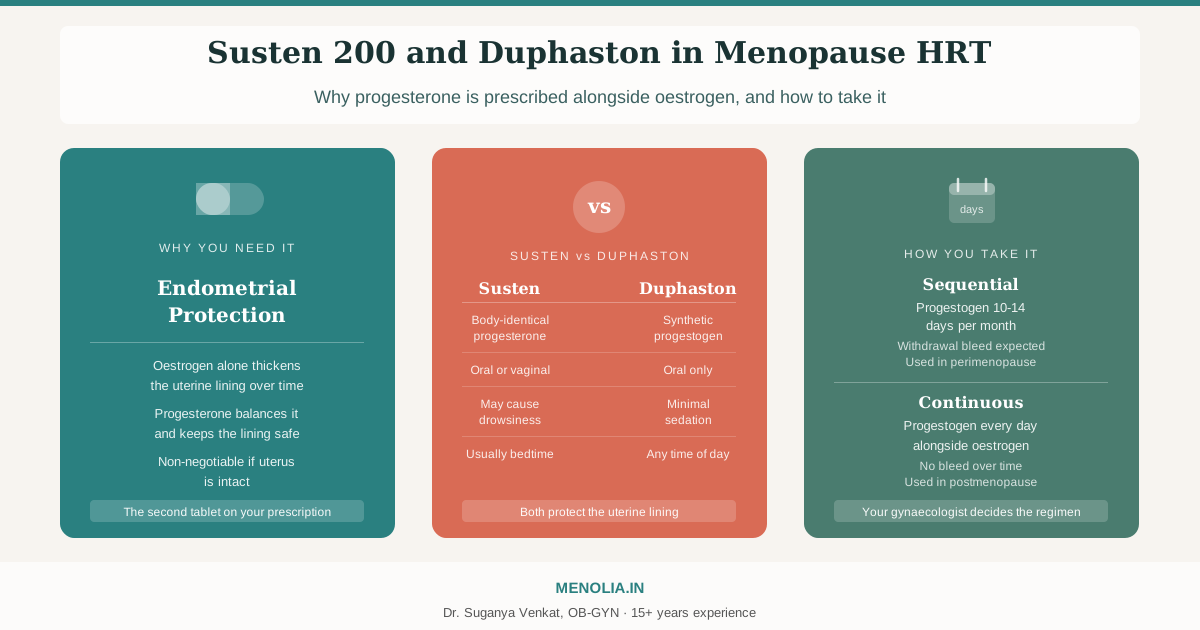
The solution is to add a progestogen. Progesterone and its synthetic relatives (collectively called progestogens) counteract oestrogen’s stimulation of the uterine lining, causing it to stabilise or shed appropriately. This is why every woman with an intact uterus taking oestrogen HRT also needs a progestogen on the prescription. It is not an optional add-on. It is a non-negotiable part of the clinical regimen.
Women who have had a hysterectomy (uterus surgically removed) do not have an endometrium to protect and can take oestrogen-only HRT without any progestogen.
If you have had a recent endometrial thickness scan and want to understand your result, the guide to endometrial thickness after menopause explains what the measurement means and when it warrants further investigation.
What Susten Is
Susten is Sun Pharma’s brand name for micronised progesterone. The hormone in the capsule is body-identical progesterone: chemically the same as the progesterone your ovaries produced throughout your reproductive years, manufactured in a laboratory rather than by your own body.
“Micronised” refers to the processing technique. Progesterone does not absorb reliably from the gut in its raw crystalline form. Breaking it into very fine (micronised) particles and suspending them in an oil base (most commonly peanut or sunflower oil) dramatically improves absorption. This is why Susten capsules are soft-gel capsules rather than conventional tablets.
Susten is available in India in three strengths: 100mg, 200mg, and 400mg. For endometrial protection in menopause HRT, the 200mg strength is the most commonly prescribed.
Oral Susten: Swallowed by mouth, the capsule travels to the gut and is absorbed, then processed through the liver before reaching the bloodstream. This first-pass metabolism reduces the amount of progesterone that reaches general circulation, and it also produces metabolite compounds that act on GABA receptors in the brain. The practical effect is mild sedation. Most gynaecologists prescribe oral Susten at bedtime precisely because of this: the drowsiness becomes useful rather than inconvenient for women who are also struggling with menopause-related sleep disruption.
Vaginal Susten: The same capsule is inserted vaginally rather than swallowed. The vaginal route bypasses the liver entirely. A larger proportion of the dose reaches the uterine lining directly via local absorption, a mechanism called the first-uterine-pass effect. Vaginal progesterone delivers strong endometrial protection with lower systemic blood levels, which means less of the sedation associated with the oral route. The trade-off is a waxy discharge that some women find uncomfortable. Your gynaecologist will guide the route choice based on your tolerance and clinical picture.
What Duphaston Is
Duphaston is Abbott India’s brand name for dydrogesterone. Despite appearing in the same position on a menopause prescription as Susten, dydrogesterone is not progesterone. It is a synthetic progestogen: a compound with a structural resemblance to progesterone, close enough to act on progesterone receptors and protect the uterine lining, but chemically distinct.
Dydrogesterone is often described as “retrograde progesterone” because its molecular structure is an inverted mirror of progesterone. This inversion gives it some useful properties:
- It does not suppress ovulation (relevant in perimenopause when some ovarian activity continues)
- It does not have oestrogenic, androgenic, or glucocorticoid side-channel activity (meaning it is unlikely to drive acne, voice changes, weight changes, or other off-target hormonal effects that some older synthetic progestins are associated with)
- It does not cross the blood-brain barrier in the same way oral progesterone does, so it does not cause significant sedation
Duphaston is taken orally as a 10mg tablet. The standard dose in HRT is 10mg once or twice daily, depending on the regimen your gynaecologist has prescribed.
Duphaston appears on prescriptions outside menopause as well: for irregular periods, threatened miscarriage support in early pregnancy, and luteal phase supplementation in fertility treatment. The tablet is identical regardless of the indication. The dose and duration are what differ.
How Susten and Duphaston Differ
| Feature | Susten 200 (micronised progesterone) | Duphaston 10mg (dydrogesterone) |
|---|---|---|
| Type | Body-identical (bioidentical) progesterone | Synthetic progestogen |
| Route | Oral or vaginal | Oral only |
| Sedation risk | Yes, especially oral route | Minimal |
| Androgenic or oestrogenic side effects | None | None |
| India availability | Widely available at most pharmacies | Widely available at most pharmacies |
| Common strengths in India | 100mg, 200mg, 400mg | 10mg |
One question that matters to many women considering HRT is breast cancer risk, and it is worth addressing directly.
Large cohort data, including the E3N study in France (Fournier et al., Breast Cancer Research and Treatment, 2008), found that women using micronised progesterone alongside oestrogen had a lower breast cancer signal than women using synthetic progestins such as norethisterone or medroxyprogesterone acetate. Dydrogesterone was not isolated in that specific cohort, but its receptor profile is different from the higher-androgenicity synthetic progestins, and some researchers have suggested it may sit closer to micronised progesterone than to MPA in terms of breast tissue effects.
The absolute difference in risk between progestogen types, for most women, is small. It sits within a larger picture that includes oestrogen type, delivery route, the age at which HRT is started, the number of years it is used, and your individual health history. Your gynaecologist will weigh these factors with you. Raising these studies in your consultation is entirely appropriate.
If you would like to talk through which option makes more sense for your clinical picture, Dr. Suganya Venkat sees women for online consultations across India.
Talk to Dr. Suganya about your HRT prescription
Sequential vs Continuous Regimens
How you take the progestogen depends on where you are in the menopause transition.
Sequential regimen: Oestrogen is taken every day throughout the month. The progestogen (Susten or Duphaston) is added for 10 to 14 days in each calendar month. At the end of the progestogen phase, the withdrawal of the hormone triggers a withdrawal bleed, similar to a light period. This regimen is typically used during perimenopause, when the uterus still responds to hormonal cycling. The regular bleed gives your gynaecologist a useful signal that the lining is shedding as expected.
Continuous combined regimen: Both oestrogen and progestogen are taken every day with no gap. Continuous low-level progesterone prevents the endometrium from building up, and most women stop having any bleeding at all after the first three to six months of stabilisation. This regimen is typically recommended in postmenopause (12 or more months since the last natural period), once the uterus is no longer in a cycling pattern. Starting continuous combined HRT too close to the final period often causes irregular spotting.
Both Susten and Duphaston can be used in either regimen. The number of days and the dose will be written on your prescription. If anything about the schedule is unclear, your prescribing gynaecologist is the right person to clarify it.
India Prices: What Susten and Duphaston Cost
Prices vary by city, pharmacy chain, and whether you purchase at a retail chemist or through an online pharmacy platform such as PharmEasy or 1mg. The figures below are approximate ranges based on pharmacy pricing in India in July and August 2026. Verify the current price at your pharmacy before purchasing.
Susten 200mg (10 capsules): Typically Rs. 100 to Rs. 250 at retail pharmacies, depending on the city and pharmacy chain. Online platforms sometimes list at MRP.
Duphaston 10mg (10 tablets): Typically Rs. 80 to Rs. 150 at retail pharmacies for 10 tablets. The branded Duphaston (Abbott) may be priced higher than generic dydrogesterone equivalents.
For a sequential HRT regimen using 10 to 14 days of progestogen per month, one strip of 10 capsules or tablets, plus a few extra, typically covers the progestogen phase. For continuous combined HRT, you will need approximately 28 to 31 units per month. Factor this into your monthly cost calculation when your gynaecologist discusses the regimen with you.
For the oestrogen component of your HRT, the guides to Progynova and oral oestrogen tablets in India and oestrogen gel brands (Oestrogel, Divigel) cover pricing and practical details for those routes.
What to Expect in the First Few Months
The progestogen phase of HRT takes time to settle. What is normal and what warrants attention:
With sequential regimens: A withdrawal bleed at the end of the progestogen phase is expected and is a sign the regimen is working. It is usually lighter than a premenopause period. It may take two or three cycles to become predictable in timing and flow. Some spotting between progestogen phases in the first three months is common as the body adjusts to the new hormonal pattern.
With continuous combined regimens: Irregular spotting in the first three to six months is normal, particularly if you start continuous combined HRT within a year or so of your final period. Most women reach a state of no bleeding by six months. Spotting that starts after a long bleed-free period on continuous HRT, or that becomes heavier rather than lighter over time, should be reviewed.
Oral Susten: Mild drowsiness within one to two hours of the dose is expected and is the reason bedtime dosing is standard. If you are currently taking it during the day and finding it affects your concentration or energy, switch to a night-time dose. If drowsiness is significant even at night, ask your gynaecologist about switching to vaginal Susten, which delivers lower systemic levels.
Any of the following should be discussed with your gynaecologist promptly: heavy or prolonged bleeding that does not ease after the first two or three cycles, pelvic pain, or new bleeding after an established period of no bleeding on continuous HRT. These deserve investigation rather than watchful waiting. The HRT side effects guide covers the broader picture of what is expected versus what to flag.
I am Dr. Suganya Venkat, an OB-GYN with fifteen years of clinical experience working with women through the menopause transition, and I see women across India through online video consultations at Menolia. If a question about your HRT prescription comes up between clinic visits, a short online consultation is often the most direct way to get a clear answer.
Frequently Asked Questions
Why has my doctor prescribed Susten 200 alongside my oestrogen tablet? Any woman with an intact uterus taking oestrogen HRT needs a progestogen to protect the uterine lining. Oestrogen alone causes the endometrium to thicken over time, which increases the risk of endometrial hyperplasia and cancer. Susten 200 (micronised progesterone) provides the balancing hormone that prevents this. If your uterus has been removed, you would not need a progestogen.
What is the difference between Susten and Duphaston for menopause? Susten contains micronised progesterone, which is body-identical (the same molecule your ovaries produced). Duphaston contains dydrogesterone, a synthetic progestogen that acts on the same receptors but is chemically different. Susten can be taken orally or vaginally; the oral route often causes mild drowsiness. Duphaston is taken orally and is not associated with significant sedation. Both protect the uterine lining effectively.
Can I take Susten orally or does it need to be inserted vaginally? Both routes are used in clinical practice. Oral Susten passes through the liver; vaginal Susten bypasses the liver and delivers a higher local concentration to the uterus with lower systemic levels. The oral route may cause drowsiness (which is why it is usually taken at bedtime); the vaginal route avoids this but produces a local discharge. Your gynaecologist will recommend the route that suits your situation.
Is dydrogesterone (Duphaston) a bioidentical hormone? No. Bioidentical means chemically identical to a hormone the human body produces. Dydrogesterone is a synthetic compound structurally related to progesterone but chemically distinct. Susten (micronised progesterone) is the body-identical option. Your gynaecologist may prefer one over the other based on your symptom picture, tolerability, or other clinical factors.
Will I have a period while taking HRT with Susten or Duphaston? With a sequential regimen (progestogen for 10 to 14 days per month), most women have a withdrawal bleed at the end of the progestogen phase. With a continuous combined regimen (progestogen every day), most women stop having any bleeding after the first few months, though irregular spotting in the early phase of treatment is common.
Susten 200 se neend aa jaati hai, kya yeh normal hai? (Susten 200 causes drowsiness. Is this normal?) Yes, mild sedation is a known effect of oral micronised progesterone. Progesterone metabolites produced during first-pass liver metabolism act on GABA receptors in the brain and have a calming, sleep-inducing effect. This is why Susten is almost always prescribed as a bedtime dose. If you are taking it at another time of day and experiencing drowsiness, switching to bedtime dosing usually resolves it. If the drowsiness is severe even at night, ask your gynaecologist about vaginal Susten or switching to Duphaston.
How long do I need to continue the progestogen tablet? For as long as you continue oestrogen HRT and have an intact uterus. The endometrial protection only works while both components are present. Stopping the progestogen while continuing oestrogen removes the protection and is not advisable. Any change to the HRT regimen, including stopping or switching the progestogen, should be made in discussion with your prescribing gynaecologist.
If you would like to discuss your HRT prescription or understand which progesterone option fits your individual picture, Dr. Suganya Venkat is available for online video consultations across India.