You have barely finished one period when the next one seems to be on its way. You check the calendar and it has been sixteen days, maybe nineteen. A year ago your cycle ran like clockwork at 28 or 30 days. Now it feels as if you are bleeding every two weeks, packing pads for every trip and wondering what has gone wrong.
For many women in their early and mid forties, nothing has gone wrong. A shorter cycle is one of the earliest and most common signs that the ovaries have started the slow change towards menopause. It is also a pattern that deserves a little attention, because the same “every two weeks” feeling can sometimes come from a polyp, a fibroid, a thyroid problem or bleeding that is draining your iron.
I’m Dr. Suganya Venkat, an OB-GYN with more than 15 years in practice, and “my periods are coming twice a month” is one of the most common things women in their forties tell me in the first five minutes of a consultation at Menolia. This post explains why cycles shorten in perimenopause, how to tell a short cycle from bleeding between periods, which numbers fall in the usual range, when a scan or a blood test makes sense, and what to track before you see a doctor.
If you want the wider picture of how periods change across the whole transition, from shorter cycles to skipped months, our guide to why your cycle changes in perimenopause covers that. This post stays with one pattern: periods that come too close together.
First, Count the Cycle the Right Way
Before deciding whether your cycle has shortened, it helps to count it the way doctors do. A cycle runs from the first day of one period to the first day of the next. It does not run from the last day of bleeding.
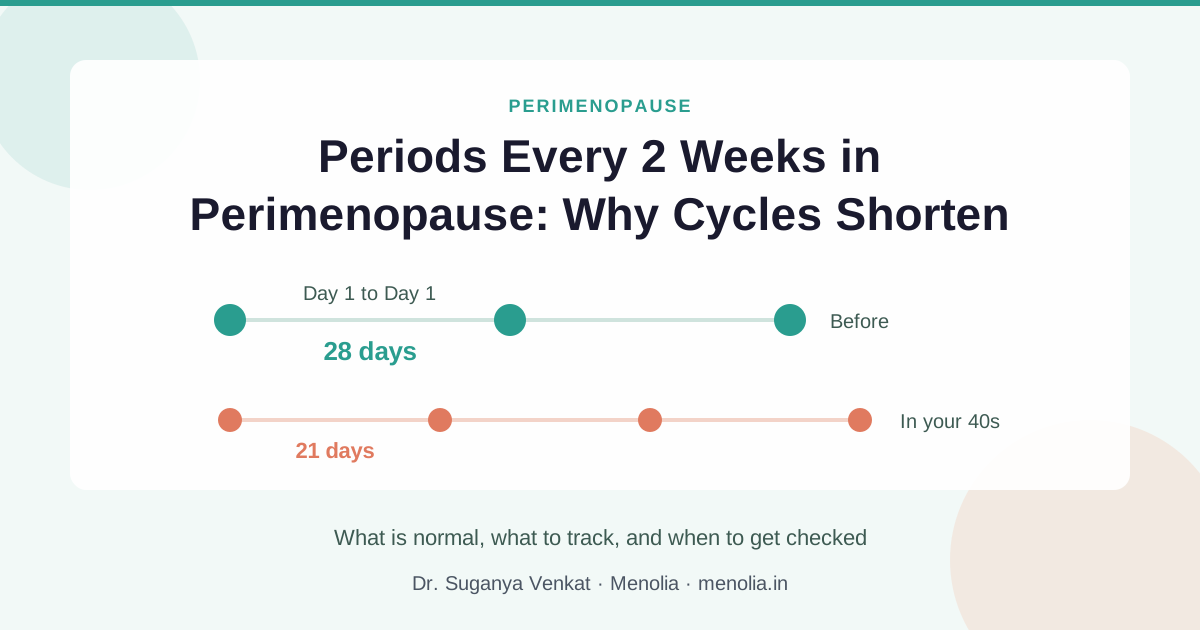
This makes a big difference. Say your cycle is now 21 days and each period lasts 6 days. From the day the bleeding stops to the day the next period starts is only 15 days. That feels like “every two weeks”, even though the cycle itself is 21 days.
The international FIGO system, used by gynaecologists worldwide, describes the bleeding pattern by four features: how often periods come, how long they last, how regular they are and how heavy the flow is (Jain V et al., Int J Gynaecol Obstet, 2023, PMID 37538019). In this system, a normal cycle is 24 to 38 days long and a normal period lasts up to 8 days, and a cycle shorter than 24 days is described as “frequent” menstrual bleeding. The same paper notes that after the age of 45, ovulation problems are common and the usual norms are not well defined. In other words, a 22-day cycle at 46 is a description worth noting, not a diagnosis.
So the first useful step is simply to write down the start date of each period for two or three months. Many women find their cycle is 21 to 23 days, which feels much shorter than it is because the bleeding days take up a third of it.
A Short Cycle or Bleeding Between Periods?
These two can feel identical when you are living through them, but they mean different things.
| Short cycle | Bleeding between periods | |
|---|---|---|
| What it feels like | A full period, with your usual flow and cramps, arriving early | Spotting or bleeding on days when you are not expecting a period |
| Pattern | Each bleed looks like a normal period, just closer together | Light or patchy bleeding in the middle of an otherwise regular cycle |
| Usual cause in your 40s | Hormonal change in the ovaries | Needs a look for a cause such as a polyp, the cervix or the lining |
If what you are noticing is light spotting between otherwise normal periods, our guide to perimenopause spotting and when to worry is the better fit. The FIGO review notes that bleeding between periods may point to a focal cause such as a polyp (Jain V et al., 2023), which is why it is assessed differently from a cycle that is simply shorter.
Why Cycles Shorten in Early Perimenopause
Your cycle has two halves. The first half, the follicular phase, runs from the start of your period until you ovulate. During this time a group of follicles in the ovary grows and one becomes the lead follicle that releases an egg. The second half, the luteal phase, runs from ovulation to your next period, and this is when progesterone is made.
In your twenties and thirties, the follicular phase usually takes around two weeks. In your forties, it often gets shorter. Here is why.
The ovaries have fewer follicles left. As the number of follicles falls, the ovaries make less inhibin B, a hormone that normally keeps follicle-stimulating hormone (FSH) in check. With that brake weaker, FSH rises, and this rise is one of the earliest hormonal signs of reproductive ageing (Klein NA, Soules MR, Clin Obstet Gynecol, 1998, PMID 9917946).
Higher FSH pushes the lead follicle along faster. In a study of women aged 40 to 45 who still had regular ovulatory cycles, FSH was higher throughout the cycle than in women aged 20 to 25, and the follicular phase was shorter because the dominant follicle developed more quickly (Klein NA et al., J Clin Endocrinol Metab, 1996, PMID 8772573). A later study from the same group found that in older women the lead follicle is chosen earlier in the cycle (Klein NA et al., J Clin Endocrinol Metab, 2002, PMID 12466381).
The result is earlier ovulation, and an earlier period. In a small study of women in perimenopause, the follicular phase averaged 11 days, compared with 14 days in younger women, and their whole cycles were shorter as a result (Santoro N et al., J Clin Endocrinol Metab, 1996, PMID 8636357).
Three days earlier ovulation, every month, turns a 28-day cycle into a 25-day one. Add a cycle where ovulation comes earlier still, and you are looking at 21 or 22 days.
The second half can shorten too
Some perimenopausal cycles also have a short luteal phase, or no ovulation at all. In both cases less progesterone is made (Prior JC, Hitchcock CL, Front Biosci, 2011, PMID 21196391). Across the stages of the menopause transition, average luteal progesterone falls and cycles without ovulation become more common (Hale GE et al., J Clin Endocrinol Metab, 2007, PMID 17550960). Low progesterone can show up as spotting for a day or two before the period proper, which adds to the feeling that you are always bleeding.
Where this sits in the bigger picture
The staging system doctors use, called STRAW+10, set out simplified bleeding criteria for the early and late menopause transition (Harlow SD et al., Climacteric, 2012, PMID 22338612). In this system, the start of the transition is marked by cycle length varying by 7 days or more from one cycle to the next, with this pattern repeating, and the later stage by gaps of 60 days or more without a period. Shorter, closer cycles usually belong to the earlier part of this journey. Many women go on to have longer gaps a few years later, which is why “too often” can quietly turn into “too far apart”. Our post on the stages of menopause walks through each stage in more detail.
When Frequent Periods Need a Closer Look
Most short cycles in your forties are hormonal. But because the same pattern can have other causes, I suggest seeing a doctor if any of these apply:
- Cycles shorter than 24 days for three months or more. Not because something is necessarily wrong, but because it is worth ruling out the treatable causes below.
- Bleeding that lasts more than 8 days, or flow heavy enough to soak a pad every hour or two. If you are soaking through a pad every hour for several hours in a row, or heavy bleeding comes with dizziness, fainting, breathlessness or chest pain, go to the nearest hospital emergency department straight away rather than waiting to keep a log or book a routine consultation.
- Bleeding between periods or after sex. These need their own assessment, whatever your cycle length.
- Tiredness, breathlessness on stairs, dizziness or a racing heart. Bleeding twice as often means losing blood twice as often, and iron stores can fall without much warning.
- A sudden change after years of steady cycles, or short cycles along with weight change, heat intolerance, tremor or palpitations.
- You are on HRT or another hormone treatment and your bleeding pattern changes.
What your doctor may check
This is the usual evaluation. Your doctor will choose what fits you.
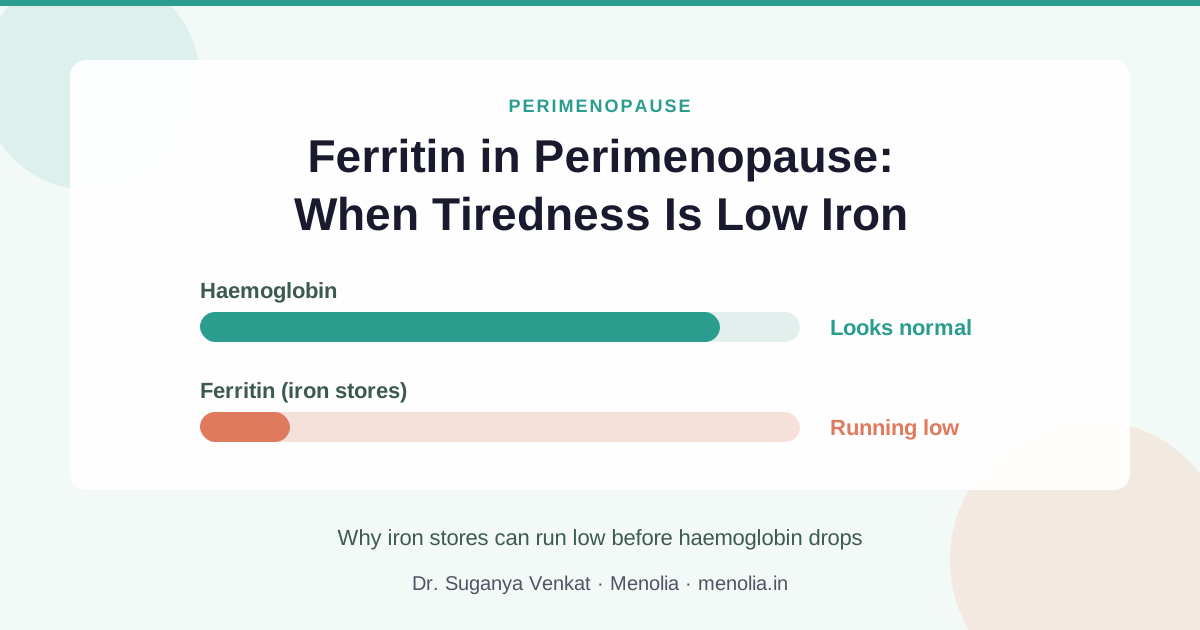
A blood count, and often ferritin. To see whether frequent bleeding has lowered your haemoglobin or iron stores. The FIGO review emphasises that heavy bleeding is the biggest contributor to iron deficiency and anaemia (Jain V et al., 2023). If your periods are both frequent and heavy, our guide to heavy and abnormal bleeding in perimenopause explains the next steps, and Chellammal’s story shows how a work-up and plan came together for one woman whose bleeding had left her anaemic.
Thyroid tests (TSH, and sometimes free T4). Thyroid problems can change the menstrual cycle in either direction. Both an overactive and an underactive thyroid can cause menstrual disturbances (Krassas GE et al., Endocr Rev, 2010, PMID 20573783), and either can change how often you bleed or how heavy the flow is. Thyroid disease is common here: in a study across eight Indian cities, including Chennai, about 11% of adults had hypothyroidism, and women were affected about three times as often as men (Unnikrishnan AG et al., Indian J Endocrinol Metab, 2013, PMID 23961480). Our guide to thyroid changes around menopause explains which tests help.
A pregnancy test, if there is any chance. Ovulation in perimenopause becomes unpredictable, not absent, and can happen without warning (Klein NA, Soules MR, 1998). Early pregnancy bleeding can be mistaken for an early period.
A transvaginal ultrasound. This looks for polyps, fibroids and the thickness of the lining. It is especially useful if the bleeding is heavy, prolonged or between periods.
Sometimes an endometrial biopsy. The FIGO review gives the example of a 49-year-old with irregular bleeding who may need uterine imaging and a sample of the lining, while a 19-year-old with the same history usually does not (Jain V et al., 2023). Age, weight, diabetes, the scan findings and how long the pattern has lasted all feed into this decision. If your doctor suggests a biopsy, it is a careful step to check that the lining is healthy, and your doctor will explain the result and what, if anything, it changes.
FSH on its own is not very helpful here. FSH swings a great deal from cycle to cycle in perimenopause, so a single value does not confirm or rule out much. Our guide to menopause blood tests explains why.
Periods coming every two or three weeks and not sure whether it needs a scan? We can go through your cycle log and symptoms together over a video call. Message Dr. Suganya on WhatsApp for a ₹399 video consultation.
What to Track Before You See a Doctor
A simple log turns a vague worry into information your doctor can use. A note in your phone is enough. For two or three cycles, write down:
- The date each period starts. This alone tells you your cycle length.
- How many days you bleed, and how many of those are heavy.
- Pads or cloths used on your heaviest day, and whether you are changing more often than every two hours.
- Any bleeding or spotting on non-period days, including after sex.
- Clots larger than a 10-rupee coin.
- How you feel: tiredness, breathlessness, dizziness, palpitations, hot flushes, sleep.
- Any medicines or supplements, including hormone tablets or blood thinners.
Bring the log, and any old reports, to your appointment. A woman who walks in with three months of start dates often gets a clearer answer in one visit.
What Can Help
If your tests are normal and the short cycles are simply perimenopause, you have choices, and you do not have to put up with it if it is wearing you down.
Watchful waiting is a reasonable choice when the bleeding is not heavy, your haemoglobin is normal and you are coping. Short cycles in early perimenopause often give way to longer ones over time.
Correcting iron makes a real difference. If your ferritin or haemoglobin is low, iron replacement as advised by your doctor can lift the tiredness that many women blame on age. Iron-rich foods help maintain stores alongside that: ragi, rajma, kala chana, drumstick leaves (murungai keerai), palak, dates and jaggery, with a squeeze of lemon or a piece of amla to help absorption, and tea or coffee kept away from mealtimes.
Hormonal options can steady the cycle. Depending on your scan, your bleeding, whether you need contraception and your overall health, your doctor may discuss options such as the hormonal IUD (LNG-IUS) or other hormone treatments. Our guide to contraception in perimenopause explains these choices, which often do double duty in your forties.
Treating the cause, if one is found. A polyp can usually be removed with a short hysteroscopy, and a thyroid problem treated with tablets. Once the cause is dealt with, the cycle often settles.
Looking after the rest of you. Steady meals, regular movement and decent sleep do not change the ovaries, but they make the months of transition easier to carry.
What It Is Called in Tamil and Hindi
Many women describe this pattern in their own language when they search or when they talk to family:
| Language | How it is often said |
|---|---|
| Tamil | Maadhavidaai (மாதவிடாய்) is the period; maadham irandu murai (மாதம் இரண்டு முறை) means “twice a month” |
| Hindi | Maasik dharm (मासिक धर्म) is the period; women often say “mahine mein do baar period” |
Whatever words your family uses, the biology is the same, and the same simple log of start dates is the most useful thing to bring to your doctor.
Practical Takeaways
- Count from day one to day one. A 21-day cycle with a 6-day period feels like “every two weeks”.
- Shorter cycles are an early, common sign of perimenopause, caused by higher FSH pushing ovulation earlier.
- Under 24 days, repeatedly, is worth a review, especially with heavy or prolonged bleeding.
- Bleeding between periods or after sex is a different pattern and always deserves a check.
- The usual checks are simple: blood count and ferritin, thyroid, a pregnancy test if relevant, and a transvaginal scan. A biopsy is sometimes added after 45.
- You can still get pregnant. Keep using contraception until your doctor advises otherwise.
- Treatment exists, from iron to hormonal options, so you do not have to simply wait it out.
Frequently Asked Questions
Is it normal to get periods every 2 weeks in perimenopause?
A cycle that shortens to 21 to 24 days is common in early perimenopause, and it can feel like a period every two weeks because the bleeding days take up so much of the cycle. If the gap from the start of one period to the start of the next is regularly under 24 days, or your periods are heavy or last more than 8 days, see a doctor to rule out thyroid problems, polyps, fibroids and anaemia.
Why are my periods getting closer together at 45?
As the number of follicles in the ovaries falls, FSH rises, and the lead follicle grows and releases an egg earlier in the cycle. Earlier ovulation means an earlier period, so a 28-day cycle can become 22 to 25 days. Studies of women in their forties have shown exactly this shorter first half of the cycle.
Mahine mein do baar period aana normal hai kya? (Is a period twice a month normal?)
In your forties, periods coming closer together is often part of perimenopause. It is still worth a check if this continues for three months or more, if the bleeding is heavy or long, or if you feel tired and breathless. A blood count, thyroid test and pelvic ultrasound usually give a clear answer.
Does a short cycle mean menopause is close?
Not necessarily. Shorter cycles usually belong to the early part of the transition, and many women have them for a while before their cycles start to lengthen and skip months. The time from the first short cycles to the final period varies a lot from woman to woman, so cycle length alone cannot tell you when your last period will be.
Can I still get pregnant if my periods come every two weeks?
Yes. Short cycles often still include ovulation, just earlier than before, and in perimenopause ovulation can happen without warning. If you do not want to become pregnant, keep using contraception until your doctor confirms it is safe to stop. Our guide on getting pregnant in perimenopause covers this.
Can thyroid problems cause periods twice a month?
They can. Both an overactive and an underactive thyroid can disturb the menstrual cycle, changing how often you bleed or how heavy the flow is, and the pattern varies from woman to woman. Thyroid conditions are common in Indian women, so a TSH test is a sensible part of checking frequent periods.
Will frequent periods make me anaemic?
They can, especially if the periods are also heavy. Bleeding twice as often means losing blood twice as often, and iron stores can drop slowly without obvious signs. If you feel unusually tired, breathless or dizzy, ask for a blood count and ferritin test. Low iron is easy to check and treat.
Short cycles in your forties are usually your ovaries changing pace, not a sign that something is wrong. Counting your cycle properly, keeping a simple log and getting a few basic checks if the pattern persists will tell you which group you belong to, and if the bleeding is wearing you down, there are good options to steady it. If you would like help making sense of your cycle and deciding whether you need a scan or tests, working alongside your own gynaecologist, I see women across India online, and you can also read about Menolia’s perimenopause program.