She had been on HRT for eleven months. The hot flashes had settled, she was sleeping through the night again, and the fog that had made her doubt herself at work had lifted. Then, at a family function, a cousin asked how long she had been “on hormones” and told her, with great confidence, that five years was the absolute maximum.
She went home and counted. Four years and one month left. From that evening, the relief she had been feeling came with a timer attached.
I’m Dr. Suganya Venkat, an OB-GYN with over 15 years of clinical experience, and this is one of the most common worries I hear from women who are doing well on HRT. It usually arrives long before any thought of stopping. Is there a limit? Will I be told one day that my time is up?
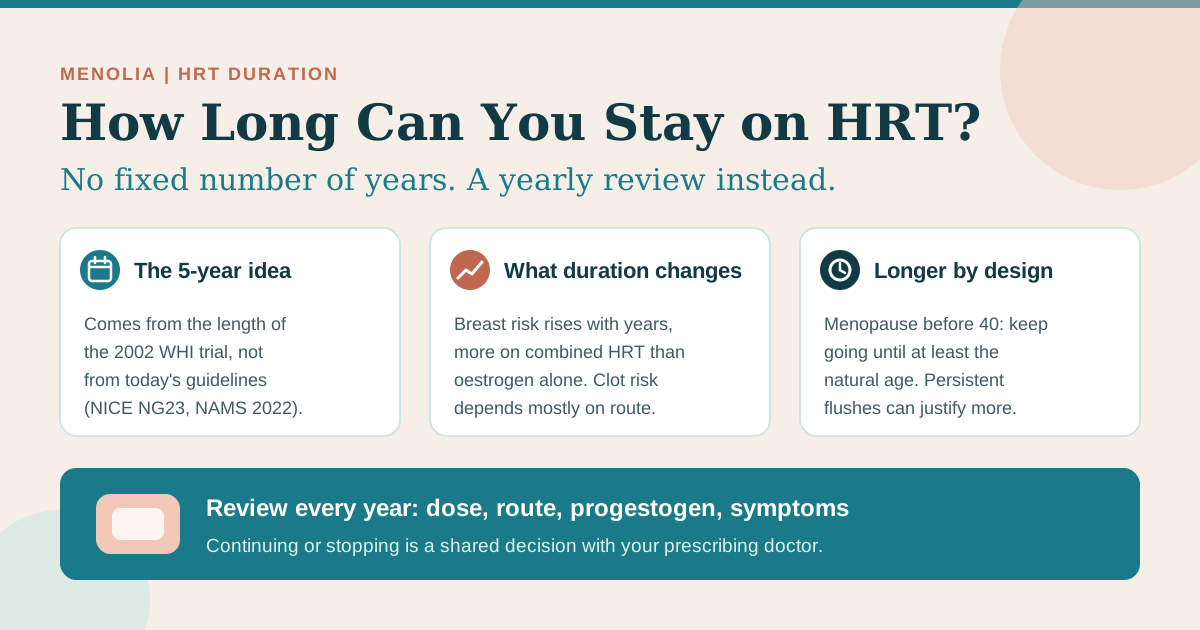
The short answer: no current major guideline sets a fixed number of years or a fixed age at which HRT must stop. What there is, instead, is a regular review of whether HRT is still doing more good than harm for you. This post explains where the five-year idea came from, which risks change with duration and which do not, and what that yearly review should cover.
If you have already decided to come off HRT and want to know how, the guide to stopping HRT safely covers tapering and what to expect. This post is about the question that comes earlier.
What the Guidelines Say About Duration
Two widely used guidelines speak directly to duration, and both are worth knowing by name.
NICE NG23 (UK, last updated 7 November 2024, nice.org.uk/guidance/ng23). The guideline asks doctors to discuss the possible duration of treatment when HRT is started, to rediscuss the benefits and risks of continuing at every review, and to review treatment at three months and then once a year. It also asks for the lowest effective dose. It does not name a maximum number of years or a cut-off age.
The North American Menopause Society 2022 position statement (The North American Menopause Society Hormone Therapy Position Statement Advisory Panel, Menopause, 2022, PMID 35797481) says treatment should be individualised, “with periodic reevaluation of the benefits and risks of continuing therapy.” It adds that longer durations should be for documented reasons, such as hot flashes that persist, with shared decision-making.
Put together, the instruction to your doctor is clear: decide together, review regularly, use the lowest dose that works, and keep going only for as long as there is a good reason to. That can be two years for one woman and fifteen for another.
Where the “Five-Year Rule” Came From
Many Indian women have heard a fixed number, usually five years, sometimes “stop at 55” or “stop at 60”. These figures did not come from nowhere, and the doctors who repeat them were following the evidence available when they trained.
In July 2002, the Women’s Health Initiative (WHI) trial of combined HRT was stopped early, after an average of 5.2 years, when an increase in breast cancer crossed a pre-set safety boundary (Rossouw JE et al., JAMA, 2002, PMID 12117397). The headlines that followed were frightening, prescriptions dropped around the world, and “around five years” became a figure people remembered.
What was less remembered is who was in the trial. It was designed to test whether HRT prevents chronic disease, not to treat symptoms, and women were enrolled between ages 50 and 79. Across the two WHI hormone trials, the average age at the start was 63.4 years (Manson JE et al., JAMA, 2017, PMID 28898378), so many were a decade or more past their last period. The regimen was one specific oral combination (conjugated equine oestrogen with medroxyprogesterone acetate), while today women also have patches, gels and other progestogens to choose from.
Those same women have now been followed for 18 years. Taking HRT for a median of 5.6 years (combined) or 7.2 years (oestrogen-only) was not associated with a higher risk of death from any cause, from heart disease, or from cancer over that period (Manson JE et al., JAMA, 2017, PMID 28898378).
So the five years was the length of a trial, and later guidance moved away from treating it as a ceiling. If your gynaecologist has mentioned a cut-off, it is entirely reasonable to bring this up at your next visit and ask how it applies to you.
What Changes With Longer Use, and What Does Not
Duration is not irrelevant. Some risks build up with years of use, some depend far more on the type of HRT, and some have more to do with your age when you started. Knowing which is which turns a vague fear into a specific conversation.
Breast cancer: depends on type and duration
This is the risk that most women have in mind, so here are the numbers.
The largest analysis to date, pooling data on more than 100,000 women with breast cancer, found that the excess risk rose steadily with years of use, and was greater with combined HRT (oestrogen plus a progestogen) than with oestrogen-only HRT. Vaginal oestrogen was the one form not linked to an excess (Collaborative Group on Hormonal Factors in Breast Cancer, Lancet, 2019, PMID 31474332).
In absolute terms, the same analysis estimated that five years of HRT started at 50 would add roughly one breast cancer between ages 50 and 69 for every 50 women using oestrogen with a daily progestogen, one in every 70 using oestrogen with a progestogen taken part of the month, and one in every 200 using oestrogen alone. For ten years, these excesses would be about twice as large. These estimates come from women of average weight in high-income countries.
The type of progestogen also matters. A large UK study found that among combined preparations, the increased risk was highest with norethisterone and lowest with dydrogesterone, the progestogen in Duphaston, which many women in India take (Vinogradova Y et al., BMJ, 2020, PMID 33115755). The same study found no increased risk with past long-term oestrogen-only use or past short-term combined use.
If you have had a hysterectomy and take oestrogen alone, your breast cancer picture with longer use is quite different from a woman on combined HRT. If you still have a uterus, the progestogen is there to protect the lining of the womb and cannot simply be dropped. The post on why HRT needs progesterone explains why. The full breakdown of HRT and breast cancer risk puts these figures next to other everyday factors, such as alcohol and weight.
Blood clots: depends on route more than years
The risk of a clot in the leg or lung (VTE) with HRT is mainly about how the oestrogen enters the body. In a study of over 80,000 women with VTE, oral HRT was linked to a higher risk, while transdermal HRT (patches and gels) was not associated with an increased risk (Vinogradova Y et al., BMJ, 2019, PMID 30626577).
For a woman thinking about long-term use, this is one of the most useful levers. Moving from tablets to a patch or gel can change her clot picture considerably. The post on HRT and blood clots goes through who benefits most from that switch.
Stroke and ovarian cancer: small duration effects
NICE NG23 (2024 update) notes that the stroke risk from combined HRT taken as tablets rises with longer use, giving more than five years as an example, and with higher doses and older age at starting. With transdermal oestrogen-only HRT, a rise in stroke risk is considered unlikely. NICE also describes a very slight increase in ovarian cancer risk after five years of oestrogen-only HRT. These are small absolute numbers, and they are exactly the kind of detail your yearly review is designed to weigh.
Age at starting matters more than years on treatment
The NAMS 2022 statement describes the benefit-risk balance as favourable for women under 60, or within 10 years of their last period, who have no reason to avoid HRT, and less favourable for women who start HRT more than 10 years after menopause or after 60 (The North American Menopause Society Hormone Therapy Position Statement Advisory Panel, Menopause, 2022, PMID 35797481). A woman who started at 50 and is now 62 is in a different position from a woman starting fresh at 62. The post on starting HRT after 60 covers the second situation.
Bones: protection while you take it
HRT protects bone while you are taking it, which is one reason some women with low bone density continue it longer. When WHI participants stopped, fracture risk did not rise above that of women who had been on placebo, and women who had taken oestrogen alone kept a small residual benefit for total fractures (Watts NB et al., J Clin Endocrinol Metab, 2017, PMID 27820659). So stopping does not cause a sudden rebound in fractures, but the extra protection fades over time. If bone health is part of your reason for staying on HRT, your doctor can plan what replaces it if you stop. Our guide to menopause and bone health covers DEXA scans and the role of calcium-rich foods like ragi, dahi and sesame.
Wondering whether your current HRT is still the right fit for the long term? Bring your prescription, how long you have been on it, and your last mammogram and blood pressure readings, and we can look at it together, alongside your own gynaecologist. Message Dr. Suganya on WhatsApp for a Rs 399 video consultation.
Situations Where Longer Use Is Expected
There are groups of women for whom continuing HRT for many years is the standard advice, not an exception.
Premature or early menopause. If your periods stopped before 40, NICE NG23 (2024 update) recommends continuing hormone treatment (HRT or a combined hormonal pill) until at least the age of natural menopause, unless there is a reason not to. For these women, HRT is replacing hormones the body would normally still be making, and NICE notes that the baseline risk of conditions like breast cancer and heart disease is very low under 40. The guide to premature menopause explains this in more detail.
Hot flashes that persist. For some women, vasomotor symptoms continue well into their sixties. The NAMS 2022 statement names persistent hot flashes as a documented reason for longer use, with shared decision-making and regular reassessment.
Vaginal and urinary symptoms. Low-dose vaginal oestrogen is treated differently from tablets, patches and gels. NICE NG23 (2024 update) describes absorption into the bloodstream as minimal compared with systemic HRT, and notes that symptoms often return when it is stopped and that treatment can be restarted. Many women continue it for years, with the same regular review. The guide to vaginal oestrogen in India covers the options.
What Your Yearly Review Should Cover
If there is no fixed end date, the yearly review is where the real decision gets made. These are the questions I go through with women in Menolia’s online consultations, and you can take this list to any doctor:
- Are the symptoms that started HRT still there? Sometimes the only way to know is a planned trial off treatment, and that is a reasonable choice to make together.
- Is this still the lowest dose that works? Many women can reduce over the years.
- Is this still the best route? Tablets, patch or gel. NICE NG23 suggests considering a patch or gel for women at higher clot risk, including a BMI over 30.
- Is the progestogen part still right for you? Both the type and whether it is taken continuously or part of the month affect breast and endometrial risk.
- Has anything changed in your health? New diagnoses, new medicines, a family member’s breast cancer diagnosis, planned surgery.
- Are your screening tests up to date? Mammogram, blood pressure, and any tests your doctor recommends based on your history. NICE NG23 asks doctors to discuss keeping up with national screening.
- What do you want? Your own sense of how HRT is helping, and how you feel about continuing, is part of the decision.
There are also specific situations where stopping or pausing is medically advised, such as a new breast cancer diagnosis, a blood clot, or certain types of major surgery. Those are covered in the stopping HRT guide. Outside of these, continuing or stopping is a shared choice.
Practical Takeaways
- No current major guideline (NICE NG23, NAMS 2022) sets a maximum number of years or a fixed age to stop HRT.
- The “five-year rule” traces back to the length of the 2002 WHI trial, whose participants averaged 63 years of age at the start.
- Breast cancer risk rises with years of use, more with combined HRT than oestrogen-only, and differs by progestogen. Vaginal oestrogen was not linked to an excess.
- Clot risk depends mainly on route: transdermal oestrogen was not associated with increased VTE risk.
- Women with menopause before 40 are advised to continue hormone treatment until at least the age of natural menopause.
- A yearly review of dose, route, progestogen, symptoms and screening is how long-term HRT stays appropriate.
- Any decision about duration is made with your prescribing doctor, based on your own picture.
Frequently Asked Questions
How long can you take HRT safely? There is no fixed limit. NICE NG23 (updated 2024) and the NAMS 2022 position statement both say duration should be individual, with benefits and risks rediscussed at regular reviews. Many women take HRT for a few years; some continue for much longer when symptoms persist and the yearly review supports it.
Is the five-year rule for HRT still followed? Current major guidelines do not include a five-year cut-off. The figure is often traced to the Women’s Health Initiative combined-HRT trial, which stopped after an average of 5.2 years in 2002. Its participants had an average starting age of 63, which is older than most women who start HRT for symptoms today.
Do I have to stop HRT at 60 or 65? Not automatically. Age is one factor in your review, along with how long ago your menopause was, your blood pressure, clot risk, breast health and how much the HRT is helping. Some women continue past 65 after a careful discussion, which may include a lower dose or a switch to a patch or gel.
Does breast cancer risk keep rising the longer I take HRT? For most types of systemic HRT, the excess risk rises with years of use, and it is higher with combined HRT than with oestrogen alone. The type of progestogen also matters, with dydrogesterone linked to the lowest increase among combined preparations in one large UK study. The risk falls after stopping, though some excess can persist for years after long-term combined use.
I went through menopause at 38. How long should I stay on HRT? NICE NG23 (2024 update) advises women with premature ovarian insufficiency to continue hormone treatment until at least the age of natural menopause, unless there is a reason not to. At that point, the decision is reviewed like any other woman’s.
Can I use vaginal oestrogen for the long term? Yes, in most cases. Low-dose vaginal oestrogen is mostly absorbed locally, and vaginal oestrogen was not linked to an excess breast cancer risk in the 2019 Lancet analysis. Symptoms often return when it is stopped, so many women continue it, with regular review.
What should I ask my doctor at my yearly HRT review? Ask whether your symptoms still need treatment, whether the dose can come down, whether a patch or gel would suit you better than tablets, whether your progestogen is still the right one, and whether your mammogram and blood pressure checks are up to date.
If you are on HRT and have been told about a cut-off, or you are unsure whether your current plan still fits you, I am happy to look at your situation in an online consultation. We can go through your history, your prescription and your goals, and work out a plan you can discuss with your own doctor.