When a woman sits down to talk about HRT, the first cancer she asks about is almost always breast cancer. The ovaries come up a little later, often with a quieter voice: “My aunt had ovarian cancer. Does that change anything?” or “I read that HRT affects the ovaries too. Is that true?”
It is a fair question, and it deserves a straight answer with numbers attached. Ovarian cancer is far less common than breast cancer, it is harder to pick up early, and many women have watched a relative go through it. So when the word “ovarian” appears next to “HRT” in a headline, the worry it causes is understandable.
I’m Dr. Suganya Venkat, an OB-GYN with more than 15 years of clinical experience, and this is the conversation I have with women at Menolia when this question comes up. The short version: yes, the large studies do show a small increase in ovarian cancer risk while women are taking HRT. In absolute terms, that increase is small, it falls after HRT is stopped, and for most women it is one factor to weigh alongside the real benefits of treatment, not a reason on its own to avoid it.
What This Post Covers
- What the biggest studies on HRT and ovarian cancer found
- The risk in absolute numbers, not only percentages
- Whether the type of HRT (tablet, patch, combined or oestrogen-only) makes a difference
- What happens to the risk after you stop
- What a family history or a BRCA result changes
- HRT after treatment for ovarian cancer
- The symptoms worth acting on, and why routine CA-125 screening is not the answer
If breast cancer is your main concern, our post on HRT and breast cancer risk covers that in detail. This post is about the ovaries.
What the Largest Analysis Found
The most important single piece of evidence comes from the Collaborative Group on Epidemiological Studies of Ovarian Cancer, which pooled individual data from 52 studies (Collaborative Group on Epidemiological Studies of Ovarian Cancer, Lancet, 2015, PMID 25684585). In the prospective studies, 12,110 postmenopausal women developed ovarian cancer during follow-up, and 55% of them had used hormone therapy at some point.
Here is what they found:
- Current users had a higher risk than women who had never used HRT, even with less than five years of use (relative risk 1.43).
- Current or recent use (stopped less than five years before diagnosis) carried a relative risk of 1.37.
- The increase was similar for oestrogen-only and combined oestrogen-progestogen HRT, and similar in European and American studies.
- It was seen only in two tumour types: serous (relative risk 1.53) and endometrioid (1.42). These are the two most common types of ovarian cancer. The other main types did not show a clear increase.
The authors wrote that the increase “may well be largely or wholly causal.” Studies of this kind observe women rather than randomly assigning them to HRT, so some uncertainty remains, but the authors judged that HRT itself was likely to explain much or all of the link.
A relative risk of 1.37 means the chance is about 37% higher than it would otherwise be. That sounds large until you put it next to how uncommon ovarian cancer is to begin with.
The Risk in Absolute Numbers
This is the part that headlines usually leave out.
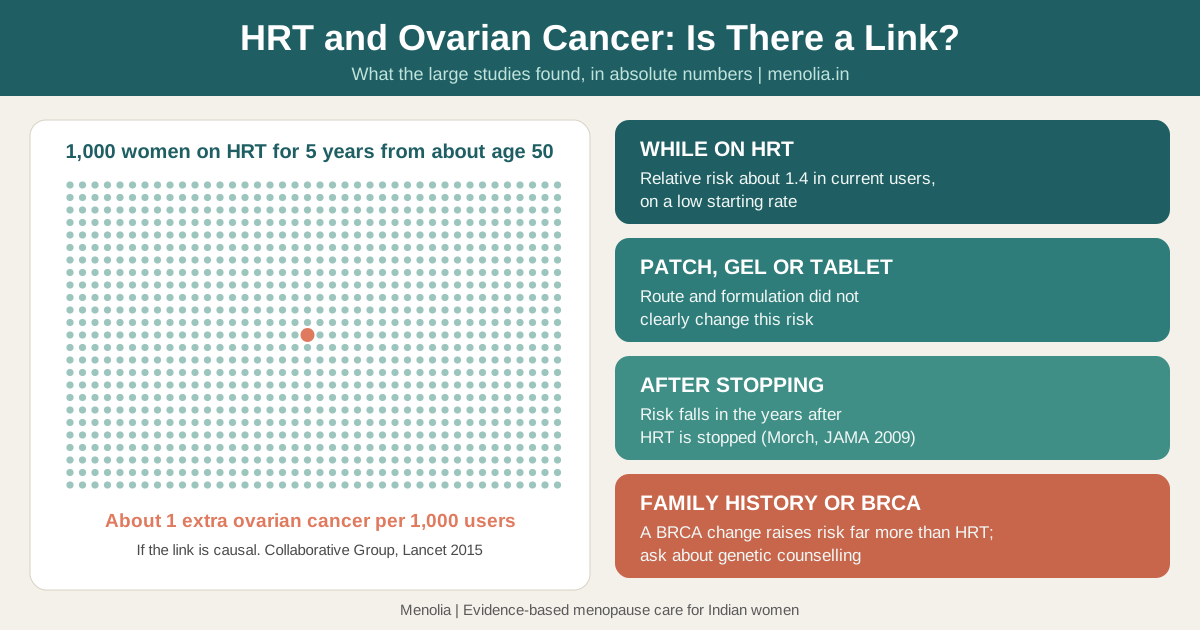
The same Lancet analysis estimated that if the link is causal, women who use HRT for five years from around age 50 would have about one extra ovarian cancer per 1,000 users. They also estimated about one extra ovarian cancer death per 1,700 users, assuming the usual outlook for the disease.
A Danish study that followed 909,946 women aged 50 to 79 through national registers gives a similar picture from a different angle (Mørch LS et al., JAMA, 2009, PMID 19602689). Among women who had never taken hormones, ovarian cancer occurred at a rate of 0.40 per 1,000 women each year. In current users, the rate was 0.52 per 1,000 each year. The authors worked out that this is roughly one extra ovarian cancer for every 8,300 women taking HRT each year.
To put both studies in plain terms: out of 1,000 women in their fifties who take HRT for five years, the large majority will never be affected by ovarian cancer either way, and about one additional case may be attributable to the hormones.
For comparison, a similar Oxford-led pooled analysis of breast cancer estimated that five years of oestrogen plus daily progestogen from age 50 adds about one breast cancer in every 50 users between ages 50 and 69, and oestrogen-only HRT about one in every 200 (Collaborative Group on Hormonal Factors in Breast Cancer, Lancet, 2019, PMID 31474332). The two estimates cover different follow-up periods, so they are not an exact like-for-like comparison, but the larger breast cancer number is why breast cancer gets most of the attention. Neither number should be ignored, and neither should be read without the benefits of HRT on the other side of the scale.
Trying to weigh HRT against a family history of cancer? Dr. Suganya Venkat can go through your personal and family history with you over a video consultation and help you understand where you stand.
Does the Type of HRT Make a Difference?
For some HRT risks, the route matters a great deal. Stroke risk, for example, rises with oral oestrogen tablets but not with standard-dose patches or gels, as our post on HRT and stroke risk explains.
Ovarian cancer appears to behave differently. In the Danish cohort, the risk among current users did not differ significantly by formulation, dose, regimen, progestogen type, or route, and did not differ significantly by duration of use (Mørch LS et al., JAMA, 2009, PMID 19602689). The Lancet pooled analysis likewise found a similar increase with oestrogen-only and combined preparations.
So a patch or gel is not a way around this particular risk. That does not make patches and gels any less useful. It just means route is chosen for other reasons, such as clot risk, stroke risk, blood pressure or migraine.
What about the randomised trial evidence? The Women’s Health Initiative tested continuous combined HRT (conjugated oestrogens with medroxyprogesterone acetate) against placebo in 16,608 women over an average of 5.6 years (Anderson GL et al., JAMA, 2003, PMID 14519708). There were only 32 cases of invasive ovarian cancer in the whole trial. The hazard ratio was 1.58, but the confidence interval ran from 0.77 to 3.24, which means the trial was too small to say for certain whether the risk went up. The authors concluded that this regimen “may increase the risk of ovarian cancer.” A rare cancer needs very large numbers of women to study, which is why the pooled observational data carries so much weight here.
What Happens After You Stop
The risk is tied mainly to current and recent use, and it falls once HRT is stopped.
In the Danish study, the relative risk was 1.22 in the first two years after stopping, and from two years onward it was no longer clearly raised (Mørch LS et al., JAMA, 2009, PMID 19602689). The Lancet analysis also found that risk declined the longer ago use had stopped, but about 10 years after stopping long-duration HRT there was still a small excess of serous and endometrioid tumours (relative risk 1.25) (Collaborative Group on Epidemiological Studies of Ovarian Cancer, Lancet, 2015, PMID 25684585).
This is one reason why the length of treatment is reviewed every year rather than decided once. Our guide on how long you can stay on HRT covers what that yearly review should look at.
If Ovarian Cancer Runs in Your Family
A mother, sister or daughter with ovarian cancer is worth mentioning at the very start of any HRT discussion. So is a family pattern of breast and ovarian cancer on the same side of the family, or breast cancer at a young age. These can point to an inherited change in genes such as BRCA1 or BRCA2, and your doctor may suggest genetic counselling and testing before anything else.
Why this matters: the inherited risk is far larger than anything HRT adds. In a large prospective study of BRCA carriers, the cumulative risk of ovarian cancer by age 80 was 44% for BRCA1 carriers and 17% for BRCA2 carriers (Kuchenbaecker KB et al., JAMA, 2017, PMID 28632866). For a woman carrying one of these genes, the main protective step is not avoiding HRT. It is discussing risk-reducing surgery to remove the ovaries and fallopian tubes, which is recommended for women with a BRCA1 mutation to prevent ovarian cancer (Kotsopoulos J et al., JAMA Oncol, 2018, PMID 29710224). BRCA2 carriers discuss the same option, and its timing, with their specialist.
Removing both ovaries brings on menopause straight away, often years before it would have happened naturally. Our post on surgical menopause covers what that feels like and why HRT is usually discussed afterwards.
Is HRT safe after that surgery? The main worry here has been breast cancer, because BRCA carriers also have a high breast cancer risk. The evidence so far is reassuring:
- In 872 BRCA1 carriers followed for an average of 7.6 years after their ovaries were removed, HRT use was not associated with a higher breast cancer risk overall (hazard ratio 0.97) (Kotsopoulos J et al., JAMA Oncol, 2018, PMID 29710224). After 10 years, the cumulative breast cancer incidence was 12% in women on oestrogen-only HRT and 22% in women on oestrogen plus progesterone, so the authors flagged progesterone-containing HRT for further study.
- An earlier study of BRCA1 and BRCA2 carriers found that short-term HRT after the surgery did not cancel out the reduction in breast cancer risk that the surgery provides (Rebbeck TR et al., J Clin Oncol, 2005, PMID 16219936).
If you are a BRCA carrier, these decisions are best made together with your gynaecologist and a genetics or breast specialist, and the type of HRT matters.
HRT After Treatment for Ovarian Cancer
Women treated for ovarian cancer often go into sudden menopause after surgery and chemotherapy, sometimes at a young age, and the symptoms can be severe. Many assume hormones are off the table for good, and the Cochrane reviewers below note that doctors are often reluctant to prescribe HRT in this situation. The evidence is limited, but it is more encouraging than many women expect.
In a randomised trial of 150 women with epithelial ovarian cancer, those randomly assigned to five years of hormone therapy (starting within nine months of diagnosis) had better overall survival than those who were not (hazard ratio 0.63), over a median follow-up of 19.1 years (Eeles RA et al., J Clin Oncol, 2015, PMID 26417001). Women with a history of a hormone-dependent cancer were not included in that trial.
A Cochrane review that combined three trials (350 women) concluded that HRT may slightly improve overall survival after surgery for epithelial ovarian cancer, but rated the certainty of the evidence as low (Saeaib N et al., Cochrane Database Syst Rev, 2020, PMID 31989588). The reviewers said the evidence was too limited to support or refute that HRT is very harmful in this group.
What this means in practice: HRT after ovarian cancer is not automatically ruled out. The decision depends on the tumour type and stage, and it belongs with your gynae-oncologist. If you are struggling with symptoms after treatment, ask the question rather than assume the answer is no. Our post on menopause after cancer treatment also covers non-hormonal options.
Symptoms Worth Acting On
Whether or not you take HRT, it helps to know which symptoms deserve a check-up. Ovarian cancer is hard to catch early partly because its symptoms are common ones that many women have for ordinary reasons.
A study comparing women with ovarian cancer to women attending primary care clinics found that the symptoms more linked to ovarian cancer were an increase in abdominal size, bloating, urinary urgency and pelvic pain (Goff BA et al., JAMA, 2004, PMID 15187051). What made them stand out was the pattern: women with ovarian cancer typically had these symptoms 20 to 30 times a month, they were more severe, and they had started recently.
So the signal to act on is not occasional bloating after a heavy meal. It is a new, frequent, persistent change that is not settling, especially bloating with a growing waistline and a need to pass urine more often. If that sounds like you, see your gynaecologist for a pelvic examination and an ultrasound. Bloating has many ordinary causes after 40, and our post on menopause bloating covers the common reasons. If a scan shows a cyst, our guide to an ovarian cyst after menopause explains how it is assessed.
Why Yearly CA-125 Tests Are Not the Answer
Some women on HRT ask for a yearly CA-125 blood test or pelvic ultrasound “just to be safe.” It is a natural instinct, but the evidence does not support it for women at average risk.
The UK Collaborative Trial of Ovarian Cancer Screening randomised 202,638 postmenopausal women aged 50 to 74 to annual screening (with CA-125 or ultrasound) or no screening, and followed them for a median of 16.3 years (Menon U et al., Lancet, 2021, PMID 33991479). Screening picked up more early-stage cancers, but it did not significantly reduce deaths from ovarian or tubal cancer. The authors concluded that general population screening cannot be recommended. That trial excluded women at increased familial risk, whose care is planned differently.
For most women, knowing the symptoms and acting on a persistent change is more useful than a routine blood test.
Putting It Together: Questions to Bring to Your Doctor
If you are considering HRT, or already taking it, these are worth raising:
- Has anyone in my family had ovarian, breast, bowel or womb cancer, and at what age? Does that pattern need genetic counselling?
- Given my symptoms, what does HRT offer me, and how does that compare with the small ovarian and breast cancer risks?
- How long do we plan to continue, and when will we review it?
- If I have had my ovaries removed, how does this evidence apply to me? (The Danish study, for example, did not include women whose ovaries had both been removed.)
- Which symptoms should make me book an appointment sooner rather than at my next review?
The studies in this post are about HRT that acts throughout the body, such as tablets, patches and gels. If you use, or are thinking about, a low-dose vaginal oestrogen cream for dryness, ask your doctor about that as a separate question.
For the wider picture of benefits and risks, including the women who should not take systemic HRT, see our guide to HRT for menopause in India.
Frequently Asked Questions
Does HRT cause ovarian cancer?
Large studies show a small increase in ovarian cancer risk while women are taking HRT and for a few years after. The biggest pooled analysis estimated about one extra ovarian cancer per 1,000 women who use HRT for five years from around age 50, and its authors thought the link was likely to be causal. The risk falls after HRT is stopped.
Is the risk lower with an HRT patch or gel than with tablets?
For ovarian cancer, the route does not appear to change the risk. A large Danish study found no significant difference by formulation, dose, regimen or route among current users. Patches and gels still have advantages for other risks, such as stroke, so the route is chosen for those reasons.
Is oestrogen-only HRT safer for the ovaries than combined HRT?
The pooled Lancet analysis found a similar increase in ovarian cancer risk with oestrogen-only and combined HRT. The choice between them depends mainly on whether you still have your womb, because a progestogen is needed to protect the womb lining when it is present.
My mother had ovarian cancer. Can I take HRT?
A family history does not automatically rule out HRT, but it should be discussed before you start. Your doctor may suggest genetic counselling, especially if more than one relative on the same side had ovarian or breast cancer, or if someone was diagnosed young. An inherited BRCA change raises ovarian cancer risk far more than HRT does, so finding out matters more than avoiding HRT.
Can BRCA carriers take HRT after their ovaries are removed?
Studies in BRCA carriers who had their ovaries removed found that HRT did not increase breast cancer risk overall, and short-term HRT did not cancel out the protective effect of the surgery. One study found lower breast cancer rates with oestrogen-only HRT than with combined HRT. This decision is best made with your gynaecologist and a genetics or breast specialist.
Can I take HRT after ovarian cancer treatment?
Possibly. A randomised trial and a Cochrane review suggest HRT may slightly improve overall survival after treatment for epithelial ovarian cancer, though the certainty of the evidence is low. It depends on the type and stage of the cancer, so the decision is made with your gynae-oncologist.
Should I get a CA-125 test every year if I am on HRT?
For women at average risk, routine yearly CA-125 or ultrasound screening is not recommended. A large UK trial of over 200,000 women found it did not significantly reduce deaths from ovarian cancer. It is more useful to know the symptoms (persistent bloating, a growing waistline, urinary urgency, pelvic pain) and see a doctor if they are new and frequent.
If you are weighing HRT and want to talk through your own family history and risks, message Dr. Suganya Venkat on WhatsApp. She consults online, pan-India, via video call.