You swing your legs out of bed, put your feet on the floor, and the first step feels like standing on a stone. The pain sits under the heel, sharp enough to make you limp to the bathroom. After a few minutes of walking around the kitchen it eases. Then you sit down for breakfast or a long phone call, stand up, and it is back. Some evenings, after a day on your feet, the heel throbs. You are in your forties or fifties, your periods have become irregular or stopped, and you wonder whether this is one more thing menopause has brought.
I’m Dr. Suganya Venkat, an OB-GYN with more than 15 years of experience. Heel pain is usually treated by orthopaedic doctors, physiotherapists and podiatrists rather than gynaecologists, but women raise it with me often when we talk about midlife aches. This post sets out what is known about plantar fasciitis and menopause, what else can cause heel pain at this age, and the steps that help you get back to walking comfortably.
If your pain is spread across several joints rather than in the heel, start with our guide to menopause joint pain instead.
What Plantar Fasciitis Is
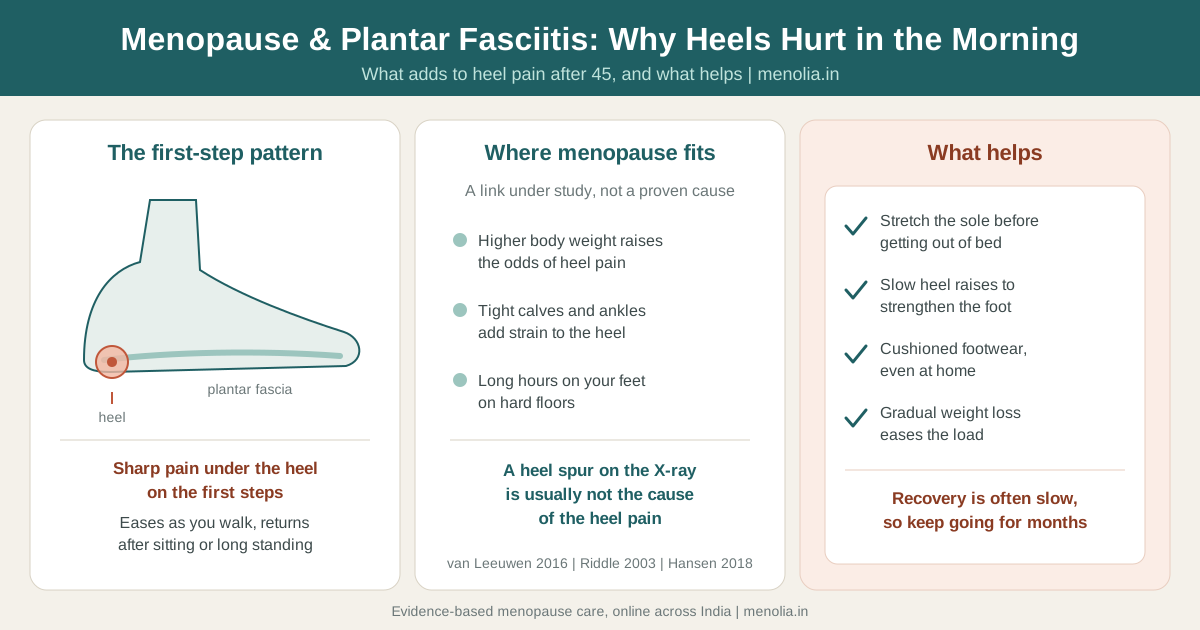
The plantar fascia is a thick band of tissue under the sole of the foot. It runs from the bottom of the heel bone to the base of the toes and supports the arch every time you stand, walk or climb stairs. When the part attached to the heel becomes irritated and thickened, the result is pain under the heel. Doctors call it plantar fasciitis or, more broadly, plantar heel pain.
The pattern is distinctive:
- Pain under the heel, often towards the inner side
- Worst with the first steps in the morning, or when you stand up after sitting for a while
- Easing after a few minutes of walking, then building again after long standing or walking
- Usually in one heel, though both can be affected
It is common in midlife. In a survey of 5,109 adults aged 50 and over registered with four general practices, 9.6% had plantar heel pain in the previous month, and for most of them (7.9% of the whole group) it was disabling enough to affect daily activities. It was slightly more common in women, and was linked with being overweight, lower physical activity, more anxiety and low mood, and manual or routine jobs (Thomas MJ et al., BMC Musculoskelet Disord, 2019, PMID 31325954). In a US national survey of 4,957 adults, 11.1% reported plantar heel pain. Women were more likely to have it than men, and among women it was most common at 65 and over, at 19.8% (Liu P et al., J Orthop Surg Res, 2024, PMID 39609875).
Does Menopause Cause Plantar Fasciitis?
No study has shown that menopause directly causes plantar fasciitis. The connection is mostly one of timing: heel pain is common in women in their forties and fifties, which is also when menopause happens.
A 2026 focus-group study of women with heel pain who were perimenopausal or postmenopausal noted in its background that plantar heel pain affects women between 40 and 60 at twice the rate of men. The authors were clear that whether menopause plays a causative role is uncertain. Of the 17 participants, 76% had not initially thought their heel pain might be linked to menopause, and said the link had not been mentioned when they sought help. All of them felt it deserved more research (Douglas-Harris M et al., J Foot Ankle Res, 2026, PMID 42224090).
There are reasonable ideas about why menopause might play a part. Oestrogen helps maintain collagen turnover, and collagen is the main protein in tendons and fascia. A 2026 narrative review of overuse injuries in midlife women named plantar fasciitis among the common ones, and noted that low bone density, aromatase inhibitor use and rapid increases in physical activity can add to the risk. The same review pointed out that much of this research relies on observational data, and argued that the focus on oestrogen alone is too narrow (Ansari M et al., Ann Rehabil Med, 2026, PMID 42332940). The hormone link is a theory under study, not a proven cause.
The factors with clearer evidence
What the research shows more firmly is that a few everyday factors raise the odds of heel pain, and several of them tend to change around menopause.
Body weight. A review of 51 studies found that, of the clinical factors that could be pooled, a body mass index (BMI) above 27 was the only one significantly linked with plantar fasciitis, with odds about 3.7 times higher (van Leeuwen KD et al., Br J Sports Med, 2016, PMID 26644427). In the US survey, the risk rose step by step with BMI: about 1.5 times higher at a BMI of 25 to 30 and 2.7 times higher at 35 or above, compared with a BMI under 25 (Liu P et al., 2024). Many women gain weight around menopause, and every extra kilo is carried by the heel with each step. Our guide to menopause weight gain covers what helps at this stage.
Tight calves and long hours standing. In a case-control study of 50 people with plantar fasciitis, those with very limited upward bend at the ankle had far higher odds of heel pain (an odds ratio of 23.3) than people with good ankle flexibility. A BMI above 30 and spending most of the working day on your feet were also independent risk factors (Riddle DL et al., J Bone Joint Surg Am, 2003, PMID 12728038). Ankle stiffness often creeps in with age and less activity, and many Indian women spend hours standing in the kitchen, at work or at family functions.
Bone health. In the US survey, osteoporosis was linked with heel pain in women (about twice the odds) but not in men (Liu P et al., 2024). This was a cross-sectional finding that cannot show cause, but it is one more reason to look after bone health after menopause, which our osteoporosis guide for Indian women explains.
Breast cancer treatment. Aromatase inhibitors, used after breast cancer to lower oestrogen further, commonly cause joint pain, which affects up to half of women who take them (Hyder T et al., Front Endocrinol, 2021, PMID 34385978). If your heel or other joint pain began after starting one of these tablets, tell your oncologist rather than stopping the medicine yourself. Our post on menopause after cancer treatment has more on managing these side effects.
So menopause may be one background factor, but the things you can change, such as weight, calf flexibility, footwear and how long you stand, carry clearer evidence.
Wondering whether your heel pain, weight gain and other changes are connected? Note when the heel hurts most, what eases it, and any other aches, and we can go through it together, along with the rest of your midlife health, over a video call. Message Dr. Suganya on WhatsApp for a Rs 399 video consultation.
What About the Heel Spur on My X-Ray?
Many women are told they have a “heel spur” and assume it is the cause of the pain. A spur is a small bony outgrowth on the underside of the heel bone, and it is a common finding on X-rays at this age.
Spurs were once thought to cause plantar fasciitis, but most experts now regard them as an incidental finding. A hospital review of 1,103 ankle X-rays put this to the test: 12.4% showed a heel spur, more often in women and older people. People with spurs did report more foot pain than those without, even after excluding plantar fasciitis, and they were also more likely to have a higher BMI, diabetes and osteoarthritis in the legs. The authors suggested that spurs may not cause pain themselves but may point to these other conditions (Moroney PJ et al., Foot Ankle Spec, 2014, PMID 24379452). In the long-term study described below, having a spur made no difference to how people recovered (Hansen L et al., Orthop J Sports Med, 2018, PMID 29536022).
In practice, plantar fasciitis is diagnosed from your symptoms and an examination. An X-ray is not needed in most cases, and a spur on the report does not mean you need surgery to remove it.
Is It Plantar Fasciitis, or Something Else?
Morning heel pain at this age is commonly plantar fasciitis, but a few other conditions cause pain around the heel. The location and pattern are the best clues.
| What you feel | What it may point to |
|---|---|
| Sharp pain under the heel on first steps in the morning or after sitting, easing as you walk | Plantar fasciitis |
| A deep bruised ache in the centre of the heel, worse barefoot on hard floors | Heel fat pad pain |
| Pain at the back of the heel, where the thick tendon attaches above the heel | Achilles tendinopathy |
| Pain that builds with walking, swelling, and tenderness when the sides of the heel are squeezed, especially with osteoporosis | A stress fracture of the heel bone |
| Burning, tingling or numbness in the heel and sole | A pinched nerve at the ankle, or a nerve root in the lower back |
| Burning or numbness in both feet, starting at the toes | Nerve damage from diabetes or low vitamin B12 |
| Pain in both heels with morning stiffness in other joints, swollen fingers or toes, or psoriasis | Inflammatory arthritis, such as psoriatic arthritis |
A few of these deserve a word more.
Both feet burning or tingling usually points to the nerves rather than the fascia. Diabetes is the first thing to check, and our guide to menopause and blood sugar lists the tests to ask for. Low vitamin B12 is another treatable cause, covered in our post on menopause and vitamin B12.
Heel pain with other joint symptoms can be part of an inflammatory arthritis. Psoriatic arthritis, for example, can affect the heel and the Achilles tendon, and often comes with long morning stiffness. Our post on menopause and psoriatic arthritis explains the clues.
Pain that travels from the back or buttock down to the heel, with tingling, is more likely a nerve root problem in the lower back. Our guide to menopause and sciatica explains how to tell.
When to see a doctor promptly
See a doctor the same day if your heel is hot, red and swollen, especially with fever, or if you cannot put weight on the foot after a fall or injury. If you have diabetes, any new wound, blister, colour change or swelling on the foot needs prompt review. If the pain builds the more you walk, the heel is swollen, or it hurts when the sides of the heel are squeezed, especially if you have osteoporosis, see a doctor within a few days, as this can be a stress fracture, and rest from long walks and heel exercises until it has been checked. See a doctor within a week or two if heel pain comes with numbness or tingling, if both heels hurt along with other joints, or if the pain is not improving after a few weeks of the steps below.
What Helps Plantar Fasciitis
Plantar fasciitis is usually managed without surgery, but recovery can be slow. In a study of 174 people whose plantar fasciitis was diagnosed from symptoms and ultrasound, then followed up an average of 9.7 years after their symptoms began, those who recovered had symptoms for about two years on average. The chance of still having symptoms was about 80% one year after the pain began and 50% at five years, and recovery tended to be slower in women and in people with pain in both heels (Hansen L et al., 2018). One group of patients may not represent everyone with heel pain, and the study could not say which treatments worked. What it does tell us is that steady, consistent care over months matters more than any single quick fix.
Stretching the sole and calf
In a trial of 82 people with long-standing plantar fasciitis, a stretch that targets the plantar fascia itself gave better results at eight weeks than Achilles tendon (calf) stretching. Two years later, after everyone had been taught the plantar fascia stretch, 92% of the 66 people who replied were satisfied or satisfied with minor reservations (DiGiovanni BF et al., J Bone Joint Surg Am, 2006, PMID 16882901). Stretching on its own is not a quick fix, though: in a trial of 92 people, two weeks of calf stretching gave no clear benefit over a sham treatment (Radford JA et al., BMC Musculoskelet Disord, 2007, PMID 17442119). Stretches seem to help most when done regularly over weeks, as part of a wider plan.
The plantar fascia stretch: sit with the painful foot crossed over the other knee. Hold the base of your toes and gently pull them back towards your shin until you feel a stretch under the arch. Hold for about 10 seconds and repeat 10 times. Many women find it helps to do this before getting out of bed and before standing up after a long sit.
Strengthening
In a trial of 48 people, single-leg heel raises with a towel under the toes, made progressively harder and done every second day alongside shoe inserts, improved foot function more at three months than stretching with shoe inserts. By six and twelve months the two groups were similar (Rathleff MS et al., Scand J Med Sci Sports, 2015, PMID 25145882). This suggests strengthening can speed up recovery. A physiotherapist can show you how to do it and how fast to progress. Building leg strength is worthwhile at this age anyway, as our post on strength training after 45 explains.
Footwear and shoe inserts
A review of 19 trials found moderate-quality evidence that shoe inserts (foot orthoses) reduce heel pain modestly over 7 to 12 weeks compared with sham inserts, though it is uncertain whether the difference is large enough to matter to most people. Custom-made inserts were no better than ready-made ones (Whittaker GA et al., Br J Sports Med, 2018, PMID 28935689). So there is no need to pay for expensive custom orthotics at the start. A cushioned shoe with a slightly raised heel and firm support, or a simple silicone heel cup, is a reasonable first step.
Steroid injections
Steroid injections into the heel are often offered. A review of 47 trials found that they eased pain in the short term better than some other treatments, but they were no more effective than a placebo injection for pain or function (Whittaker GA et al., BMC Musculoskelet Disord, 2019, PMID 31421688). They may help some people through a bad phase, but they are not a cure. Injections also carry recognised risks, including a tear of the plantar fascia and thinning of the cushioning fat pad under the heel, particularly with repeated injections, so the decision is best made with your orthopaedic doctor.
Shock wave therapy
Extracorporeal shock wave therapy (ESWT) uses pulses of sound energy on the heel. A 2025 analysis of 22 trials found it more likely than placebo to give a successful result, though the certainty of the evidence was low to very low (Zhao P et al., PM R, 2025, PMID 40709373). It is usually considered when several months of stretching, strengthening and footwear changes have not helped.
Where HRT fits
I am not aware of any trial that has tested HRT as a treatment for plantar fasciitis, so it is not used for this purpose. A 2026 review of tendon problems in active postmenopausal women suggested that HRT may improve tendon composition and structure, but this has not been tested as a treatment for heel pain (Bourhill J et al., Post Reprod Health, 2026, PMID 42554117). Decide about HRT based on your hot flushes, sleep, mood, bone health and overall risk profile. Our guide to HRT in India walks through that decision.
Practical Steps for Daily Life
These are simple changes that many women find make a real difference. None of them needs special equipment.
- Stretch before your first steps. Do the plantar fascia stretch while still sitting on the bed, then stand up slowly.
- Wear soft footwear at home. Many Indian homes have marble, granite or tiled floors, and walking barefoot on them all day puts the heel under strain. Cushioned indoor slippers with a little heel height are kinder to a painful foot while it settles.
- Choose supportive outdoor footwear. Flat, thin rubber chappals give the heel little cushioning. A sandal or shoe with a firm, padded sole and some arch support is better for long walks, temple visits and shopping.
- Roll the arch. Some women find that rolling the sole over a cold water bottle for a few minutes in the evening eases soreness.
- Break up long standing. If you cook or work standing, use a folded mat to stand on, shift your weight, and sit for a few minutes when you can.
- Keep active, but change the activity. If long walks make the heel worse, swap some of them for cycling, swimming or seated exercises for a few weeks, then build walking up gradually.
- Work on weight gradually. Even a modest loss reduces the load on the heel with every step.
- Be patient and consistent. Improvement usually comes gradually, over weeks to months, not days. A short note of how the first steps feel each morning helps you see progress.
Who to see: for persistent heel pain, a physiotherapist or podiatrist, and an orthopaedic doctor or physical medicine and rehabilitation (PMR) doctor if it is not improving. Orthopaedics and physiotherapy departments in government medical college and district hospitals see plantar fasciitis regularly.
Heel Pain in Tamil, Hindi and Telugu
Many women describe heel pain in their own language, and these are the words often used at home.
| Language | Term | Notes |
|---|---|---|
| Tamil | kudhikaal vali (குதிகால் வலி) | Heel pain; kudhikaal (குதிகால்) is the heel |
| Hindi | edi mein dard (एड़ी में दर्द) | Pain in the heel; edi (एड़ी) is the heel |
| Telugu | madama noppi | Heel pain |
Whatever words you use, the questions are the same: is the pain worst on the first steps, is it under the heel or at the back, and is there any numbness, swelling or pain in other joints?
Frequently Asked Questions
Can menopause cause plantar fasciitis?
Menopause has not been shown to cause plantar fasciitis directly. Heel pain is common in women in their forties and fifties, and researchers are studying whether falling oestrogen plays a part, but the evidence so far is observational. Factors with clearer evidence include higher body weight, tight calves and ankles, and long hours standing.
Why does my heel hurt most in the morning?
Pain with the first steps after sleep or after sitting is the typical pattern of plantar fasciitis. The irritated tissue under the heel is stretched suddenly when you stand, and the pain usually eases after a few minutes of walking. Stretching the sole before you get out of bed helps many women.
Edi mein dard menopause mein kyon hota hai?
Heel pain (edi mein dard) around menopause is most often plantar fasciitis. Menopause has not been proven to cause it, but weight gain, tight calves, osteoporosis and long hours of standing can add to it. Stretching, supportive footwear and gradual strengthening are the main steps that help.
How long does plantar fasciitis take to heal?
It varies, and it is often slower than women expect. In one long-term study, people who recovered had symptoms for about two years on average, and recovery took longer in women and in those with pain in both heels. Stretching, strengthening and better footwear usually bring gradual improvement, so steady care over months works better than switching treatments every few weeks.
Do I need to get the heel spur removed?
Usually not. Heel spurs are a common X-ray finding at this age, and most experts no longer see them as the cause of plantar fasciitis. In one long-term study, having a spur made no difference to recovery. Plantar fasciitis is treated by caring for the soft tissue, not by removing the spur.
Will HRT help my heel pain?
No trial has shown that HRT treats plantar fasciitis. Decide about HRT based on your other menopause symptoms and long-term health, and treat heel pain with stretching, strengthening and footwear changes.
When should I see a doctor for heel pain?
See a doctor the same day if the heel is hot, red and swollen, especially with fever, or if you cannot bear weight after an injury. If the pain builds with walking and the heel is swollen or tender when squeezed from the sides, especially if you have osteoporosis, see a doctor within a few days and avoid long walks and heel raises until it has been checked. If you have diabetes, any foot wound or colour change needs prompt review. Book an appointment if the pain is not improving after a few weeks, or if it comes with numbness or pain in other joints.
Heel pain can make every morning start badly, and it is easy to feel that your body is letting you down on all sides at once during menopause. Plantar fasciitis can be slow, but with time, stretching, strengthening and kinder footwear, many women get back to comfortable walking, and the same steps, staying active, keeping strong and managing weight, support the rest of your midlife health too. If you would like help making sense of your symptoms, your blood tests or HRT decisions alongside the care you get from your orthopaedic doctor or physiotherapist, I see women across India online.
Chat with Dr. Suganya on WhatsApp
Related reading: Menopause Body Aches: Why Everything Hurts After 45 · Menopause Joint Pain: Why It Happens After 40