It may have started as a dull ache in your lower back. Now there is a hot, electric line that runs from one buttock down the back of your thigh and past the knee. It is worse when you sit through a long family function, when you get up from the floor after puja, or when you sneeze. Your toes on that side tingle at night. You are somewhere in your late forties or fifties, your periods have changed or stopped, and since everything else in your body seems to be shifting, you wonder whether this is menopause too.
I’m Dr. Suganya Venkat, a gynaecologist with more than 15 years of experience. Sciatica is diagnosed and treated by orthopaedic and spine surgeons, neurologists, rehabilitation doctors and physiotherapists, not by gynaecologists. Still, it comes up often when women talk to me about midlife aches, usually with one question attached: are my hormones doing this? This post sets out what the research says.
It covers what sciatica is, what the evidence says about menopause and the spine, the other conditions that feel like sciatica in women over 45, the red flags that need same-day care, and what helps, including where HRT does and does not fit. If your pain is in several joints rather than travelling down one leg, our guide to menopause joint pain is the better starting point. For numbness in the hands, see our post on menopause and carpal tunnel.
What Sciatica Is
The sciatic nerve is the largest nerve in the body. It is formed from nerve roots that leave the lower spine, passes through the buttock, and runs down the back of the leg to the foot. “Sciatica” describes pain that follows this path. It usually means a nerve root in the lower back is being pressed or irritated.
In most people the cause is a disc. The discs between the vertebrae act as cushions, and a disc can bulge or herniate (the everyday term in India is “slip disc”) and press on a nerve root nearby. In older adults, two other causes become more common: narrowing of the spinal canal (lumbar spinal stenosis) and one vertebra slipping forward on the one below (degenerative spondylolisthesis).
Sciatica tends to have a recognisable pattern:
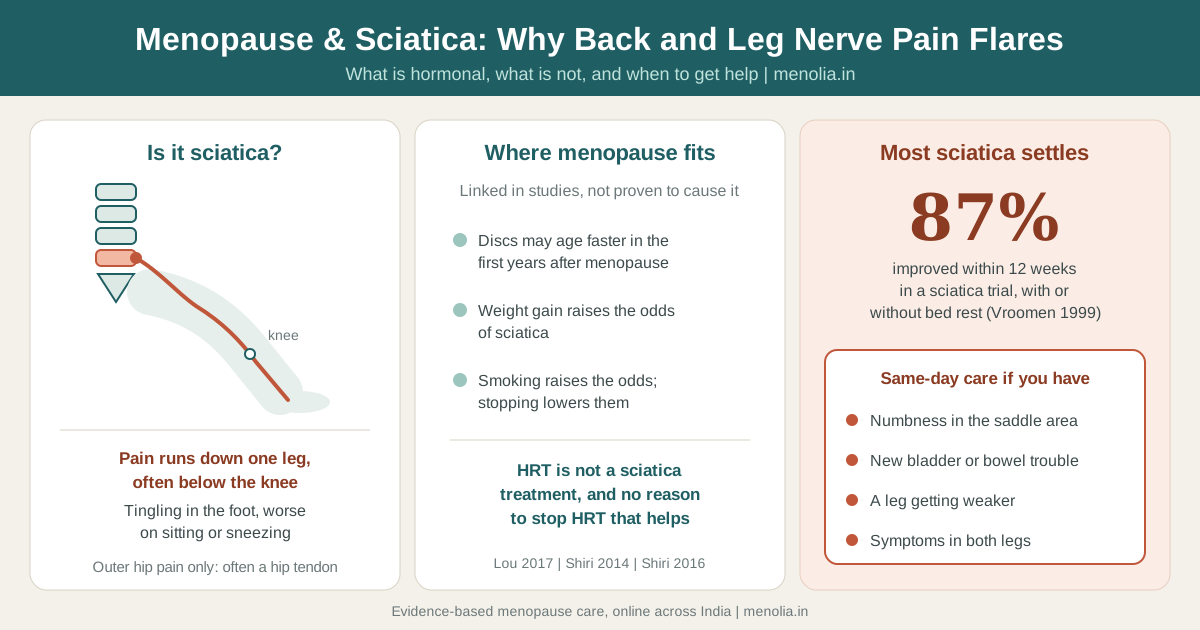
- Pain in the buttock that travels down one leg, often below the knee
- Leg pain that is as bad as, or worse than, the back pain
- A burning, shooting or electric quality, sometimes with pins and needles or numbness in the foot
- Pain that is sharper when sitting for long, bending forward, coughing or sneezing
How common it is depends on how it is counted. A review of 23 studies found estimates that ranged from 1.2% to 43%. The authors suggested this may be due to differences in definitions, methods of data collection and perhaps the populations studied (Konstantinou K et al., Spine, 2008, PMID 18923325). Whatever the exact figure, it is a common problem.
Does Menopause Cause Sciatica?
No study has shown that menopause directly causes sciatica. What the research does show is a set of connections between menopause and the lower spine. All of them come from observational studies, which can show that two things go together but cannot prove that one causes the other.
Discs may change faster after menopause
A Chinese MRI study of 1,566 women and 1,382 men of similar ages, all admitted to hospital with low back pain, found that before menopause, women had less disc degeneration than men of the same age. After menopause, women had more severe disc degeneration than age-matched men, and more than premenopausal or perimenopausal women. The link was seen in roughly the first 15 years after menopause. The authors suggested that oestrogen deficiency might be a risk factor and said more research was needed to separate the effect of menopause from the effect of age (Lou C et al., Menopause, 2017, PMID 28609385).
There is an important limit here. Disc degeneration on a scan does not mean it is causing symptoms. A review of 33 imaging studies in 3,110 people with no back pain found disc degeneration in 37% of 20-year-olds and 96% of 80-year-olds, and disc bulges in 30% of 20-year-olds and 84% of 80-year-olds (Brinjikji W et al., AJNR Am J Neuroradiol, 2015, PMID 25430861). Many of these changes are part of normal ageing and cause no pain at all.
Back pain becomes more common in women after 50
A review that pooled 98 studies with 772,927 people found that women report low back pain more often than men at every age, and that the gap widens after the age of menopause. Weighted by study size, women were about 1.13 times as likely as men to report back pain between 20 and 50, and about 1.28 times as likely from 50 onwards (Wáng YX et al., Quant Imaging Med Surg, 2016, PMID 27190772). This was back pain in general, not sciatica specifically.
A slipped vertebra is more common in women
In the Copenhagen Osteoarthritis Study, spine X-rays of 4,151 adults showed degenerative spondylolisthesis in 8.4% of women and 2.7% of men. In the women, age at menopause and the number of childbirths were not linked to it, but a higher body mass index (BMI) was (Jacobsen S et al., Spine, 2007, PMID 17202902). A slipped vertebra can narrow the space for the nerves and cause leg pain, especially on walking.
Weight and smoking: the factors you can change
Weight gain is common around menopause, and weight matters for sciatica. A meta-analysis of 26 studies found that obesity raised the odds of doctor-diagnosed sciatica by about 31% and being overweight by about 12%, with a stepwise pattern and similar findings in men and women (Shiri R et al., Am J Epidemiol, 2014, PMID 24569641). Our guide to menopause weight gain explains what helps at this stage.
Smoking matters too. Across 28 studies, current smokers had 46% higher odds of sciatica or nerve-root leg pain, while former smokers had only slightly higher odds (15%) than people who never smoked (Shiri R et al., Am J Med, 2016, PMID 26403480). Stopping appears to reduce, though not completely remove, that extra risk.
What this adds up to
My reading of the evidence: menopause is, at most, one background factor. Discs and spinal joints that have aged, a few extra kilos, smoking, and how much we sit, bend and lift all play a part. Falling oestrogen has not been shown to trigger sciatica directly. So when sciatica appears at this age, the questions to answer are what is pressing on the nerve and what will help it settle.
Not sure whether your back and leg pain is part of menopause or something that needs a spine specialist? Write down where the pain travels, what makes it worse and any numbness, and we can go through it together, along with the rest of your midlife health, over a video call. Message Dr. Suganya on WhatsApp for a Rs 399 video consultation.
Is It Sciatica, or Something Else?
Several common midlife problems cause leg pain and get called “sciatica” by family and friends. The pattern of the pain is the best clue.
| What you feel | What it may point to |
|---|---|
| Pain from the buttock down one leg, often below the knee, with tingling; worse sitting, bending or sneezing | Sciatica from a nerve root in the lower back |
| Heaviness, aching or numbness in one or both legs when you walk or stand, eased by sitting down or bending forward | Lumbar spinal stenosis |
| Pain on the outer side of the hip, sore to lie on that side, sometimes spreading down the outer thigh | Greater trochanteric pain syndrome (a hip tendon and bursa problem) |
| Pain in the groin or front of the thigh, stiffness when sitting cross-legged or putting on footwear | Hip osteoarthritis |
| Burning, tingling or numbness in both feet, starting at the toes | Nerve damage from diabetes or low vitamin B12 |
| A sudden hard knot in the calf at night, or an urge to keep moving the legs | Leg cramps or restless legs |
| Legs that feel heavy and achy by evening, with ankle swelling or visible veins | Venous insufficiency or varicose veins |
| Sudden sharp back pain after a small bend or lift, especially with known osteoporosis | A vertebral compression fracture |
A few of these deserve a word more.
Hip-side pain is very common in women. In a community study of 3,026 adults aged 50 to 79, pain and tenderness over the outer hip on one side (greater trochanteric pain syndrome) was found in 15.0% of women and 6.6% of men (Segal NA et al., Arch Phys Med Rehabil, 2007, PMID 17678660). It can be mistaken for sciatica, but the treatment is different, so it is worth asking your doctor or physiotherapist to examine the hip itself. If the pain is deeper, in the groin, our post on HRT and osteoarthritis explains what treats an arthritic joint.
Both feet burning or tingling usually points away from a single pinched nerve root and towards the nerves themselves. Low vitamin B12 is one possible treatable cause that a doctor should assess without delay, since nerve symptoms from low B12 may not fully recover if treatment starts late. Our post on menopause and vitamin B12 has more detail. Diabetes is the other cause to check, and our guide to menopause and blood sugar lists the tests to ask for.
Night leg pain is often a cramp or restless legs rather than a nerve. Our post on leg cramps and restless legs in menopause explains how to tell the two apart. Heavy, achy legs at the end of a day spent standing are more often about the veins, covered in our post on menopause and varicose veins.
New back pain after a minor strain needs prompt assessment if you have osteoporosis or have noticed loss of height. Vertebral fractures can happen without a fall, as our osteoporosis prevention guide explains.
Red Flags: When Back or Leg Pain Needs Same-Day Care
Most sciatica settles with time. A small number of people develop pressure on the bundle of nerves at the bottom of the spinal canal, called cauda equina syndrome, which needs emergency care. A review of 105 articles proposed that the diagnosis requires one or more of these: bladder or bowel dysfunction, reduced sensation in the “saddle” area, and sexual dysfunction, sometimes with weakness or numbness in the legs (Fraser S et al., Arch Phys Med Rehabil, 2009, PMID 19887225).
Go to an emergency department immediately if you have back or leg pain with any of these:
- Numbness or a strange feeling around the genitals, anus, buttocks or inner thighs (the area that would touch a saddle)
- New difficulty passing urine, losing control of urine or stools, or not feeling when your bladder is full
- Leg weakness that is getting worse, or a foot that slaps or drags when you walk
- Sciatica symptoms in both legs at the same time
Get medical help the same day if new back pain comes with a fever, as this can occasionally be a sign of an infection in the spine. If you have ever had cancer, see a doctor the same day about new back pain, and go to an emergency department immediately if it comes with pain travelling down the leg, numbness or weakness. See a doctor promptly (within days, not weeks) if back pain comes with unexplained weight loss or severe pain that does not ease with rest or lying down. These are uncommon, but they are the reason to know the pattern.
What Helps Sciatica
Time, and staying as active as you can
The single most reassuring fact about sciatica is how often it improves. In a Dutch trial, 183 people with sciatica were randomly assigned to two weeks of bed rest or to “watchful waiting”. Bed rest was no better, and after 12 weeks 87% of people in both groups reported improvement (Vroomen PC et al., N Engl J Med, 1999, PMID 9971865). A Cochrane review later found little or no difference in pain or function between advice to rest in bed and advice to stay active for people with sciatica (Dahm KT et al., Cochrane Database Syst Rev, 2010, PMID 20556780).
In practice, that means you do not need to lie in bed for days. Move as much as pain allows, rest in comfortable positions when you need to, and build up gradually.
Physiotherapy and exercise
A physiotherapist can show you positions that ease leg pain, gentle nerve and back exercises, and how to return to walking, housework and work. Evidence on which exercises work best for sciatica is limited, so the best programme is one you can keep doing. Once the worst has settled, building general strength is worthwhile at this age for your back, bones and balance, and our post on strength training after 45 shows how to start safely.
Medicines
A systematic review of the medicines commonly given for sciatica in primary care, including anti-inflammatories, steroids, antidepressants, anticonvulsants, muscle relaxants and opioids, found that the evidence was of moderate to low quality and their benefit was unclear (Pinto RZ et al., BMJ, 2012, PMID 22331277).
Pregabalin is often prescribed for nerve pain. In a trial of 209 people with sciatica, it did not reduce leg pain more than a placebo at 8 weeks or at one year, and dizziness was more common with pregabalin (Mathieson S et al., N Engl J Med, 2017, PMID 28328324). If you already take pregabalin or gabapentin, do not stop it suddenly on your own. Ask the doctor who prescribed it how to review or reduce it.
Some people find that a painkiller, used for a short time as their doctor advises, makes the worst days easier and helps them keep moving. Anti-inflammatory tablets such as ibuprofen or diclofenac are not suitable for everyone after 50, especially with high blood pressure, kidney disease, stomach ulcers or blood thinners, so check with your doctor first.
Injections
Epidural steroid injections are sometimes offered when leg pain is severe. A meta-analysis of 23 placebo-controlled trials found a small reduction in leg pain in the short term (up to about three months), with smaller effects at a year that were not statistically significant (Pinto RZ et al., Ann Intern Med, 2012, PMID 23362516). They can help some people through a bad phase, but there is no clear evidence that they change how things stand a year later.
Surgery
Surgery to remove the part of the disc pressing on the nerve (discectomy) is an option when pain stays severe despite time and treatment, or when there is significant weakness. In a Dutch trial of 283 people with severe sciatica for 6 to 12 weeks, early surgery relieved leg pain faster than prolonged non-surgical care. By one year, outcomes were similar: the chance of reporting recovery was 95% in both groups, and 39% of those in the non-surgical group ended up having an operation (Peul WC et al., N Engl J Med, 2007, PMID 17538084). A 2023 meta-analysis reached a similar conclusion: discectomy reduced leg pain moderately in the first three months, but the difference was negligible by 12 months, and the certainty of the evidence was very low to low (Liu C et al., BMJ, 2023, PMID 37076169).
So surgery is a reasonable choice for some women, made with a spine surgeon, based on how much the pain limits your life and how fast you want relief. It is rarely urgent unless one of the red flags above is present.
Do you need an MRI?
Not usually at the start. Because disc bulges are so common in people with no pain, an early MRI often shows changes that do not explain your symptoms. Scans are useful when red flags are present, when pain or weakness is not improving after several weeks, or when injections or surgery are being considered. If you already have a report that says “disc bulge” or “degenerative changes”, take it to a spine specialist to interpret alongside your examination.
Where HRT Fits
No trial has tested HRT as a treatment for sciatica, so it is not used for that purpose.
The closest evidence looks at disc height. In a further analysis of a two-year trial in 355 postmenopausal women, those given HRT had a small increase in disc height compared with their starting measurement, but the differences between the HRT and placebo groups were not statistically significant (Stevenson TEJ et al., Climacteric, 2023, PMID 36626929). The discs measured were between the lowest thoracic and third lumbar vertebrae (T12 to L3), and the study reported disc height, not back or leg pain.
A Swedish survey that did ask about back pain found no sign of benefit. Among women aged 55 and 56, current HRT users reported slightly more back pain than non-users (48% compared with 42%), a weak association that the authors considered probably of minor clinical importance (Brynhildsen JO et al., Spine, 1998, PMID 9563112).
My advice: decide about HRT based on your hot flushes, sleep, mood, bone health and overall risk profile, not on sciatica. If HRT is helping your other symptoms, sciatica is not a reason to stop it. Our guide to HRT in India walks through that decision.
Practical Steps for Daily Life
These are simple changes that many women find make a flare easier to live with. None of them needs special equipment.
- Keep moving in short spells. Several short walks through the day are often easier to manage than one long one while the pain is bad.
- Break up long sitting. Stand up every 30 to 45 minutes at work, in front of the TV or at a function. If sitting cross-legged on the floor or on a low stool sets off the leg pain, use a chair with a back for now.
- Lift close and low. For water pots, buckets, a gas cylinder or a grandchild, bend your knees, hold the load close to your body and turn with your feet rather than twisting at the waist. Ask for help with the heaviest loads while the pain is bad.
- Find a comfortable sleeping position. Lying on your side with a pillow between the knees, or on your back with a pillow under the knees, is more comfortable for many people.
- Break long two-wheeler or car journeys if they bring the pain on.
- Work on weight and strength gradually, once the worst has settled.
- Stop smoking. Smokers have higher odds of sciatica, and stopping also protects your heart and bones.
- Keep a short symptom note: where the pain travels, any numbness or weakness, and what makes it better or worse. It makes a consultation far more useful.
Who to see: for persistent sciatica, an orthopaedic or spine surgeon, a neurologist, or a physical medicine and rehabilitation (PMR) doctor, along with a physiotherapist. Orthopaedics departments in government medical college and district hospitals see sciatica, and many medical colleges also have a PMR department.
Sciatica in Hindi, Tamil and Telugu
Many women describe sciatica in their own language, and family members often use words for back pain and nerve pain together.
| Language | Term | Notes |
|---|---|---|
| Hindi | kamar dard (कमर दर्द) | Lower back pain |
| Hindi | nas dabna (नस दबना) | Literally “a pressed nerve”, a common way of describing sciatica |
| Tamil | iduppu vali (இடுப்பு வலி) | Pain in the waist and lower back |
| Tamil | narambu vali (நரம்பு வலி) | Nerve pain; kaal narambu vali is nerve pain in the leg |
| Telugu | nadumu noppi | Lower back and waist pain |
| Telugu | naraala noppi | Nerve pain |
Whichever words you use, the questions that matter are the same: does the pain travel below the knee, is there numbness or weakness, and are there any of the red flags above?
Frequently Asked Questions
Can menopause cause sciatica?
Menopause has not been shown to cause sciatica directly. Studies link menopause with faster disc degeneration and more back pain in women after 50, but these are observational findings, and disc changes on scans are common in people with no pain. Weight gain, smoking, age-related changes in the spine and daily load are clearer factors.
How long does sciatica last?
Most sciatica improves over weeks to a few months. In one trial, 87% of people reported improvement within 12 weeks, and in another, 95% reported recovery at one year, whether they were assigned to early surgery or to non-surgical care first. Pain that is not improving after several weeks, or any weakness or numbness that is getting worse, should be reviewed by a doctor.
Will HRT help my sciatica?
There is no evidence that HRT treats sciatica. One trial found a small increase in disc height with HRT that was not significantly different from placebo, and it reported disc height, not pain. Decide about HRT for your other menopause symptoms and long-term health, and treat sciatica on its own terms.
Kamar se pair tak dard menopause mein kyon hota hai?
Pain that runs from the lower back (kamar) down one leg is usually sciatica, caused by a nerve root being pressed in the lower spine, most often by a disc. Menopause has not been shown to cause it directly, though disc changes, weight gain and smoking can add to the risk. If the pain goes below the knee or comes with numbness, see a doctor for an examination.
Do I need an MRI for sciatica?
Not usually in the first few weeks. Disc bulges show up on scans in many people without pain, so an early MRI can confuse more than it helps. An MRI is useful if there are red flags, if the pain is not improving after several weeks, or if an injection or surgery is being considered.
Is it safe to exercise or do yoga with sciatica?
Gentle movement is generally safe and helps you recover your normal activity. Avoid any pose or exercise that sends the pain further down the leg, and build up slowly. A physiotherapist can suggest movements suited to your back. Stop and seek advice if you notice new numbness or weakness.
When is sciatica an emergency?
Go to an emergency department immediately if back or leg pain comes with numbness around the genitals, anus or inner thighs, new trouble passing or controlling urine or stools, leg weakness that is getting worse, or symptoms in both legs. These can be signs of cauda equina syndrome, which needs urgent treatment.
Sciatica is painful and it can be frightening when it arrives in the middle of everything else menopause brings. For most women it settles with time, movement and the right support. The habits that lower the odds of sciatica, a healthy weight and not smoking, along with steady strength, protect the rest of your midlife health too. If you would like help making sense of your symptoms, your blood tests or HRT decisions alongside the care you get from your spine or orthopaedic doctor, I see women across India online.
Chat with Dr. Suganya on WhatsApp
Related reading: Menopause Body Aches: Why Everything Hurts After 45 · Menopause Joint Pain: Why It Happens After 40