You wake up with a dry, tight feeling inside your nose. There is a small crust that you cannot leave alone, and when you blow your nose there is a streak of blood on the tissue. A week later, while you are bending over the sink, a few drops fall on the steel and you stand there pinching your nose, wondering why this is happening now, at 49, when it never happened before.
If your periods have become irregular or have stopped, it is natural to wonder whether menopause is behind this too. Many women I see already know about vaginal dryness and dry eyes. Very few have been told that the lining of the nose is another moist surface that can change in midlife.
I’m Dr. Suganya Venkat, and in more than 15 years as an OB-GYN I have heard women mention nosebleeds almost in passing, often at the end of a consultation about hot flushes or sleep. This post covers what the research says about menopause and the nose (including where the evidence is thin), why most nosebleeds at this age come from a dry, fragile spot near the front of the nose, how to stop one properly, and the situations where you should see a doctor, especially if you have high blood pressure or take a blood thinner.
Why Nosebleeds Happen in the First Place
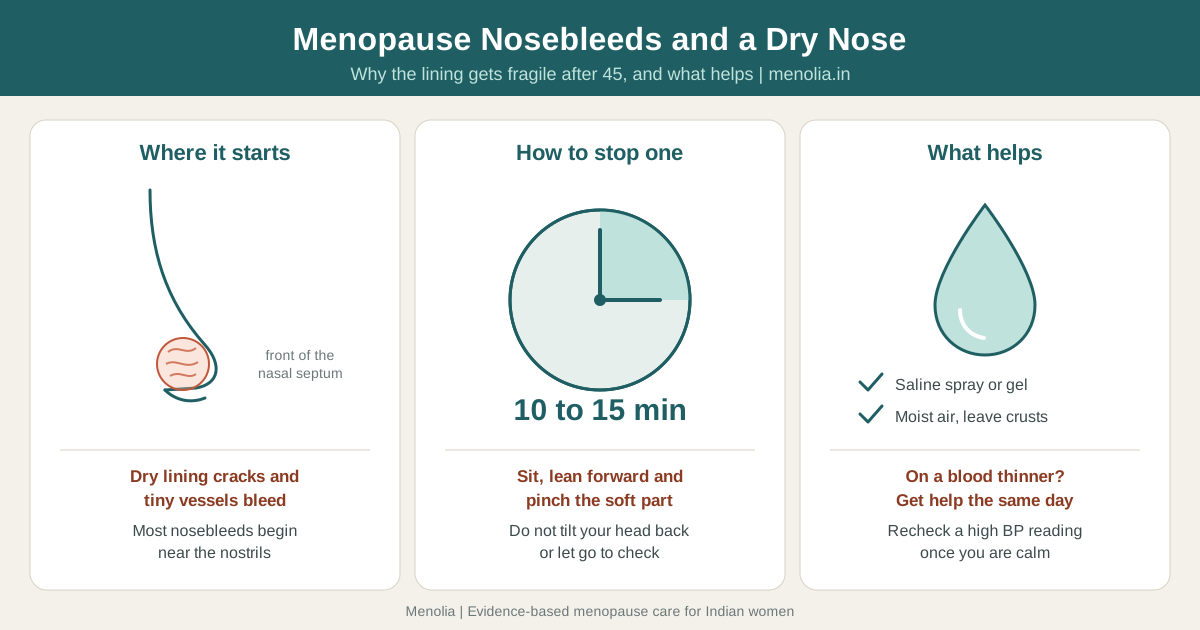
The front part of the wall that divides your two nostrils (the septum) carries a dense web of tiny blood vessels sitting just under a thin lining. Most everyday nosebleeds start here. When that lining dries out, it cracks and forms crusts. Picking at a crust, rubbing the nose or blowing hard tears the lining, and one of those tiny vessels bleeds. Less often, bleeding comes from further back inside the nose. The NHS notes that these deeper bleeds usually affect adults and are the ones more likely to need medical attention.
The NHS lists a dry nose, picking and hard blowing as the common causes, and names adults over 45 and people with high blood pressure among those more likely to get nosebleeds (nhs.uk, nosebleed page, reviewed December 2023). The main guideline on nosebleeds, from the American Academy of Otolaryngology, estimates that at least 60% of people in the United States have a nosebleed at some point and that only about 6% of them seek medical attention (Tunkel DE et al., Otolaryngol Head Neck Surg, 2020, PMID 31910122).
So a nosebleed after 45 is common, and most are minor. The useful questions are why your lining has become drier and more fragile, and whether anything else is making bleeding easier.
Does Menopause Make the Nose Drier?
The lining of the nose responds to female hormones, and there is some evidence that it works less efficiently after menopause. What has not been shown is that menopause directly causes nosebleeds. Here is what the studies show, and what they do not.
The nose clears mucus more slowly after menopause. The lining of the nose is covered with tiny hair-like structures that sweep a thin layer of mucus towards the throat, keeping the surface moist and clean. Doctors measure this with a simple saccharin test: a tiny particle is placed inside the nose and the time until you taste sweetness is recorded. In a study of 60 women, this took about 11.4 minutes on average before menopause and 16.8 minutes after it, and the longer a woman had been postmenopausal, the slower it became (Soylu Özler G et al., Eur Arch Otorhinolaryngol, 2015, PMID 24895211). A second study of 50 women found a similar gap, 11.8 against 18.6 minutes, with slower clearance linked to lower oestradiol and higher FSH levels (Hepkarsi S et al., Otolaryngol Head Neck Surg, 2026, PMID 41221842).
The change also shows up after the ovaries are removed. In 47 women who had both ovaries removed in their early forties, clearance time rose steadily from 12.6 minutes before surgery to 19.4 minutes at one year (Gumussoy S et al., Eur Arch Otorhinolaryngol, 2020, PMID 32592009). Because this was the same group of women followed over time, it is harder to explain the change by age alone.
Older women report more nasal symptoms, but the bleeding link is weaker. In a French study of 2,197 women aged 50 to 64 followed for a year, 16.5% noticed traces of blood from the nose and 7.6% had a proper nosebleed. Rhinitis (a runny or blocked nose) was more common in women who had reached menopause, while nosebleeds were linked to breathing in other people’s cigarette smoke (Lund VJ et al., Rhinology, 2006, PMID 16550946).
Oestrogen may help protect nasal blood vessels. In Wales, where hospital admissions for nosebleeds were tracked across 26,725 patients over 18 years, women between 15 and 49 were admitted about half as often as men of the same age, and admissions rose for everyone from age 40. The authors suggested that oestrogen may protect the blood vessels of the nose, as it does elsewhere, but their data could not prove it (Fishpool SJ, Tomkinson A, Ann R Coll Surg Engl, 2012, PMID 23131225).
Putting this together: a slower, drier nasal lining after menopause is plausible and has some measured support from small studies. But no study has shown that menopause on its own causes nosebleeds, and the factors with clearer evidence are a dry environment, picking and blowing, smoke exposure, nasal sprays and medicines that affect clotting. For the same story in other moist surfaces, see our posts on dry eyes in menopause and dry mouth after menopause.
Other Things That Make the Nose Bleed More Easily After 45
Before blaming hormones, it helps to go through this list. Often there is more than one factor.
| Factor | Why it matters |
|---|---|
| Air-conditioning, fans, cold or dry weather | Dry air dries the lining further, so it cracks and crusts more |
| Steroid nasal sprays for allergy | A large review of 72 trials found nosebleeds were about 1.5 times as common with these sprays as with a dummy spray (Wu EL et al., Otolaryngol Head Neck Surg, 2019, PMID 30779679) |
| Decongestant sprays used for weeks | MedlinePlus lists overuse of these sprays as a cause of nosebleeds (medlineplus.gov, nosebleed, reviewed July 2025) |
| Allergic rhinitis, colds and sneezing | Irritation and frequent blowing damage the lining |
| Blood thinners: aspirin, clopidogrel, warfarin, apixaban, rivaroxaban, dabigatran | Make bleeding start more easily and last longer |
| Second-hand smoke at home | Linked to nosebleeds in the French study of women aged 50 to 64 above; your own smoking also irritates the lining |
| Sjögren’s syndrome | An autoimmune condition that dries the eyes, mouth and nose |
Sjögren’s is worth a mention because it is easy to mistake for menopause dryness. In a small study, a third of people with Sjögren’s syndrome had visibly dry nasal lining, and none of the matched controls did (Kamel UF, Maddison PJ, J Laryngol Otol, 2021, PMID 34420533). If your nose, eyes and mouth are all dry, and especially if you also have joint pain or swollen glands, read our guide to Sjögren’s syndrome and menopause and ask your doctor whether testing makes sense.
If a nosebleed problem began soon after you started an allergy spray, it is worth asking your doctor or pharmacist to check how you are using it, rather than stopping it on your own if it is helping your symptoms. Our post on new allergies after 45 covers why allergy symptoms can change around this time.
Noticing nosebleeds along with dry eyes, a dry mouth or other new changes and not sure how they fit together? We can go through your symptoms, your medicines and your blood pressure readings over a video call. Message Dr. Suganya on WhatsApp for a ₹399 video consultation.
High Blood Pressure and Nosebleeds
Many women are told that a nosebleed means their blood pressure is high. The evidence here is mixed.
A pooled analysis of 10 studies found that people with high blood pressure were more likely to have nosebleeds (odds ratio about 1.5), but the authors stressed that this does not show that high blood pressure causes them (Min HJ et al., Otolaryngol Head Neck Surg, 2017, PMID 28742425). Blood pressure is often high at the moment of a nosebleed, and a review of nine studies pointed out that the fright of seeing blood and the hospital setting can push the reading up. The authors added that this reading can still be the first clue to blood pressure that was already high (Kikidis D et al., Eur Arch Otorhinolaryngol, 2014, PMID 23539411). In one emergency department, 73% of people arriving with a nosebleed had a reading above 140/90, which fell to 26% after 30 minutes. In that study, taking a blood thinner was the main independent risk factor, and high blood pressure was not (Modesti CL et al., High Blood Press Cardiovasc Prev, 2024, PMID 39289332).
What this means for you:
- A high reading during a nosebleed is not, by itself, a diagnosis. Recheck your blood pressure once you have calmed down, and again over the following days. If a repeat reading after resting is still 180 or higher (top number) or 120 or higher (bottom number), get medical advice the same day. If a high reading comes with chest pain, severe breathlessness, weakness, numbness, confusion or difficulty speaking, go to an emergency department straight away.
- If readings stay above your target, see your doctor. Blood pressure tends to rise after menopause whether or not you have nosebleeds; our post on menopause and blood pressure explains why and what helps.
- Do not stop or skip your blood pressure tablets because of a nosebleed.
How to Stop a Nosebleed Properly
Most nosebleeds stop with correct first aid. The two common mistakes are tilting the head back and checking too soon.
- Sit down and lean forward, with your mouth open. Leaning forward stops blood running down your throat, which can make you feel sick.
- Pinch the soft part of your nose, just above the nostrils, firmly between your thumb and finger. The bony upper part is the wrong place.
- Hold the pressure for 10 to 15 minutes by the clock, breathing through your mouth. Do not let go to check whether it has stopped.
- A cold pack on the bridge of your nose may help a little, such as a bag of frozen peas wrapped in a cloth. The NHS notes that the evidence for this is not strong, so treat it as an extra to the pinch (nhs.uk, nosebleed page, reviewed December 2023).
For the next 24 hours, the NHS advises not blowing or picking your nose, avoiding hot drinks and alcohol, avoiding heavy lifting and strenuous exercise, and not lying flat.
When to get medical help
Go to the nearest emergency department (ask someone else to drive you) if:
- the bleeding has not stopped after 10 to 15 minutes of continuous pressure
- the bleeding is heavy, or you are swallowing a lot of blood
- you feel faint, dizzy or short of breath
- the nosebleed followed a blow to the head or face
Get medical help the same day if you take a blood thinner, even if the nosebleed stops. MedlinePlus advises emergency care for anyone on blood thinners who has a nosebleed, and the NHS advises seeing a doctor. Keep taking the tablet unless a doctor tells you otherwise: the nosebleed guideline advises treating the bleed itself first, and stopping a blood thinner is a decision for the doctor who prescribed it (Tunkel DE et al., Otolaryngol Head Neck Surg, 2020, PMID 31910122). If you take an anticoagulant and are also thinking about HRT, our post on HRT and blood thinners explains how the two fit together.
Book a routine appointment, ideally with an ENT doctor, if:
- you have nosebleeds more than once or twice a month
- the bleeding is always from the same side, especially with a blocked nose or unusual discharge on that side
- you feel tired, breathless or look paler than usual, which can be signs of anaemia
- you bruise easily or bleed for a long time after cuts or dental work
- close family members also have frequent nosebleeds
The guideline recommends examining the inside of the nose with a thin camera (nasal endoscopy) for people whose nosebleeds keep coming back despite treatment, or keep coming from one side, so the source can be found (Tunkel DE et al., 2020, PMID 31910122). When a bleeding point is found, it can usually be treated in the clinic, for example by sealing it with cautery under local anaesthetic. If you are bruising more easily as well, our post on easy bruising after 45 goes through the medicines, vitamin deficiencies and blood conditions worth checking.
How to Keep Your Nose Moist and Prevent Repeat Bleeds
Prevention is mostly about keeping the lining moist and leaving it alone while it heals.
- Use saline. MedlinePlus suggests a saline nasal spray and a water-based nasal gel to stop the lining drying out (medlineplus.gov, nosebleed, reviewed July 2025). Plain saline drops or sprays from the chemist are inexpensive and can be used a few times a day.
- Add moisture to the air. MedlinePlus also suggests a vaporiser indoors. If you sleep with the air-conditioner on, a bowl of water in the room and pointing the airflow away from your bed can help. Avoid sitting directly in front of a fan for long periods.
- Do not pick or rub crusts. Let saline soften them so they come away on their own. Keep your nails short if you tend to pick in your sleep.
- Blow gently, one nostril at a time.
- Be careful with oil or ghee nose drops. Putting oil drops into the nose is a common home remedy. A German review advised using oil-containing nose drops and sprays only with great caution, because these products have been linked to a rare lung condition called lipoid pneumonia. The risk is best documented for mineral oils such as liquid paraffin (Ganso M et al., Laryngorhinootologie, 2016, PMID 27504726). Saline and a water-based gel avoid that issue.
- Keep smoke out of the house. Both your own cigarettes and other people’s matter.
- Drink enough water through the day, especially in hot weather.
- Take blood pressure seriously and keep a record if your doctor has asked you to.
If a doctor examines your nose after a bleed, they may prescribe an antiseptic nasal cream for a short time to stop crusting. The NHS advises checking the cream’s ingredients first, as it may not be suitable if you have a peanut or soya allergy (nhs.uk, nosebleed page, reviewed December 2023).
Does HRT Help a Dry Nose?
HRT is not a treatment for nosebleeds, and I would not start it for this reason alone. The research points in both directions and is small.
In a study of 20 postmenopausal women who had a stuffy, uncomfortable nose, six months of HRT improved their nasal symptoms, the appearance of the lining and mucus clearance (Nappi C et al., Menopause, 2004, PMID 15243283). But another study of 20 women starting HRT found no measurable change in any nasal test after about three months (Wild DC et al., J Laryngol Otol, 2008, PMID 18267047). Neither study looked at nosebleeds.
If you are considering HRT for hot flushes, sleep, mood or bone health, a more comfortable nose may be a small bonus for some women, but it is not a reason in itself. Our guide to HRT in India walks through that decision.
Nosebleed and Dry Nose in Tamil, Hindi and Telugu
Many women search for this in their own language, often typed in Roman letters:
| Language | Common words and search terms |
|---|---|
| Hindi | Naak se khoon aana (नाक से खून आना); nakseer (नकसीर); menopause me naak se khoon; naak sukhna (dry nose) |
| Tamil | Mookil ratham varuthal (மூக்கில் ரத்தம் வருதல்); mooku varatchi (dry nose) |
| Telugu | Mukku nundi raktam; mukku endipovadam (dry nose) |
Whatever words you use, the details that help a doctor most are which side bleeds, how often, how long each bleed lasts, and which medicines you take.
Practical Takeaways
- Most nosebleeds after 45 start at the front of the nose, where a dry, cracked lining tears easily.
- Menopause may make the nasal lining drier and slower to clear, but a direct link to nosebleeds has not been proven.
- To stop one, sit, lean forward and pinch the soft part of your nose for 10 to 15 minutes without letting go.
- Saline, moist air and leaving crusts alone can help reduce repeat bleeds linked to dryness and irritation.
- Recheck a high blood pressure reading once you are calm, rather than treating the reading taken mid-bleed as final.
- If you take a blood thinner, see a doctor the same day after a nosebleed and do not stop the tablet on your own.
- Frequent or one-sided nosebleeds deserve a look inside the nose by an ENT doctor.
Frequently Asked Questions
Can menopause cause nosebleeds?
Menopause has not been shown to cause nosebleeds directly. Small studies show that the nasal lining clears mucus more slowly after menopause, which may leave it drier and easier to crack. Dry air, picking, hard blowing, nasal sprays, smoke and blood thinners have clearer links with nosebleeds.
Why is my nose so dry and crusty after menopause?
Lower oestrogen may play a part, since the nasal lining responds to female hormones and works more slowly after menopause in small studies. Air-conditioning, fans, allergy sprays and decongestant sprays dry it further. If your eyes and mouth are also very dry, ask your doctor about Sjögren’s syndrome.
Menopause me naak se khoon kyon aata hai?
Nosebleeds (naak se khoon aana) around menopause usually come from a dry, fragile spot at the front of the nose. Dry air, picking, allergy sprays and blood thinners make it more likely. Saline drops, moist air and pinching the soft part of the nose for 10 to 15 minutes help most women.
Is a nosebleed a sign of high blood pressure?
Not necessarily. Blood pressure is often high during a nosebleed because of anxiety, and in one emergency study most high readings had come down within 30 minutes. Recheck your blood pressure once you are calm and over the following days, and see your doctor if it stays high.
What should I do if I get a nosebleed while taking aspirin or a blood thinner?
Use the same first aid: sit, lean forward and pinch firmly for 10 to 15 minutes. Go to an emergency department if it does not stop. Even if it does stop, get medical help the same day, and keep taking your tablet unless that doctor advises otherwise.
Will HRT stop my nosebleeds?
HRT is not a treatment for nosebleeds. One small study found that HRT improved nasal symptoms in women with a stuffy nose, while another found no change. Decide about HRT based on your other menopause symptoms and long-term health.
When should I see an ENT doctor?
See one if you have nosebleeds more than once or twice a month, if they always come from the same side, or if you have signs of anaemia such as tiredness or breathlessness. An ENT doctor can look inside your nose with a small camera and, if a bleeding vessel is found, can usually treat it in the clinic.
A nosebleed can be frightening, especially when it comes out of nowhere at a stage of life when so much else is already changing. Most of them come from a small dry patch that heals well with saline, moist air and a few days of leaving it alone, and the checks that matter most, your blood pressure and your medicines, are worth doing for the rest of your health too. If you would like help putting your nose, your blood pressure and your other menopause symptoms into one picture, alongside the care you get from your ENT doctor or physician, I see women across India online.