It starts with small things. Lifting the pressure cooker off the stove sends a sharp pain to the outer side of your elbow. Wringing out a wet dupatta, opening a tight jar of pickle or even holding a cup of tea at arm’s length makes it worse. Or it is your hand: you wake up and your ring finger is stuck bent, and when you straighten it there is a painful click, as if something has jumped over a bump. By mid-morning it moves more freely, but the click is still there.
You are in your forties or fifties, your periods have become irregular or stopped, and you are wondering whether this is menopause too, or the start of arthritis.
I’m Dr. Suganya Venkat. In more than 15 years as an OB-GYN, I have heard women describe both of these problems many times while we are talking about something else entirely, usually hot flushes or sleep. They are treated by orthopaedic doctors, hand surgeons and physiotherapists, but women in midlife often want to understand where they fit in the bigger picture. This post covers what tennis elbow and trigger finger are, what the research says about menopause, how to tell them apart from carpal tunnel and arthritis, and the treatments with the best evidence.
If your main problem is numbness or tingling in the fingers, our post on carpal tunnel in menopause covers that nerve problem. For a stiff, painful shoulder, see our guide to frozen shoulder.
Two Tendon Problems That Often Get Called “Arthritis”
Both conditions affect tendons, the tough cords that connect muscle to bone. Neither is a problem of the joint itself, which is why they are often misnamed as arthritis.
Tennis elbow (lateral epicondylitis)
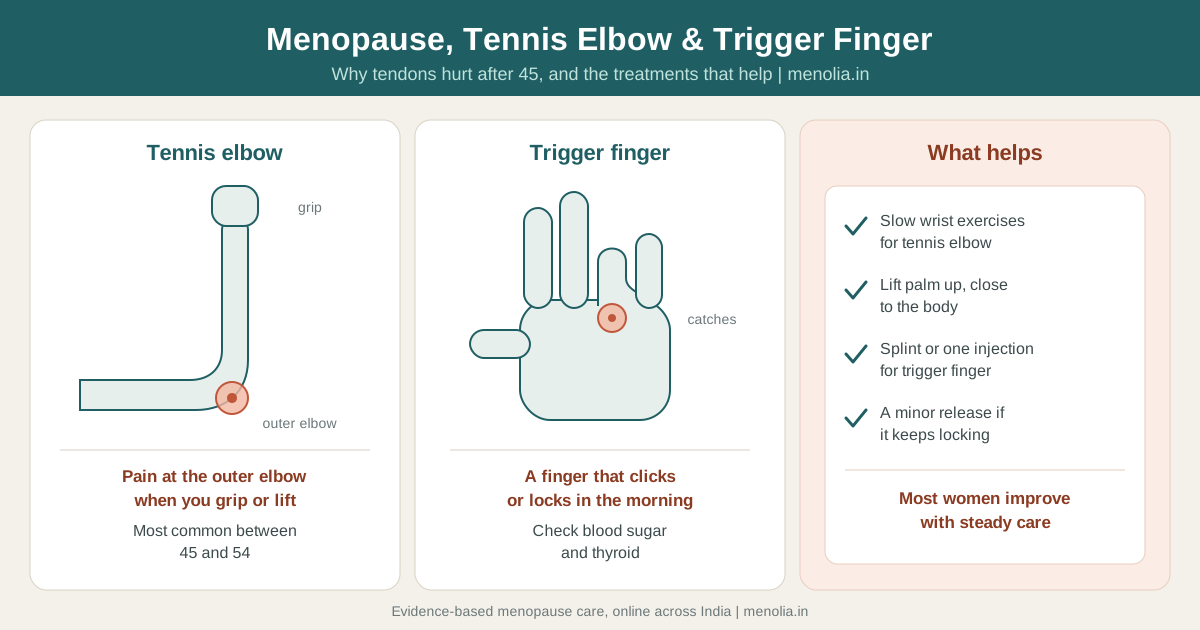
The muscles that lift your wrist and fingers backwards attach by a shared tendon to a bony point on the outer side of the elbow. With repeated gripping and lifting, that tendon attachment becomes irritated and slow to heal. Doctors now often call it lateral elbow tendinopathy. You do not need to play tennis to get it; gripping and lifting at home or at work is enough.
Typical signs:
- Pain on the outer side of the elbow, sometimes spreading down the forearm
- Worse when you grip, lift with the palm facing down, twist a lid or wring out cloth
- Tenderness when you press on the bony point at the outer elbow
- A weaker grip, so you may drop things or avoid carrying the heavy bag
The same problem on the inner side of the elbow is called golfer’s elbow (medial epicondylitis). It is less common and is managed in a similar way.
Trigger finger (stenosing tenosynovitis)
The tendons that bend your fingers run through a tunnel of tight bands in the palm, rather like a thread through a series of rings. If the tendon thickens or the first ring at the base of the finger narrows, the tendon catches as it slides. The finger clicks, snaps, or gets stuck bent and then suddenly straightens.
Typical signs:
- A click or catch when you bend or straighten a finger or thumb
- Stiffness and locking that is worst first thing in the morning
- A tender lump in the palm at the base of the affected finger
- In more advanced cases, the finger stays bent and needs the other hand to straighten it
Any finger or the thumb can be affected, and the ring and middle fingers are often involved.
Does Menopause Cause Tennis Elbow or Trigger Finger?
No study has shown that menopause directly causes either condition. What the research does show is that both peak around midlife, that trigger finger is clearly more common in women, and that oestrogen has some role in how tendons maintain themselves. The evidence on the hormone link itself is limited.
Tennis elbow peaks around the menopausal years, in both sexes. In a Finnish population study of 4,783 adults aged 30 to 64, 1.3% had definite tennis elbow at the time of examination. It was equally common in men and women and was most common between 45 and 54. Smoking, and work that combined repetitive and forceful arm movements, were both strongly associated with tennis elbow (Shiri R et al., Am J Epidemiol, 2006, PMID 16968862). Because men in their late forties get it just as often, age and load explain more of the pattern than hormones alone can.
Trigger finger is clearly more common in women. In 413 people aged 50 to 89, drawn at random from a Japanese town registry, the weighted prevalence of trigger finger was 9.7%, at 14.3% in women against 4.4% in men (Okita G et al., J Hand Surg Asian Pac Vol, 2022, PMID 35135427). In UK Biobank, which compared 2,250 people with trigger finger against nearly 400,000 without it, the condition was linked with older age, female sex, higher body weight, diabetes, an underactive thyroid, rheumatoid arthritis, carpal tunnel syndrome and Dupuytren’s disease (Guggenheim L et al., J Plast Reconstr Aesthet Surg, 2024, PMID 38776627).
Oestrogen does play a part in tendon upkeep. In a small study of 20 postmenopausal women, those taking oral oestrogen had a markedly higher rate of tendon collagen production at rest than women not taking it (Hansen M et al., J Appl Physiol, 2009, PMID 18927264). A 2026 review of tendon problems in active postmenopausal women noted that the tensile strength of tendons falls after menopause and that HRT may improve tendon composition (Bourhill J et al., Post Reprod Health, 2026, PMID 42554117). A 2026 literature review on overuse injuries in midlife women made the same point but warned that much of this research is observational and that focusing on oestrogen alone is too narrow (Ansari M et al., Ann Rehabil Med, 2026, PMID 42332940).
The clearest hormonal signal comes from breast cancer treatment. Aromatase inhibitors lower oestrogen further in postmenopausal women. In one hospital’s records, trigger finger was diagnosed in 5.1% of women with breast cancer taking these tablets, against 1.5% of women with breast cancer who were not (Regent-Smith AJ et al., Hand, 2023, PMID 34078170). A second centre found a rate of 4.5% on aromatase inhibitors against 2.75% across all its breast cancer patients (Hollins AW et al., Plast Reconstr Surg, 2023, PMID 36729073). If finger locking or hand stiffness began after starting letrozole, anastrozole or exemestane, tell your oncologist and do not stop the tablet on your own. Our post on menopause after cancer treatment has more on these side effects.
Putting this together, menopause may be one background factor in tendons that heal more slowly, but the factors with clearer evidence are age, repetitive gripping and lifting, smoking, body weight, and, for trigger finger, diabetes and thyroid disease.
Why diabetes and thyroid matter so much
Diabetes is one of the best-established links with trigger finger. In a study of about 1.1 million adults in southern Sweden, trigger finger and other hand problems were more common and arose more often in people with type 1 or type 2 diabetes than in people without it (Rydberg M et al., BMJ Open Diabetes Res Care, 2022, PMID 35046015). Since the risk of type 2 diabetes rises after menopause, a new trigger finger in your late forties is a good reason to check your HbA1c and fasting sugar. Our guide to menopause and blood sugar explains which tests to ask for. An underactive thyroid is also linked, and a TSH test is simple; see our post on thyroid changes during menopause.
Not sure whether your elbow or finger pain is part of something bigger? Note when it started, which tasks bring it on, and any other aches or symptoms, and we can go through it together, along with your blood tests and the rest of your midlife health, over a video call. Message Dr. Suganya on WhatsApp for a ₹399 video consultation.
Is It a Tendon, Arthritis or a Nerve?
Hand and elbow pain at this age has several possible causes, and the pattern tells you a lot.
| What you feel | What it may point to |
|---|---|
| Pain at the outer elbow when gripping or lifting with the palm down | Tennis elbow |
| Pain at the inner elbow when gripping or bending the wrist | Golfer’s elbow |
| A finger that clicks, catches or locks bent, with a tender lump in the palm | Trigger finger |
| Pain on the thumb side of the wrist when lifting a baby or twisting | De Quervain’s tenosynovitis, a related tendon problem |
| Night-time tingling or numbness in the thumb, index and middle fingers | Carpal tunnel syndrome |
| Tingling in the ring and little fingers, sometimes with elbow pain | Pressure on the ulnar nerve at the elbow |
| Bony knobs on the finger joints, pain at the base of the thumb | Hand osteoarthritis |
| Swollen, warm knuckles in both hands with more than an hour of morning stiffness | Inflammatory arthritis, such as rheumatoid arthritis |
| A firm cord in the palm that slowly pulls a finger down, usually without pain | Dupuytren’s disease |
Trigger finger and carpal tunnel syndrome often occur together, so you can have both. Numbness points to the nerve, while clicking and locking point to the tendon.
If both hands are swollen and stiff for a long time each morning, an inflammatory arthritis needs to be ruled out. Our post on menopause and autoimmune flares covers rheumatoid arthritis at this stage of life, and our guide to menopause joint pain covers the more general aches many women notice.
When to see a doctor promptly
- The same day: a finger that is red, hot and swollen along its length, painful to straighten, especially after a cut, thorn prick or fish bone injury, or with fever. This can be an infection of the tendon sheath and needs urgent treatment.
- Within a few days: a finger that has locked bent and will not straighten.
- After a fall on the elbow: get it checked the same day if the pain is severe, the elbow is swollen or you cannot fully bend or straighten it. Go to an emergency department straight away if the elbow looks out of shape, or if the hand turns cold, pale or numb, as these can be signs of a fracture or dislocation. A minor knock with mild pain that is steadily easing can be watched, but see a doctor if it is not clearly better within a few days.
- Within a week or two: numbness or weakness in the hand, both hands swollen and stiff, or pain that is not improving after six weeks of the steps below.
What Helps Tennis Elbow
Tennis elbow usually settles without surgery. The two best-known trials are reassuring about the long term, and they also changed how doctors think about steroid injections.
In a Dutch trial of 185 people, steroid injections gave the best results at six weeks (92% success, against 47% with physiotherapy and 32% with a wait-and-see approach). By one year the picture had reversed: success was 91% with physiotherapy, 83% with wait-and-see and 69% with injections, because symptoms came back often in the injection group (Smidt N et al., Lancet, 2002, PMID 11879861). An Australian trial of 198 people found the same pattern. Injections helped most at six weeks, but 47 of the 65 people who did well after an injection later relapsed. At one year, most people in both the physiotherapy and wait-and-see groups reported a successful outcome (Bisset L et al., BMJ, 2006, PMID 17012266).
A review of 41 trials across different tendon problems confirmed this pattern for tennis elbow: a large short-term gain, followed by worse results than no treatment at six months and one year (Coombes BK et al., Lancet, 2010, PMID 20970844). So a steroid injection is best kept for a short window when pain is stopping you from working or sleeping, after you have talked through the trade-off with your doctor.
Exercise
A review of 30 trials with 2,123 people found that exercise programmes did better than steroid injections on every outcome except short-term pain, though the advantage over other approaches was small and the certainty of evidence low (Karanasios S et al., Br J Sports Med, 2021, PMID 33148599). A physiotherapist usually starts with gentle holds and then slow, controlled wrist movements:
- Static hold: rest your forearm on a table with the hand over the edge, palm down. Press the back of your hand up into your other hand without moving, and hold for 30 to 45 seconds. Repeat 4 to 5 times.
- Slow lowering: holding a 500 ml water bottle, palm down, use your other hand to lift the wrist up, then lower it slowly on its own over about 3 to 4 seconds. Start with a few repetitions and build up over weeks.
- Mild discomfort during the exercise is acceptable. Pain that is worse the next morning means you did too much, so reduce the load.
Changing how you grip and lift
- Lift with your palm facing up, close to your body, rather than palm down at arm’s length
- Use both hands for the pressure cooker, the water bucket and heavy kadais
- Use the mixer instead of grinding by hand for a few weeks, and let the washing machine wring clothes
- Thicker handles on knives and ladles, or a cloth wrapped around them, need less grip force
- Take short breaks when typing or scrolling on your phone for long stretches
Recovery takes time. Many people improve over several months, so steady exercise and lighter loads pay off more than switching treatments every few weeks.
What Helps Trigger Finger
Mild trigger finger sometimes settles with rest from heavy gripping. When it does not, the main options are a splint, a steroid injection and a minor release procedure.
Splinting. A small splint that holds one joint of the finger straight can reduce pain and catching. A review recommended wearing it for 6 to 10 weeks, though it noted that more randomised trials are needed (Lunsford D et al., J Hand Ther, 2019, PMID 29290504). A hand therapist can fit one.
Steroid injection. Unlike tennis elbow, trigger finger responds well to an injection into the tendon sheath. A pooled analysis of six randomised trials with 368 people found success in about 64% of fingers injected with steroid, against about 28% with a control injection (Pathak SK et al., J Hand Surg Asian Pac Vol, 2022, PMID 35135421). An evidence-based guideline published in a hand surgery journal supports a single injection as a first treatment, with surgery as the next step if it fails or symptoms come back (Amirfeyz R et al., J Hand Surg Eur Vol, 2017, PMID 28488453).
If you have diabetes, two points matter. Injections work less well: in one trial, 25 of 29 fingers in people without diabetes improved after one or two injections, against 12 of 19 in people with diabetes (Baumgarten KM et al., J Bone Joint Surg Am, 2007, PMID 18056491). And blood sugar rises for a few days afterwards, most clearly on the first two days (Stepan JG et al., J Hand Surg Am, 2014, PMID 24679910), so check your sugars more often and tell your diabetes doctor before the injection.
Release procedure. If the finger keeps locking, the tight band at the base of the finger can be released, either through a small cut under local anaesthesia or with a needle. A 2026 review of 14 trials found both approaches effective. The needle method gave a quicker return to daily activities, and results at six months were similar (Huang KC et al., J Orthop Sci, 2026, PMID 41571568).
Where HRT Fits
I am not aware of any trial that has tested HRT as a treatment for tennis elbow or trigger finger, so it is not used for this purpose. The research points both ways. Small studies suggest oestrogen supports collagen turnover in tendons, as above. But a large health-records study of women aged 45 and over with tendon problems found that those using systemic HRT had slightly higher rates of some specific diagnoses, including tennis elbow (27.8% against 22.7% in matched women not using it). The authors noted that the differences were modest, and a records study of this kind cannot show cause (Bcharah G et al., Orthop J Sports Med, 2026, PMID 42212202).
So decide about HRT based on your hot flushes, sleep, mood, bone health and overall risk profile, and treat the tendon on its own terms. Our guide to HRT in India walks through that decision.
Practical Steps for Daily Life
- Reduce the load, but keep the hand moving. Complete rest makes tendons stiffer. Cut back on the tasks that hurt, and keep gentle movement through the day.
- Warm water in the morning. If your fingers are stiff and catching on waking, moving them gently in a bowl of warm water for a few minutes often helps.
- Spread kitchen work across the week. Rolling chapatis, chopping and grinding in one long session is hard on both elbow and fingers. Shorter sessions and shared tasks help.
- Carry loads close to the body. Shopping bags and buckets held at your side, with both hands where you can.
- Stop smoking if you smoke. It is one of the stronger risk factors for tennis elbow.
- Keep your whole body strong. Shoulder and upper-back strength takes some load off the elbow. Our post on strength training after 45 shows where to start.
- Get your sugar and thyroid checked if you have a trigger finger, especially if you have not had blood tests in the last year.
Who to see: an orthopaedic doctor or a physical medicine and rehabilitation (PMR) doctor, with a physiotherapist or hand therapist for exercises and splints. Government medical college and district hospitals have orthopaedic and physiotherapy departments that treat both conditions regularly.
Elbow and Finger Pain in Tamil, Hindi and Telugu
| Language | Common words | Notes |
|---|---|---|
| Tamil | muzhangai vali (முழங்கை வலி) | Elbow pain; viral (விரல்) is finger |
| Hindi | kohni mein dard (कोहनी में दर्द) | Pain in the elbow; ungli (उंगली) is finger |
| Telugu | mocheyi noppi | Elbow pain |
Many women simply call both problems arthritis. Whatever words you use, the useful details for a doctor are the same: which side of the elbow hurts, which finger clicks, whether there is numbness, and whether other joints are swollen.
Frequently Asked Questions
Can menopause cause tennis elbow?
Menopause has not been shown to cause tennis elbow. It is most common between 45 and 54, but it affects men and women equally at that age. Repetitive, forceful gripping and lifting, and smoking, have clearer evidence. Falling oestrogen may slow tendon repair, but this is still being studied.
Can menopause cause trigger finger?
In one Japanese study of people over 50, trigger finger was about three times more common in women than men, and it is more common in women taking aromatase inhibitors after breast cancer, which lower oestrogen further. That suggests hormones may play some part, but diabetes, an underactive thyroid, rheumatoid arthritis and carpal tunnel syndrome have stronger links.
Kohni mein dard menopause mein kyon hota hai?
Elbow pain (kohni mein dard) around menopause is most often tennis elbow, which peaks between 45 and 54. Repeated, forceful gripping and lifting in the kitchen and at work, along with smoking, are the main contributors. Exercise, lifting with the palm up and patience over a few months help most women.
Why is my finger stuck bent in the morning?
Morning locking is the typical pattern of trigger finger. The tendon swells a little overnight and catches in the tight band at the base of the finger. Moving the fingers in warm water often eases it. If the finger stays locked and will not straighten, see a doctor within a few days.
Is a steroid injection a good idea?
For trigger finger, a single injection helps about two in three people and is a standard first treatment. For tennis elbow, injections ease pain quickly but results at one year are worse than with physiotherapy or simply waiting, so they are best kept for short-term relief. If you have diabetes, check your sugars more often for a few days afterwards.
Will HRT help my tendons?
No trial has shown that HRT treats tennis elbow or trigger finger, and one large records study found slightly more tendon diagnoses in HRT users. Make the HRT decision on your other menopause symptoms and long-term health, and treat the tendon with exercise, splints or injections.
How long does tennis elbow take to heal?
Often several months. In two large trials, most people who had physiotherapy or simply waited reported a good result by one year. Steady exercise and lighter loads work better than repeated injections.
Tendon pain in the elbow or fingers can make ordinary tasks, cooking, washing, carrying a grandchild, feel like hard work, and it is easy to feel that your body is wearing out all at once. Most women recover with time, sensible changes to how they use their hands and a little patience, and the checks that matter most, blood sugar and thyroid, are worth doing for the rest of your health too. If you would like help making sense of your symptoms, your blood tests or the HRT question alongside the care you get from your orthopaedic doctor or physiotherapist, I see women across India online.
Chat with Dr. Suganya on WhatsApp
Related reading: Menopause & Plantar Fasciitis: Why Heels Hurt in the Morning · HRT and Osteoarthritis: Does It Help Joint Pain?