You had a Mirena fitted a couple of years ago, maybe for heavy periods, maybe for contraception. Now the hot flashes have arrived, the nights are broken, and your doctor has mentioned starting oestrogen. Then comes the next question: do you also need a progesterone tablet every day, or is the coil already doing that job?
Women ask me this often, and the answer is good news for most of them. I’m Dr. Suganya Venkat, an OB-GYN with more than fifteen years of practice, and in many women the Mirena already in place can serve as the progestogen part of hormone therapy, so the only thing added is oestrogen.
This post covers how a Mirena protects the womb lining, what its product licence says about using it with HRT, why the time limit is shorter than the one you may have been told for contraception, which other coils do not count, and when a tablet or capsule is still added.
If you want the background on why progestogen is needed in the first place, our guide on why HRT needs progesterone for endometrial protection explains it in full. This post stays with the coil.
Why Oestrogen Needs a Partner If You Have a Womb
Oestrogen thickens the lining of the womb (the endometrium). On its own, over months, that thickening can become endometrial hyperplasia, an overgrowth of the lining that can, in some women, progress towards cancer. Progestogen keeps the lining thin and stable.
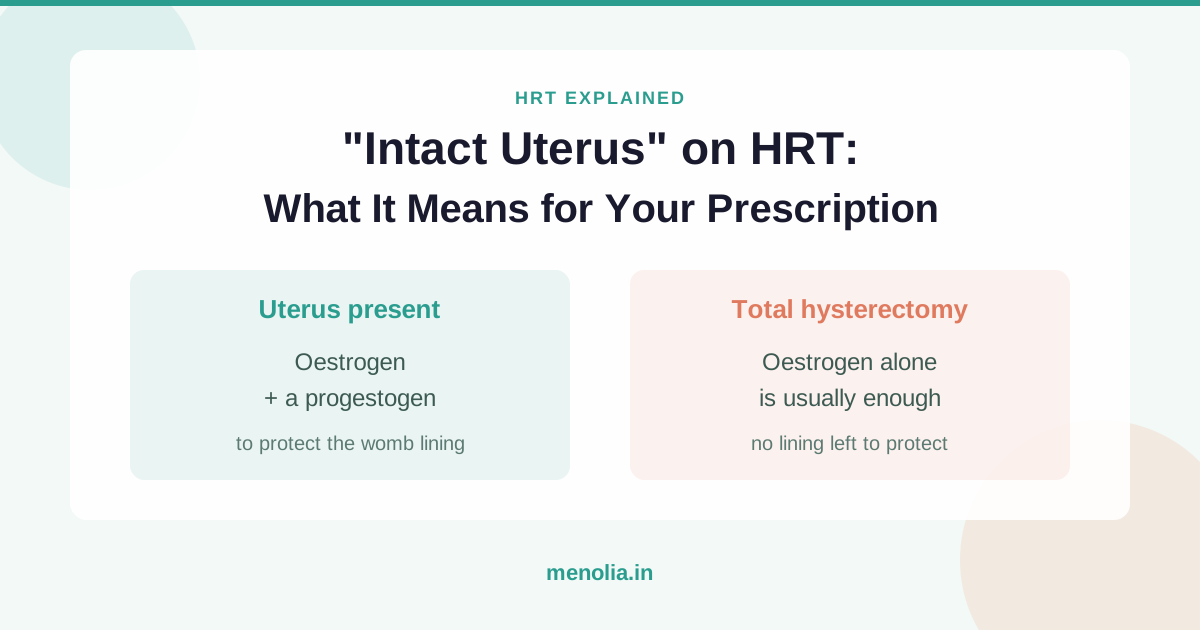
So the rule is simple. If you have had a hysterectomy, you usually take oestrogen alone. If you still have your womb, oestrogen is paired with a progestogen. That progestogen can come as a tablet, a capsule of micronised progesterone, a combined patch, or a hormone-releasing coil placed inside the womb.
The UK product information for Mirena puts a number on the risk it is guarding against: the rate of hyperplasia seen with oestrogen alone in its studies was “as high as 20%” (Mirena Summary of Product Characteristics, medicines.org.uk, text revised 25 September 2026). That is why the progestogen part is never optional for a woman with a womb, whatever form it takes.
What a Mirena Is, and Why It Works for HRT
Mirena is a levonorgestrel intrauterine system (LNG-IUS), a small T-shaped device that sits in the womb and slowly releases a progestogen called levonorgestrel. It contains 52 mg of levonorgestrel and releases about 20 micrograms a day in the first year, falling gradually after that, according to the same product information.
Because the hormone is released right where it is needed, the lining gets a strong local dose while the amount that reaches the rest of the body stays low. That is the practical reason many women prefer it: steady protection of the womb without a daily tablet, and often less of the bloating or low mood some women notice with oral progestogens.
The Mirena product information lists three licensed uses in the UK:
- Contraception
- Heavy menstrual bleeding with no other cause found (idiopathic menorrhagia)
- Protection from endometrial hyperplasia during oestrogen replacement therapy
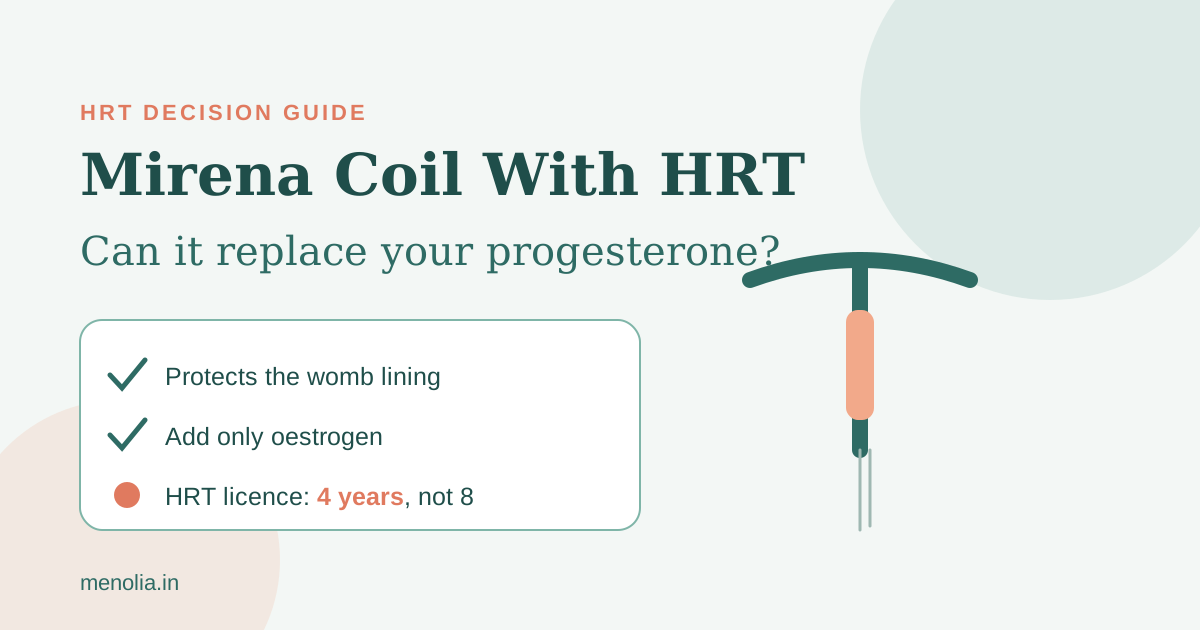
On the third, it states that Mirena “provides the progestogen component” of HRT and can be used with oral or transdermal oestrogen “without additional exogenous progestogens”. In plain words: with a Mirena in place, you add oestrogen as a tablet, patch, gel or spray, and you do not need a separate progesterone pill.
Does the Research Back It Up?
Yes. A systematic review and meta-analysis of six randomised trials, covering 518 perimenopausal and postmenopausal women on oestrogen, compared the LNG-IUS with progestogens taken by mouth (Somboonporn W et al., Menopause, 2011, PMID 21720280). The coil was comparable to other systemic progestogen regimens for protecting the lining, and more effective than one older regimen, sequential medroxyprogesterone acetate. Oestrogen with either option relieved menopause symptoms.
A later clinical review (Depypere H and Inki P, Climacteric, 2015, PMID 25553775) described the LNG-IUS as a highly effective way to reduce the hyperplasia risk of oestrogen, with added benefits for women in the transition: it still provides contraception, it helps with heavy bleeding, and many women stop bleeding altogether.
The Mirena product information also reports that, across clinical studies of 634 perimenopausal and postmenopausal users, no cases of endometrial hyperplasia were reported up to four years, and that protection was the same whether the oestrogen was taken orally or through the skin.
The Time Limit: 4 Years for HRT, Not 8
This is the detail most women have not been told, and it matters.
The Mirena licence gives different durations for different jobs:
| What the Mirena is being used for | Remove or replace by |
|---|---|
| Contraception | 8 years after insertion |
| Heavy menstrual bleeding | Up to 8 years (review if symptoms return after 5) |
| Endometrial protection with oestrogen (HRT) | 4 years after insertion |
Source: Mirena Summary of Product Characteristics, section 4.2, medicines.org.uk (text revised 25 September 2026).
The reason is that the coil releases less hormone each year (about 12 micrograms a day by year four, down from about 20), and the product information says clinical data for the HRT use beyond four years are limited. Contraception needs less hormone than protecting a lining that oestrogen is actively stimulating, so the contraceptive licence runs longer.
What this means for you: if your Mirena went in for contraception five or six years ago and you are now starting oestrogen, do not assume it still covers you. Note the insertion date and take it to your gynaecologist. They may suggest replacing the coil, or adding a progestogen for now. Some specialists do use a coil beyond the licensed period in particular situations; that is a decision to make with your own doctor, who knows your history.
A practical tip from my consultations: write the date the coil was fitted, and the reason, somewhere you will find it. Many women in their late forties cannot remember whether it was 2019 or 2021, and that single date decides the plan.
Not Every Hormonal Coil Counts
Only the 52 mg levonorgestrel system is licensed for protecting the lining during HRT. Smaller hormonal coils, such as Kyleena (19.5 mg levonorgestrel), are licensed for contraception only (Kyleena Summary of Product Characteristics, medicines.org.uk). They release less hormone and have not been licensed for this purpose.
The copper coil (Cu-T) contains no hormone at all, so it gives no protection to the lining. If you have a copper coil and start oestrogen, you still need a separate progestogen.
If you are not sure which coil you have, the clinic or hospital where it was fitted will have the record. The name on the box matters here.
Have a Mirena and thinking about starting HRT? Bring your insertion date and any recent scan or blood reports, and we can work out together over a video call whether your coil covers you and which oestrogen suits you. Message Dr. Suganya on WhatsApp for a ₹399 video consultation.
When a Tablet or Capsule Is Still Added
A Mirena handles the progestogen part in most women, but there are situations where your doctor may still add or switch to oral progestogen:
- The coil has passed its HRT window. If it is more than four years old and replacement is not convenient right now, a tablet or capsule can cover the gap.
- The coil has moved or come out. Expulsion is uncommon but happens. Heavier bleeding or not being able to feel the threads are reasons to get the position checked, usually with an ultrasound.
- You would rather not have a coil. Some women find insertion uncomfortable or simply prefer tablets. Micronised progesterone or dydrogesterone are common alternatives in India; our post on Susten and Duphaston in menopause HRT explains these.
- Your doctor wants a different plan for another reason. Fibroids that distort the womb, for example, can affect how well a coil sits. Your gynaecologist will weigh this with your scan.
Bleeding With a Mirena and HRT
Spotting and irregular bleeding are common in the first three to six months after starting oestrogen alongside an LNG-IUS (Somboonporn W et al., 2011). For most women it settles, and many have no bleeding at all once things settle.
The product information is clear on one point: if bleeding problems begin after you start oestrogen with a Mirena that was fitted earlier, or appear after a long stretch of settled use, the lining should be checked. That usually means a pelvic ultrasound and, if your doctor advises it, a sample of the lining. This is routine care, and most of the time the cause is minor. Our guide to breakthrough bleeding on HRT explains what is expected and what needs a look.
The Hidden Advantage: Contraception Through the Transition
HRT is not contraception. In your forties you can still ovulate now and then, even with irregular cycles and hot flashes. One of the reasons the Mirena suits this stage so well is that the same device keeps protecting against pregnancy while it protects the lining. For more on how long contraception is needed and when to stop, see our guide to contraception in perimenopause.
Keep in mind the different time limits: the contraceptive cover may still be in date when the HRT cover is not. Your doctor will plan around the shorter one.
Choosing the Oestrogen to Go With It
With the progestogen handled, you and your doctor choose the oestrogen. The coil works with tablets, patches, gels and sprays. Patches and gels avoid the first pass through the liver, which matters for some women, for example those with migraine or a higher clot risk. Our comparison of HRT patch vs gel vs pill walks through the options available in India.
What Women Call It
In India, most women simply say “Mirena”, “the coil” or “loop”, and many use “Copper-T” for every coil, which causes confusion because the copper version has no hormone. If you have been told you have “a Copper-T”, check whether it is actually a Mirena before assuming it protects your lining.
Practical Takeaways
- If you have a womb and start oestrogen, you need a progestogen. A Mirena can be that progestogen.
- With a Mirena in place, you add only oestrogen: tablet, patch, gel or spray.
- For HRT, the Mirena licence runs 4 years from insertion, not the 8 years given for contraception.
- Smaller coils like Kyleena, and the copper coil, do not protect the lining during HRT.
- Spotting in the first few months is common. New bleeding after it has settled should be checked.
- Write down when your coil was fitted and which coil it is.
Frequently Asked Questions
Can a Mirena replace progesterone in HRT?
Yes. The Mirena product licence includes protection of the womb lining during oestrogen therapy, and states it can be used with oral or transdermal oestrogen without an extra progestogen. Research comparing it with progestogen tablets found it gave comparable protection.
How long does a Mirena last when used with HRT?
For endometrial protection with HRT, the licence says to remove or replace it no later than 4 years after insertion. That is shorter than the 8 years for contraception, because the hormone released falls each year and data beyond four years for this use are limited.
My Mirena was fitted 6 years ago for contraception. Does it still protect me on HRT?
Not within its licence. Take the insertion date to your gynaecologist before starting oestrogen. They may suggest a new coil, or a progestogen tablet or capsule alongside it for now.
Do I need a progesterone tablet if I have a Mirena?
Usually not, as long as the coil is the 52 mg Mirena, is in the right place, and is within 4 years of insertion. Your doctor may still add one in specific situations.
Does Kyleena or a copper coil work with HRT?
No. Kyleena is licensed for contraception only, and the copper coil releases no hormone. With either, you still need a separate progestogen if you have a womb and take oestrogen.
Is bleeding normal with a Mirena and HRT?
Spotting is common in the first three to six months. If bleeding starts after it has settled, or begins after you add oestrogen to an older coil, get the lining checked with an ultrasound.
Mirena aur HRT saath mein le sakte hain?
Yes, a Mirena and HRT can be used together, and the Mirena then works as the progesterone part. You add only oestrogen, and the coil is replaced within 4 years for this purpose.
Talk to Dr. Suganya
If you have a Mirena, or are considering one, and want to plan HRT around it, you can speak with Dr. Suganya Venkat at Menolia over a video consultation from anywhere in India.