You are reading the leaflet that came with your HRT, or a menopause guide online, and one phrase keeps coming up: “for women with an intact uterus.” Some guides split every recommendation into two columns, one for women “with a uterus” and one for women “without.” You are not sure which column you belong in, especially if you have had some kind of procedure on your womb in the past.
It is a fair question, and it matters more than it looks. That one phrase decides whether your prescription is oestrogen alone or oestrogen plus a second hormone.
I’m Dr. Suganya Venkat, an OB-GYN with over fifteen years of practice, and this is one of the first things I confirm before writing any HRT prescription at Menolia. This post explains what “intact uterus” means in plain language, which situations count, and how the answer shapes the type of HRT you are offered.
If you want the detailed reasons progesterone protects the womb lining, our guide to why HRT needs progesterone covers that in depth. This post stays with the simpler question: does it apply to you?
What “Intact Uterus” Means
“Intact uterus” simply means you still have your uterus (womb). It has not been removed by a hysterectomy.
That is all. It does not mean your uterus is “healthy,” “perfect” or “unchanged.” A uterus with fibroids is still an intact uterus. A uterus that has carried pregnancies, had a caesarean scar, or stopped bleeding after menopause is still an intact uterus. A woman whose periods stopped years ago still has an intact uterus if the organ itself is there.
Doctors use this phrase because the uterus is lined by a tissue called the endometrium. The endometrium responds to oestrogen by growing. When there is no progesterone to balance that growth, the lining can keep thickening over time.
Why One Phrase Changes the Whole Prescription
HRT for menopause symptoms is built around oestrogen. Oestrogen is the hormone that eases hot flashes, night sweats, sleep disturbance and vaginal dryness, and helps protect bone.
The trouble is that oestrogen taken on its own also stimulates the womb lining. A Cochrane review of 46 randomised trials found that unopposed oestrogen (oestrogen with no progestogen) was linked to a higher risk of endometrial hyperplasia, a thickening of the lining, at all doses studied and over one to three years of use. Its conclusion was direct: HRT for postmenopausal women with an intact uterus should include both oestrogen and a progestogen (Furness S et al., Cochrane Database Syst Rev, 2012, PMID 22895916).
So the phrase sorts women into two groups:
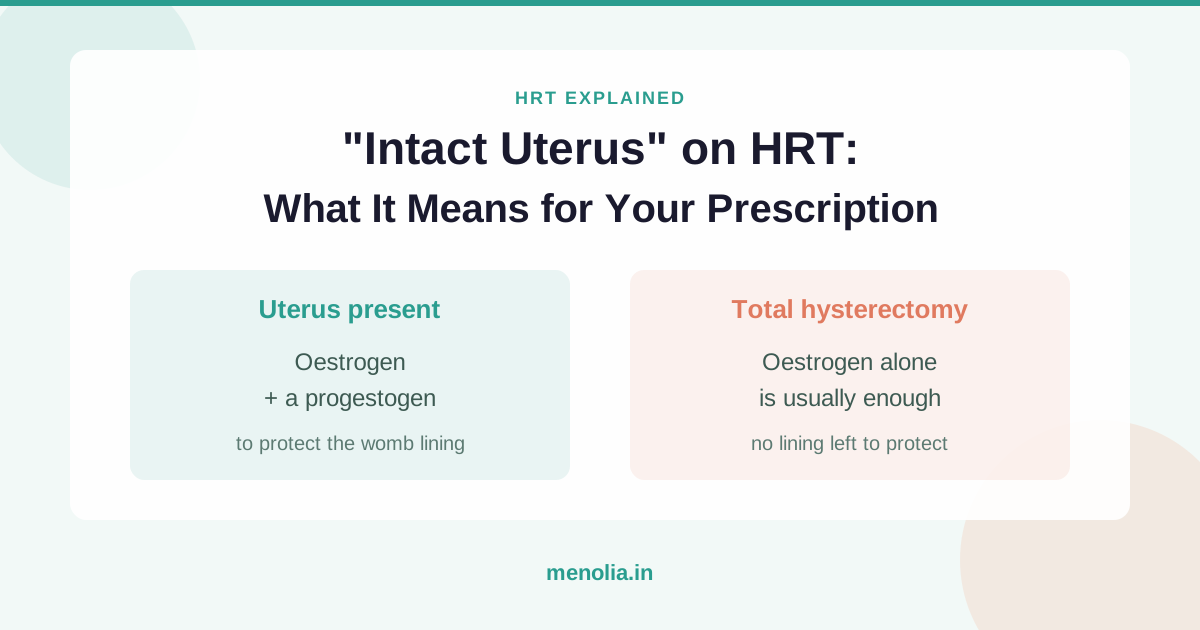
| Your situation | Usual type of HRT | Why |
|---|---|---|
| Uterus present (intact uterus) | Oestrogen plus a progestogen (“combined HRT”) | The progestogen protects the womb lining |
| Uterus fully removed (total hysterectomy) | Oestrogen alone (“oestrogen-only HRT”) | No lining left to protect, so a progestogen usually adds side effects without benefit |
“Progestogen” is the umbrella word for progesterone itself (such as micronised progesterone capsules) and its synthetic relatives (such as dydrogesterone, norethisterone, or the levonorgestrel in a hormonal coil).
Not sure which group you fall into? If you have had a procedure on your womb and are unsure what was removed, we can go through your surgical notes and plan the right HRT together over a video call. Message Dr. Suganya on WhatsApp for a ₹399 video consultation.
Who Counts as Having an Intact Uterus
This is where most of the confusion lies. Here are the common situations I see, and how each one is usually handled.
You have never had surgery on your uterus
You have an intact uterus. If you take systemic HRT (tablets, patches or gel that act throughout the body), you will usually need a progestogen alongside the oestrogen.
You had a total hysterectomy
In a total hysterectomy, the whole uterus, including the cervix, is removed. You do not have an intact uterus, and oestrogen-only HRT is usually the plan.
Whether your ovaries were removed at the same time is a separate question. It affects when menopause symptoms begin, not whether you need a progestogen. Our post on menopause after hysterectomy, ovaries in or out explains that side of it.
You had a subtotal (partial) hysterectomy
In a subtotal hysterectomy, the body of the uterus is removed but the cervix is left behind. This is the situation that most often gets missed.
A small amount of endometrial tissue can remain near the top of the cervix. For that reason, many gynaecologists either add a progestogen for women after a subtotal hysterectomy or first check whether any lining is still present, for example by seeing whether a small withdrawal bleed appears on a trial of combined HRT. This is a decision to make with your doctor, using your operation notes.
You had an endometrial ablation
Ablation destroys most of the womb lining to treat heavy periods, but the uterus itself stays in place, and some patches of lining can survive or regrow. Your uterus is still intact, so a progestogen is still needed with systemic oestrogen, even if you no longer bleed. Our guide to endometrial ablation has more on the procedure.
A practical point here: if a lining patch does grow behind scar tissue, it may not cause bleeding, so the usual bleeding signals are less reliable after ablation. This is one more reason to keep the progestogen in the plan.
You have a Mirena (hormonal coil)
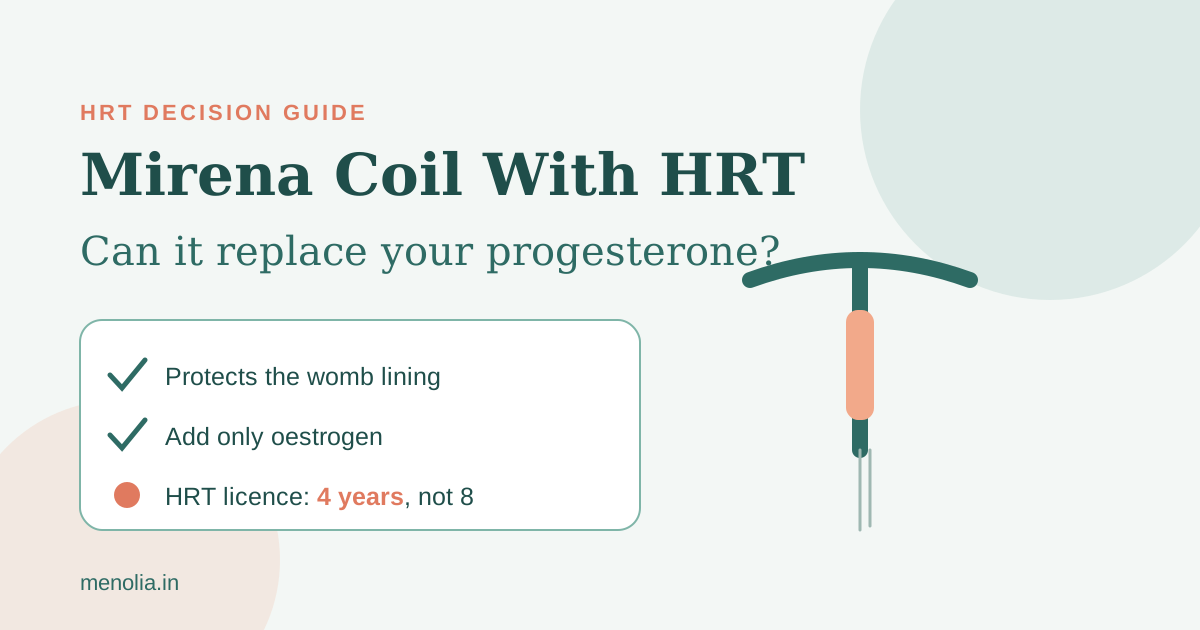
You still have an intact uterus. The difference is that the Mirena can be your progestogen. A clinical review in Climacteric describes the levonorgestrel-releasing intrauterine system as a way to protect the endometrium during oestrogen therapy (Depypere H and Inki P, Climacteric, 2015, PMID 25553775). In that case you usually take oestrogen alone by mouth or skin, because the protection is coming from the coil.
There are rules about which coil and how long it can be relied on for this purpose. Our post on the Mirena coil with HRT covers them.
You had a hysterectomy for endometriosis
Even with the uterus removed, small deposits of endometriosis can remain elsewhere in the pelvis and respond to oestrogen. Some women in this group are advised to take a progestogen, at least for a period, even though they have no uterus. Our article on HRT after endometriosis goes into this.
You have fibroids
Fibroids grow in the wall of the uterus. A uterus with fibroids is still intact, so combined HRT is the usual approach. See fibroids and hormone therapy at menopause for how they tend to behave.
How Combined HRT Is Given When You Have a Uterus
If you have an intact uterus, the progestogen can be added in two main ways. The choice depends mostly on when your last period was.
- Sequential (cyclical) combined HRT: oestrogen every day, with a progestogen for part of each month. This usually brings a planned monthly bleed. It is commonly used in perimenopause, when periods are still coming.
- Continuous combined HRT: oestrogen and progestogen every day, with no planned bleed. This is usually started once you are clearly postmenopausal.
Some women also take tibolone, a single tablet that acts as a combined treatment on its own. Our post on tibolone (Livial) explains who it suits.
Light, irregular bleeding is common in the first few months of combined HRT. Our guide to breakthrough bleeding on HRT explains what is expected and when to get it checked.
What About Vaginal Oestrogen?
Low-dose vaginal oestrogen (creams, pessaries or tablets placed in the vagina for dryness and painful sex) works mainly on the local tissue, and only a small amount reaches the bloodstream. For this reason, women with an intact uterus using low-dose vaginal oestrogen alone are generally not given a progestogen. Any bleeding while using it should still be reported. Our post on vaginal oestrogen cream in India covers how to use it.
This is different from systemic HRT. If you use both, the progestogen decision is based on your systemic oestrogen.
Practical Takeaways
- “Intact uterus” means your womb is still there. It is about whether the organ is present, not whether it is healthy or still bleeding.
- If you have a uterus, systemic oestrogen is usually paired with a progestogen. This protects the womb lining.
- If your whole uterus and cervix were removed, oestrogen alone is usually enough. A progestogen is not needed for womb protection.
- Partial hysterectomy, ablation and endometriosis are grey zones. Bring your operation notes so your doctor can decide.
- A Mirena can count as the progestogen. Check that it is the right coil and still within its time limit.
- Do not stop the progestogen part on your own. If it gives you side effects, ask about a different progestogen or route instead.
Not Sure What Surgery You Had?
Many women in India are told “the uterus was removed” without being told whether the cervix or ovaries went too. Your discharge summary or operation notes usually say “total abdominal hysterectomy,” “total laparoscopic hysterectomy,” “subtotal hysterectomy” or “supracervical hysterectomy,” and whether the ovaries were removed (often written as “BSO” or “bilateral salpingo-oophorectomy”). If you cannot find these papers, the hospital where you had surgery can usually give you a copy. A pelvic ultrasound or a speculum examination can also show whether the cervix is still present.
Frequently Asked Questions
What does “intact uterus” mean?
It means you still have your uterus (womb) and it has not been removed by hysterectomy. Women with an intact uterus usually need a progestogen added to systemic oestrogen HRT to protect the womb lining.
Do I need progesterone with HRT if I have a uterus?
Usually yes, if you take systemic oestrogen as tablets, patches or gel. The progestogen protects the lining of the womb from thickening. The exception is low-dose vaginal oestrogen used on its own, which generally does not need one.
My periods stopped years ago. Do I still have an intact uterus?
Yes. Periods stopping is a sign of menopause, not a change in the organ. As long as the uterus is present, the lining can still respond to oestrogen, so a progestogen is still usually needed.
Can I take oestrogen-only HRT after a partial hysterectomy?
Sometimes, but not automatically. After a subtotal hysterectomy, where the cervix is kept, some lining may remain. Your doctor may add a progestogen or check for remaining lining first, based on your operation notes.
Does a Mirena coil count as my progesterone?
It can. A Mirena releases levonorgestrel inside the uterus and can protect the lining, so you usually take only oestrogen. There are limits on how long it can be relied on for this, so check with your doctor.
I had an endometrial ablation. Do I need a progestogen?
Yes, if you take systemic oestrogen. Ablation removes most of the lining but your uterus stays in place, and some lining can remain or regrow.
Why does my friend take only one hormone when I take two?
She has most likely had a total hysterectomy, so she has no womb lining to protect and can take oestrogen alone. If you still have your uterus, the second hormone is there to protect it.
Talk to Dr. Suganya
If you are starting HRT, or you are unsure whether your past surgery changes what you need, you can go through it with Dr. Suganya Venkat over a video consultation from anywhere in India.