The suitcase is half packed. There is a box of sweets for your daughter’s family in New Jersey, a packet of homemade podi, a shawl for the baby’s other grandmother. Somewhere in that pile is your hormone therapy: a strip of tablets, a tube of gel, or a box of patches. And with it comes a set of small worries. Will security take the gel away? Will a patch survive the heat of a Chennai summer or a long day on a train? What happens to your dose times when the clock jumps by ten hours?
The trip may be shorter: a wedding in Hyderabad, a train journey to Kashi, two weeks at your sister’s place in Dubai. The questions are the same.
This is Dr. Suganya Venkat. Over fifteen years as an OB-GYN, I have found that the questions women ask about HRT before a trip are almost always practical ones about packing, paperwork and timing. This post answers them: how much to carry, which papers to keep with you, how airport security treats gels and patches, what heat does (and whether anything needs a fridge), how to handle time zones, and what a long journey means if you are on hormone therapy.
Two related questions have their own posts. If a dose gets missed or a patch comes off during the trip, our guide on what to do after a missed HRT dose goes through each format. For what each format costs, see our HRT cost guide.
Before You Pack: Count Every Dose
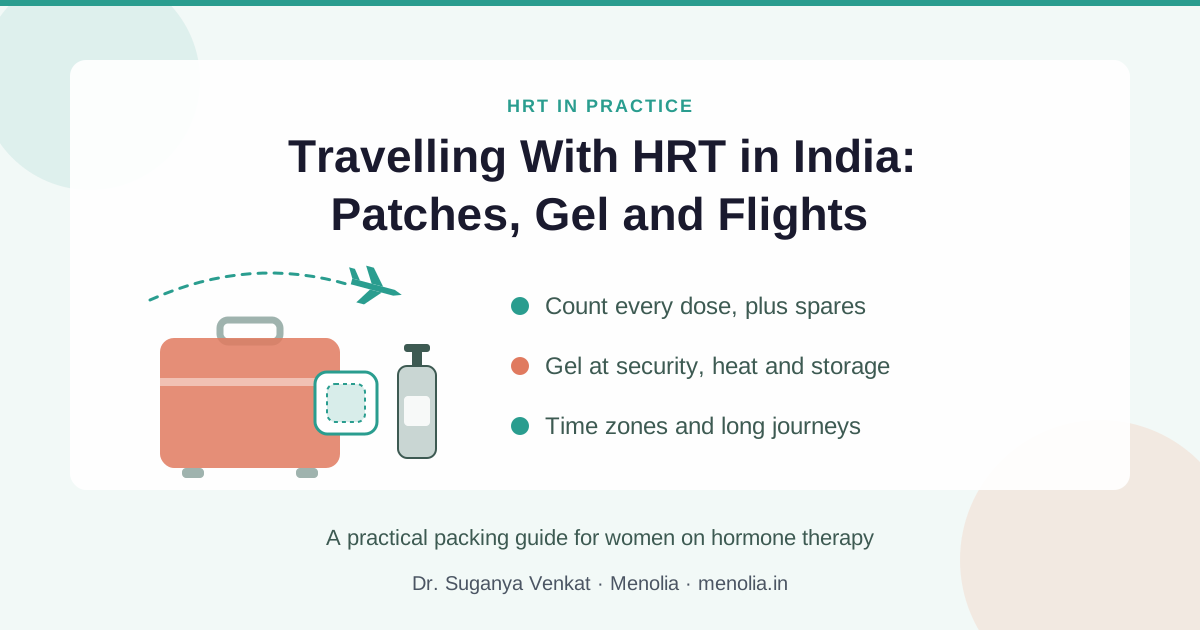
Count how many days you will be away, then count each part of your HRT for those days and add at least a week extra for delayed flights and changed plans.
- Patches. A twice-weekly patch means two a week; a weekly patch means one. Add at least two spares, because a patch that lifts in heat and sweat may need replacing.
- Gel. Each pump of Oestrogel delivers 1.25 g of gel, and the usual starting dose is two pumps a day, according to its UK product information (medicines.org.uk, checked November 2026). At that dose an 80 g pack lasts roughly a month. If you use more pumps, count accordingly.
- Tablets. Count the oestrogen and the progestogen separately if they come as two medicines.
- Progestogen on certain days only. If your progesterone (such as Susten) or dydrogesterone (Duphaston) runs for part of each month, check which of those days fall during your trip. Our post on Susten and Duphaston in HRT explains why this tablet matters so much.
Patches need the most planning. When we checked on 23 September 2026 for our HRT cost guide, we could not find a reliably in-stock estradiol patch on four major Indian online pharmacies. Specialty and hospital pharmacies may still stock them, but you cannot count on finding one in another city at short notice. If you use patches, buy the full trip’s supply plus spares before you leave.
Split your supply. Keep most of it in your handbag or cabin bag, and a smaller share in a companion’s cabin bag or your checked suitcase. If one bag goes missing, you still have medicine. Keep every medicine in its original carton with the pharmacy label.
The Papers to Carry
For travel within India, a copy of your prescription is usually all you need. For travel abroad, carry three things:
- A recent copy of your prescription.
- A short letter from your doctor in English that lists each medicine by its generic name (estradiol, micronised progesterone, dydrogesterone and so on), its strength and dose, and that it is prescribed for you. Brand names change from country to country. Susten, for example, is an Indian brand of micronised progesterone, and a pharmacist or customs officer abroad may not recognise it.
- A photo of both on your phone, in case the paper copies are in the bag that goes missing.
If you are visiting the United States, US Customs and Border Protection’s guidance for non-US citizens says you should generally have a valid prescription or doctor’s note written in English, keep the medicine in its original container, and bring no more than you need for your stay, with a 90-day supply as a rule of thumb (cbp.gov, checked November 2026). For stays longer than 90 days, the same page says more medicine may be sent to you by mail or courier, with documents such as a copy of your visa and passport, a letter from your doctor and a copy of your prescription in English.
Rules differ from country to country, so check the official customs or health ministry website of the country you are visiting before you travel.
At Airport Security: Gel, Patches and Tablets
Gel raises the most questions because of the liquids rule. Medicines are treated differently from toiletries.
At Indian airports. Delhi Airport’s security page says liquids, aerosols and gels can only be carried in containers of up to 100 ml each, up to 1,000 ml in total, in a transparent resealable plastic bag. It also says exceptions apply for essential medicines (carry your prescription if required), and that medicines must be taken out of your bag and screened separately (newdelhiairport.in, checked November 2026). Other airports and airlines may word this differently, so check your departure airport’s page too.
In the UK. The UK government’s hand luggage rules allow essential medicines in containers over 100 ml. You need proof that the medicine is prescribed to you, such as a doctor’s letter or a copy of the prescription, only if it is a liquid in a container larger than 100 ml. Tablets do not need proof (gov.uk, checked November 2026).
In the US. The Transportation Security Administration allows larger amounts of medically necessary liquids and gels in reasonable quantities, as long as you declare them to the officers at the checkpoint for inspection (tsa.gov, checked November 2026).
In practice:
- Put the gel pack in a clear plastic bag at the top of your cabin bag, with the prescription folded inside.
- Take it out at the security tray and tell the officer it is a prescribed hormone medicine.
- Patches and tablets are not liquids. Keep them in their cartons in your handbag.
- Wear your current patch as usual during the flight.
Heat, Humidity and the Fridge Question
None of the HRT products I checked needs a fridge. The UK product information for Estradot, a twice-weekly estradiol patch, says not to refrigerate or freeze the patches and to keep them in their original pouch and carton. For Oestrogel gel, Utrogestan (a micronised progesterone capsule like Susten) and Progynova (estradiol valerate tablets), the UK product information lists no special storage conditions (medicines.org.uk, checked November 2026).
Packs sold in India carry their own storage line on the carton, and that is the one to follow for your pack. In practice, keep your HRT in your handbag or in a cupboard, out of direct sun, and never leave it in a parked car or on a sunny windowsill. You do not need an ice pack or a cool bag for any of these.
Keeping a patch on in heat and sweat
The Estradot product information sets out five rules, and each one matters more in Indian weather:
- Choose clean, dry skin that is not oily, damaged or irritated. In practice, skip coconut oil and body lotion on the spot where the patch will go.
- Avoid the waistline, because tight clothing can dislodge the patch. For many Indian women that means keeping clear of the line where the petticoat or salwar drawstring is tied.
- Press the patch firmly with your palm for about 10 seconds, paying attention to the edges.
- You can bathe with it on.
- If it falls off, you can reapply the same patch, or put on a new one, and then carry on with your usual changing days.
After a bath, pat the patch dry rather than rubbing it.
More application detail is in our estradiol patch guide.
Using gel while you travel
The UK product information for Oestrogel adds a few points that matter more when you are away from your usual routine:
- Let it dry for 5 minutes before you dress.
- Keep it away from flames until it is dry. The gel contains alcohol and is flammable until dry. Wait until it has dried before you light a lamp, stand at a gas stove, or light incense or a mosquito coil.
- Do not wash the area, or put other skin products on it, for an hour. The same document advises avoiding high-alcohol skin products such as sunscreens on the area, as they can change how much is absorbed. Put sunscreen on your face and the skin you have not used for the gel.
- Mind the grandchildren. Others, especially children, should not touch the skin where the gel was applied. Cover it with clothing, and if a child does touch it, wash the child’s skin with soap and water. If you are travelling to meet a new grandchild, apply the gel where your sleeves will cover it, before you pick the baby up.
Our estrogen gel guide covers the full application routine.
Planning a long trip and not sure your HRT will travel well? If you would like to sort out supplies, timing or a format that suits travel before you go, we can go through it together over a video call. Message Dr. Suganya on WhatsApp for a ₹399 video consultation.
Changing Time Zones Without Losing Track
The US East Coast is about ten hours behind India, the UK about five, and Dubai an hour and a half. Dose times feel complicated across those gaps, but the product information for the common formats leaves room for a dose that comes a few hours late.
Tablets and gel. The Progynova product information says the time of day you take it does not matter, as long as you keep to the time you choose, and that a forgotten tablet can still be taken within 12 hours. For Oestrogel, a forgotten dose can still be applied if the next one is more than 12 hours away (medicines.org.uk, checked November 2026). So a simple plan works:
- On the day you travel, take your dose at your usual time by the clock at home, if that is practical.
- From the next day, take it at your usual hour by local time.
- For the Gulf or Singapore, the change is small enough to switch to local time from the first day.
Flying to the US East Coast, that switch makes one gap between doses about ten hours longer than usual, which still sits inside the 12-hour window in the Progynova and Oestrogel product information. The US West Coast and Vancouver are about 12.5 to 13.5 hours behind India, which is more than that window. For those trips, split the change over two days: move your dose about half the difference later on the first day, and the rest on the second. If you take a different oestrogen tablet, a combined tablet or a sequential regimen, check its leaflet or ask your doctor before you go, because the rules differ. Our missed dose guide explains each type.
Patches. Keep your usual changing days by the local calendar. If the flight means you change a patch a few hours late, change it when you can and then go back to your usual days, which is what the Estradot product information advises for a forgotten patch.
Bedtime progesterone. Take it at bedtime by local time. The Utrogestan product information says it should be taken at bedtime and not with food, and that drowsiness or brief dizziness can occur 1 to 3 hours after a dose. On an overnight flight, take it when you settle to sleep, a while after the meal service, and hold on to the seat backs if you get up soon after. Avoid taking it just before landing if you will be walking through the airport or driving straight afterwards. If your progesterone is a different brand, follow its own leaflet.
Long Journeys and Blood Clots
Any long journey where you sit still for hours slightly raises the chance of a blood clot in the leg, called a deep vein thrombosis. A meta-analysis of 14 studies found that travellers had two to three times the risk of non-travellers, and the risk rose by 18% for every extra two hours of travel by any mode of transport, so long train and bus journeys count too (Chandra D et al., Ann Intern Med, 2009, PMID 19581633).
In absolute terms the risk is small. A study that followed 8,755 employees of international organisations counted about one clot for every 4,656 flights of four hours or longer, with risk highest in the first two weeks after travel (Kuipers S et al., PLoS Med, 2007, PMID 17896862).
The form of HRT matters here. In a UK study of more than 80,000 women with a clot and nearly 400,000 matched women without, oral HRT was linked to a higher risk of clots, while transdermal HRT (patches and gels) was not associated with a higher risk (Vinogradova Y et al., BMJ, 2019, PMID 30626577). If you take HRT as tablets, simple movement on a long journey is worth the effort. If you use a patch or gel, the same habits are good practice for everyone:
- Walk up and down the aisle or the train corridor every hour or two when it is safe to.
- While seated, flex your ankles and press your feet up and down for a few minutes at a time.
- Drink water regularly, and go easy on alcohol.
- Book an aisle seat if you can, and wear loose clothing.
Most travellers do not need stockings or injections. A 2018 American Society of Hematology guideline suggests compression stockings or a blood-thinning injection for long-distance travellers only when they are at high risk of clots (Schünemann HJ et al., Blood Adv, 2018, PMID 30482763). If you have had a clot before, had surgery recently, or are being treated for cancer, speak to your doctor before a long trip about whether you need extra protection. Our post on HRT and blood clots explains how a past clot affects HRT choices.
Know the signs. Pain, swelling or warmth in one calf in the weeks after a journey needs a doctor’s review the same day. Sudden breathlessness or chest pain needs emergency care straight away, wherever you are.
Staying for Months: Visiting Children Abroad
Many Indian women travel abroad for months at a time, often to help when a daughter or daughter-in-law has a baby. Long stays need a little more planning:
- Have your HRT review before you leave if one is due, so that you travel on a dose that suits you.
- Count the whole stay. If it is longer than you can carry, look up the destination’s rules on sending medicine by courier well before you need it, as the US guidance above describes.
- Carry the generic names. If you do need a local doctor abroad, a letter listing estradiol or micronised progesterone with the dose makes it far easier for them to match what you take.
- Think about the format. If keeping a patch on in a humid climate has been a struggle, or you swim every day where you are going, the format is worth discussing before the trip rather than halfway through it. Our comparison of patch, gel and pill sets out the trade-offs.
Distance does not have to interrupt your care. Dr. Suganya Venkat consults online, so women already on HRT can check in from abroad over a video call when a question comes up. The first consultation is ₹399 in India and US $20 from outside India.
Practical Takeaways
- Count every dose for the trip and add a week, plus at least two spare patches if you use them.
- Buy patches before you leave. They can be hard to find at short notice in India.
- Keep HRT in your cabin bag, in original cartons, with a backup share in a second bag.
- Carry a prescription copy and a doctor’s letter in English with generic names.
- Declare gel at security as a prescribed medicine. Tablets and patches are not liquids.
- No fridge needed. Keep packs out of direct sun and out of parked cars, and follow the storage line on your carton.
- Shift to local time the day after you land. A gap a few hours longer than usual is within the window for Progynova and Oestrogel; check combined regimens.
- Move on long journeys, especially if you take HRT as tablets.
Frequently Asked Questions
Can I carry HRT gel in my hand luggage on a flight?
Yes. Essential medicines are an exception to the 100 ml liquids rule at Indian, UK and US airports. Keep the gel in its original pack with your prescription, take it out at the security tray and tell the officer it is a prescribed medicine. In the UK, proof of prescription is needed only for liquid medicines in containers over 100 ml, and in the US you need to declare medical gels at the checkpoint.
Do HRT patches need to be kept in the fridge when travelling?
No. The UK product information for Estradot patches says not to refrigerate or freeze them, and to keep them in their original pouch and carton. Keep them in your handbag, out of direct sun and out of hot cars, and follow the storage line on your own carton.
How do I take HRT when I change time zones?
On the travel day, take your dose at your usual time by your home clock if practical, then move to the same hour by local time from the next day. For Progynova tablets and Oestrogel, the product information allows a dose up to 12 hours late, which covers the jump to the US East Coast, the UK or the Gulf. For the US West Coast, split the change over two days. Keep patch changing days by the local calendar. If you take a combined or sequential regimen, check with your doctor before travelling.
How much HRT can I take to the USA?
US Customs and Border Protection suggests bringing no more than you need for your stay, with a 90-day supply as a rule of thumb, in the original containers with a prescription or doctor’s note in English. For longer stays, more medicine can be sent by mail or courier with supporting documents such as your doctor’s letter, prescription and a copy of your passport and visa.
Is a long flight safe if I am on HRT?
For most women, yes. Long journeys slightly raise the chance of a leg clot for everyone, and oral HRT adds to that risk, while patches and gels were not linked to higher clot risk in a large UK study. Walk around every hour or two, flex your ankles while seated and drink water. If you have had a clot before or recent surgery, ask your doctor before the trip.
Can I swim or bathe with an HRT patch on holiday?
Yes, you can bathe with a patch on, and a swim is usually fine. Pat the patch dry afterwards. If it comes off, reapply it or use a new one and carry on with your usual changing days. If you will be swimming every day for weeks, ask your doctor whether gel would suit that trip better.
Videsh jaate waqt HRT ki dawai kaise le jaayein? (How do I take my HRT medicines abroad?)
Keep them in your cabin bag in their original cartons, with a copy of your prescription and a doctor’s letter in English that lists the generic names and doses. Carry enough for the whole stay plus a week. Check the customs rules of the country you are visiting before you fly, and declare any gel at airport security.
Your HRT can travel with you to a wedding, a pilgrimage or a long stay with your grandchildren. A little planning keeps your doses steady while you are away. If you would like help working out supplies, timings or a format that suits the way you travel, alongside your own doctor, I see women online over video consultation, from anywhere in India or abroad: ₹399 in India and US $20 from outside India. You can also read about Menolia’s menopause program.