You have been on Cerazette for a few years. It suited you when the combined pill did not, perhaps because of migraines, blood pressure or simply your age. Now the hot flushes and broken sleep have arrived, and HRT is on the table. The question comes up almost immediately: can you take HRT while you are still on the mini-pill, or does one have to stop before the other starts?
The short answer is reassuring. Yes, most women can take Cerazette and HRT together. The part that surprises people is what each tablet is doing. Cerazette is there to prevent pregnancy. It is not counted as the hormone that protects the lining of your womb from the oestrogen in HRT. So if you still have a uterus, you will usually need a separate progestogen as part of your HRT, even though Cerazette is itself a progestogen.
I’m Dr. Suganya Venkat. Across fifteen-plus years as an OB-GYN, the women who ask me this are usually in their late forties and need two things at once: reliable contraception and relief from symptoms. This post explains why the two can sit together, why the mini-pill does not double as womb protection, the usual ways doctors set up the combination, and how long the contraception part needs to continue.
If your question is about which contraceptive suits you in perimenopause in general, our guide to contraception in perimenopause and when to stop covers that. If you are coming off the combined pill, switching from birth control to HRT walks through the switch itself. This post stays with one question: the mini-pill and HRT, side by side.
What Cerazette Is, and How It Prevents Pregnancy
Cerazette is a progestogen-only pill, often called the mini-pill. In India it is marketed by Organon as a strip of 28 tablets, and each tablet contains desogestrel 0.075 mg (75 micrograms). There is no oestrogen in it. On PharmEasy the listed MRP was ₹529.20 per strip when we checked on 29 October 2026; prices change, so check with your pharmacy.
The patient factsheet on contraception after 40 from Women’s Health Concern (the patient arm of the British Menopause Society, reviewed December 2025, womens-health-concern.org) explains that the progestogen-only pill mostly stops the egg being released each month and also keeps the cervical mucus thick, which creates a barrier to sperm. The same factsheet says it can safely be used up until the age of 55.
The ovulation-stopping effect is what sets desogestrel apart from older mini-pills. In a randomised, double-blind trial of 71 women, desogestrel 75 micrograms inhibited ovulation significantly better than a 30 microgram levonorgestrel mini-pill (Rice CF et al., Hum Reprod, 1999, PMID 10221231).
Timing still matters. The NHS page on how to take the progestogen-only pill (nhs.uk, updated December 2024) says a desogestrel pill still protects you if it is taken within 12 hours of your usual time, compared with 3 hours for a traditional mini-pill. It describes the progestogen-only pill as over 99% effective when taken correctly all the time, and about 91% effective with typical use, when pills are sometimes missed or taken late.
A trap on Indian pharmacy shelves
If you search for “desogestrel” at an Indian pharmacy, most of the products that come up are not mini-pills. Novelon and Femilon, for example, contain desogestrel 0.15 mg together with ethinylestradiol, which makes them combined pills (product listings checked on pharmeasy.in, 29 October 2026). That difference matters a great deal here, as the next section explains. Read the composition on the strip: a mini-pill lists desogestrel alone.
Can You Take HRT and Cerazette Together?
In most cases, yes. The NHS page on when to take HRT (nhs.uk, updated March 2026) says that if you are taking the progestogen-only pill (mini pill), you can usually take HRT alongside it. The Women’s Health Concern factsheet (December 2025) lists the progestogen-only pill among the suitable methods for sexually active women who start HRT before their periods have stopped.
This is different from the combined pill. The same NHS page states that you cannot take HRT at the same time as the combined pill. The combined pill already contains a strong oestrogen, so adding HRT oestrogen on top of it is not how either medicine is designed to be used. This is why it helps to know exactly which pill is in your handbag.
Why you need both in the first place
HRT is not contraception. The Women’s Health Concern factsheet says this plainly. HRT doses are designed to replace falling hormone levels and ease symptoms, not to stop ovulation. In perimenopause your ovaries can still release an egg, sometimes without warning, so a pregnancy remains possible. Our post on whether you can get pregnant in perimenopause explains why irregular periods do not mean you are no longer fertile.
Cerazette is not HRT. It contains no oestrogen, so it will not treat hot flushes, night sweats, vaginal dryness or the other symptoms of low oestrogen. For those, you need the oestrogen part of HRT.
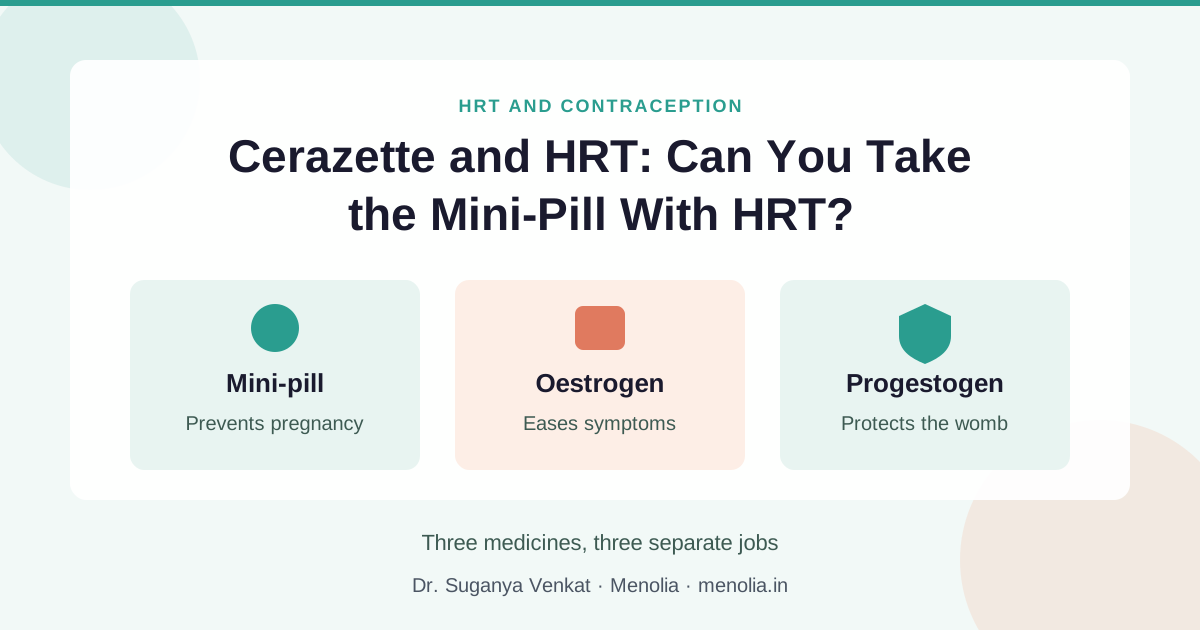
So the two tablets do separate jobs. The question that remains is the third job: protecting the womb lining.
Why the Mini-Pill Does Not Count as Womb Protection
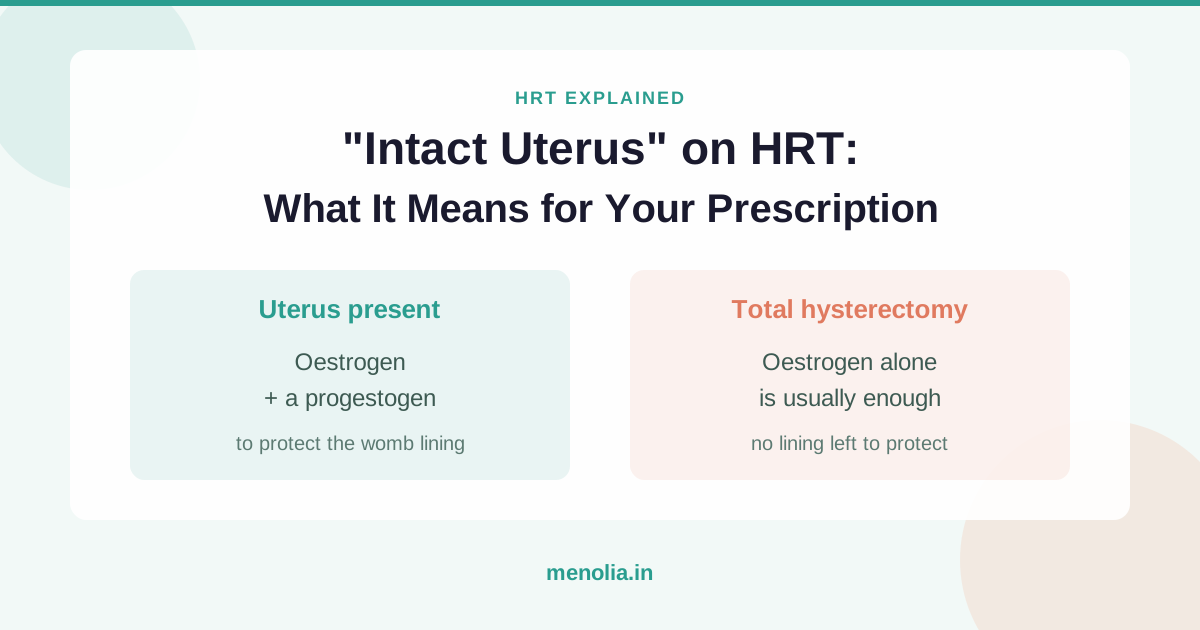
When you take oestrogen as HRT and you still have a uterus, the lining of the womb needs a progestogen to keep it from building up. The British Menopause Society’s clinician guide on progestogens and endometrial protection (thebms.org.uk, reviewed February 2026) summarises why. In the PEPI trial it describes, oestrogen taken alone led to endometrial hyperplasia (an overgrown lining) in 20% of women in the first year and 62% after three years. In the groups that took a progestogen alongside the oestrogen, the risk was no different from placebo. The full reasoning is in our guide to why HRT needs progesterone.
Cerazette is a progestogen, so it is natural to assume it covers this. The BMS guide addresses exactly this point. It says there is a lack of evidence on using desogestrel 75 micrograms as the progestogen part of HRT, and that if desogestrel 75 micrograms is used as contraception in a woman receiving HRT, further progestogen should be added to give adequate endometrial protection. The examples it gives are micronised progesterone 100 mg daily, or 200 mg for 12 days a month.
The higher dose of desogestrel has been studied in HRT. In a small Finnish study, 24 women took oestradiol with desogestrel 150 micrograms for the last 12 days of each cycle for a year; no hyperplasia or atypia was found in the endometrial samples (Saure A et al., Maturitas, 1993, PMID 8429799). That is twice the amount in a Cerazette tablet, given in a different pattern, which is why the BMS guide treats the 150 microgram evidence and the 75 microgram mini-pill separately. It is also why you should not change how you take Cerazette on your own to try to make it cover both jobs.
So the practical rule is simple: Cerazette for contraception, plus oestrogen for symptoms, plus a progestogen that is proven to protect the lining.
On Cerazette and wondering how HRT would fit in? We can go through your periods, your symptoms and your contraception needs together over a video call and work out a plan to discuss with your own gynaecologist. Message Dr. Suganya on WhatsApp for a ₹399 video consultation.
The Usual Ways Doctors Set This Up
There is no single correct arrangement. Which one fits depends on whether you still have a uterus, how heavy or irregular your bleeding is, how you tolerate progestogens, and what you prefer. These are the options your doctor is most likely to discuss.
Option 1: Keep Cerazette, add oestrogen and a separate progestogen
You carry on with Cerazette every day for contraception. HRT is added as oestrogen (a patch, gel or tablet) together with its own progestogen, such as micronised progesterone. In India, micronised progesterone is sold under brands such as Susten; our guide to Susten and Duphaston in menopause HRT explains these. Whether the progestogen is taken every day or for part of each month, and at what dose, is a decision for your prescriber, based on your stage of the transition. If you are deciding between the oestrogen forms, our comparison of HRT patch, gel and pill may help.
This means taking more tablets, and some women find that tiresome. It does keep each medicine doing the job it is proven for.
Option 2: Swap Cerazette for a 52 mg hormonal IUD, add oestrogen
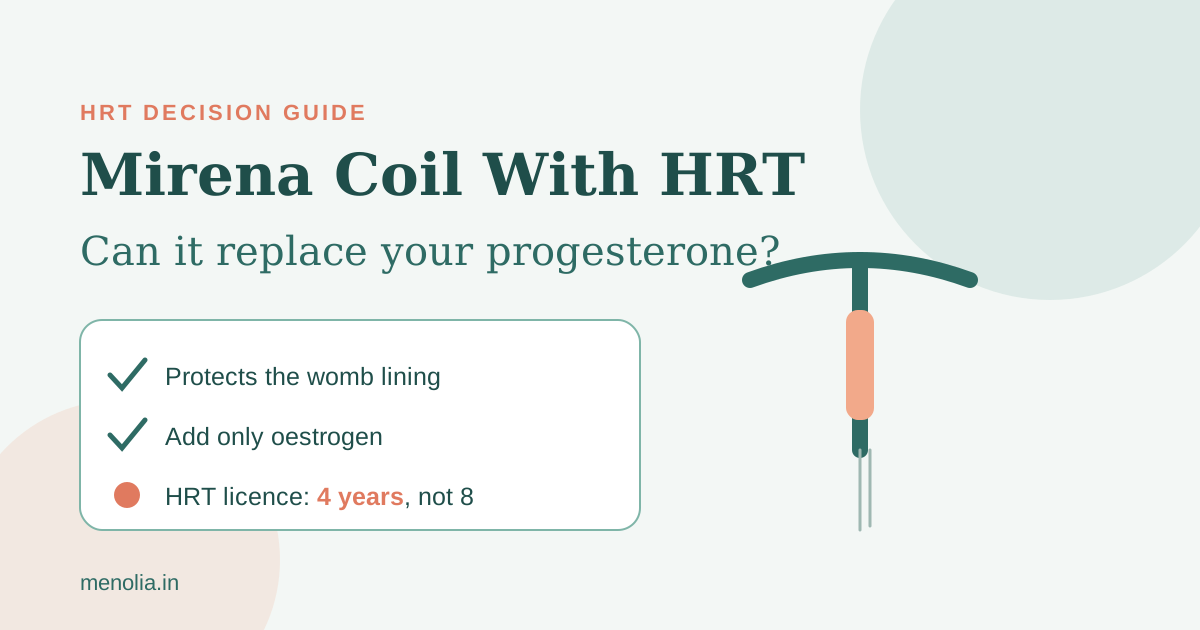
A 52 mg levonorgestrel intrauterine device (Mirena is one brand available in India) can do double duty. The Women’s Health Concern factsheet (December 2025) says it provides contraception and can serve as the progestogen part of HRT, so you only add oestrogen. The BMS guide (February 2026) says the 52 mg device gives adequate endometrial protection for up to 5 years within HRT, and the factsheet notes it needs replacing every 5 years when used this way. It also tends to make periods much lighter, which many women with heavy perimenopausal bleeding welcome.
The lower-dose hormonal coils (13.5 mg and 19.5 mg) are different. The BMS guide says there is a lack of evidence that they protect the lining during HRT and recommends adding a progestogen if one of these is used.
Option 3: If you have had a hysterectomy
Without a uterus, there is no lining to protect, so HRT is usually oestrogen alone. Pregnancy is also no longer possible after a hysterectomy, so if Cerazette was only ever for contraception, ask your doctor whether you still need it at all. If it was prescribed for another reason, that decision is worth making with the doctor who started it.
Option 4: Other progestogen-only pills that can double up
The BMS guide also describes two progestogen-only contraceptive pills that can be used, outside their licence, as the progestogen part of HRT in the UK: drospirenone 4 mg (Slynd) taken continuously, and a traditional norethisterone mini-pill taken as three tablets a day. These are UK products and UK practice, and availability in India varies, so this is one to ask your doctor about rather than arrange yourself.
If you only use vaginal oestrogen
Low-dose vaginal oestrogen for dryness or bladder symptoms is a separate case. The BMS HRT Guide for clinicians (thebms.org.uk, reviewed February 2026) states that systemic absorption is minimal and a progestogen is not required. So if vaginal oestrogen is your only HRT, Cerazette continues for contraception and no extra progestogen is needed for it.
Bleeding When You Take Both
Bleeding patterns on this combination vary. The Women’s Health Concern factsheet (December 2025) notes that all progestogen-only methods may cause irregular bleeding or no bleeding at all, and that having no periods does not necessarily mean you have reached menopause. Adding HRT, especially a regimen with a monthly progestogen phase, can bring a regular withdrawal bleed on top of that.
Some irregular bleeding in the first few months of HRT is common and usually settles. The BMS guide (February 2026) says that adjusting the progestogen often controls it, and that bleeding which continues beyond 4 to 6 months despite this, or a pattern or amount that is worrying, should be assessed. Our guide to breakthrough bleeding on HRT explains what is expected and when a scan makes sense.
Keep a simple note of the days you bleed and how heavy it is. It makes the conversation with your doctor much quicker.
How Long Do You Need Cerazette Once You Are on HRT?
This is where the combination needs a little planning. The Women’s Health Concern factsheet (December 2025) says contraception should continue for one year after your last natural period if it came after 50, and for two years if your periods stopped before 50. If menopause cannot be confirmed, contraception can stop at 55.
On Cerazette and HRT together, it is hard to tell when your natural periods have stopped, because both medicines change your bleeding. The same factsheet says that some HRT products produce regular monthly bleeds, which makes it difficult to know when contraception can be stopped, and that it is best to continue contraception alongside HRT until the age of 55. Your doctor may still talk through blood tests or your personal situation, but 55 is the simple, safe default.
When the time comes, stopping Cerazette is straightforward. Your HRT carries on, with its own progestogen already in place, so stopping the mini-pill does not leave your womb lining unprotected.
Practical Takeaways
- Cerazette and HRT can usually be taken together. The combined pill and HRT cannot.
- Check your strip. A mini-pill lists desogestrel 0.075 mg alone. Novelon and Femilon contain ethinylestradiol and are combined pills.
- Cerazette is contraception, not womb protection. If you have a uterus, your HRT will normally include its own progestogen.
- A 52 mg hormonal IUD is the one option that does both jobs. Then you only add oestrogen.
- Vaginal oestrogen alone does not need an extra progestogen.
- Plan to continue contraception alongside HRT until 55, unless your doctor advises otherwise.
- Do not change how you take Cerazette on your own to try to make it cover HRT.
Frequently Asked Questions
Can you take Cerazette and HRT at the same time?
Yes, in most cases. The NHS says you can usually take HRT alongside the progestogen-only pill. Cerazette continues to provide contraception and HRT treats your menopause symptoms. If you still have a uterus, your HRT will normally include its own progestogen as well, because Cerazette is not counted as womb protection.
Does Cerazette protect the womb lining when I take oestrogen?
Not reliably. The British Menopause Society says there is a lack of evidence on desogestrel 75 micrograms, the dose in Cerazette, as the progestogen part of HRT, and recommends adding a further progestogen such as micronised progesterone. The studies of desogestrel in HRT used 150 micrograms, twice the amount in a Cerazette tablet.
Can I take two Cerazette tablets a day instead of a separate progesterone?
Please do not do this on your own. Cerazette is licensed and dosed as a contraceptive. The studies of desogestrel 150 micrograms in HRT were small and used specific regimens, so any plan to use a progestogen for womb protection needs to be chosen and monitored by your doctor. Your doctor can set up a regimen that covers both contraception and womb protection safely.
Is HRT enough contraception on its own?
No. HRT is not a contraceptive. If you are sexually active and your periods have not stopped for long enough, you still need contraception, such as the mini-pill, a coil or condoms, alongside HRT.
Can I take HRT with the combined pill instead?
No. The NHS states that you cannot take HRT at the same time as the combined pill. If you are on the combined pill, your doctor may suggest staying on it until about 50, or switching to a progestogen-only method or a coil before HRT starts.
I only use vaginal oestrogen cream. Do I need extra progesterone with Cerazette?
No. The British Menopause Society says low-dose vaginal oestrogen has minimal absorption into the body and does not need a progestogen. Cerazette continues to do its contraceptive job.
When can I stop Cerazette if I am also on HRT?
Because both medicines change your bleeding, it is hard to know when your natural periods have stopped. The usual safe approach is to continue contraception alongside HRT until 55. Your HRT, including its own progestogen, simply continues when you stop the mini-pill.
The mini-pill and HRT work well together once each tablet has a clear job: Cerazette prevents pregnancy, oestrogen eases your symptoms, and a proven progestogen, or a 52 mg coil, protects your womb. If you would like help working out which arrangement suits your periods, symptoms and preferences, alongside your own gynaecologist, I see women across India online, and you can also read about Menolia’s perimenopause program.